
Mouse NGAL ELISA Kit
Cat no : KE10045
Synonyms
Lcn2, Lipocalin-2, Lipocalin 2, Neutrophil gelatinase-associated lipocalin, Oncogene 24p3
Validation Data Gallery
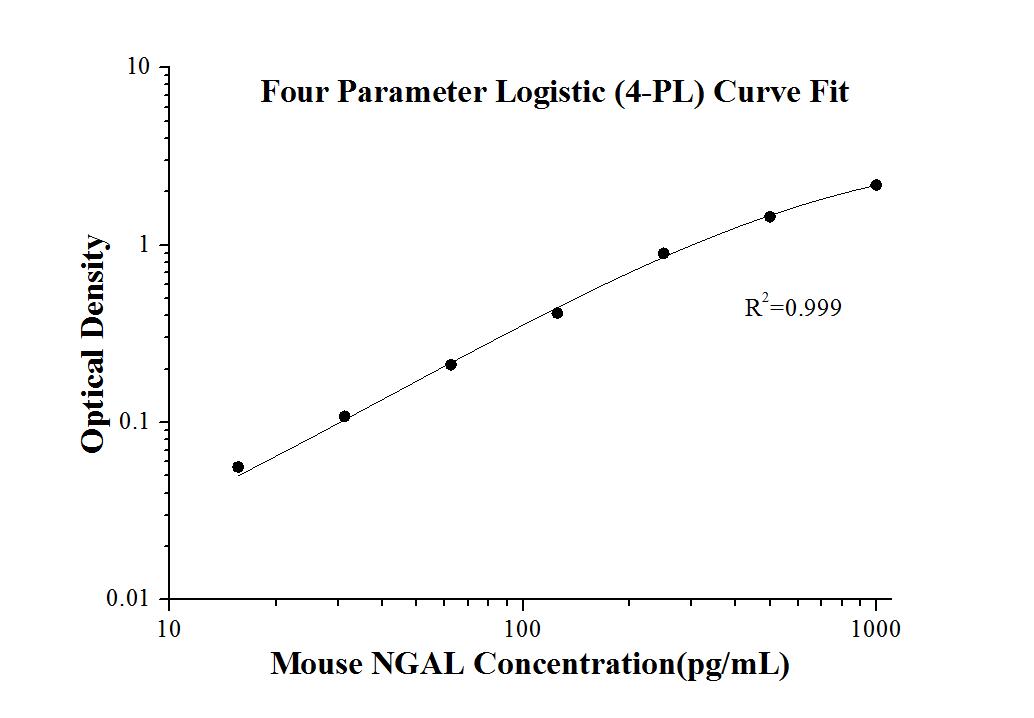
Product Information
KE10045 is a solid phase sandwich Enzyme Linked-Immuno-Sorbent Assay (Sandwich ELISA). The Mouse NGAL ELISA kit is to be used to detect and quantify protein levels of endogenous mouse NGAL. The assay recognizes mouse NGAL. An antibody specific for mouse NGAL has been pre-coated onto the microwells. The mouse NGAL protein in samples is captured by the coated antibody after incubation. Following extensive washing, another antibody of biotinylated specific for mouse NGAL is added to detect the captured mouse NGAL protein. For signal development, Streptavidin-HRP is added, followed by Tetramethyl-benzidine (TMB) reagent. Solution containing sulfuric acid is used to stop color development and the color intensity which is proportional to the quantity of bound protein is measurable at 450 nm with the correction wavelength set at 630 nm.
| Product name | Mouse NGAL ELISA Kit |
| Tests | 1 X 96 well plate |
| Sample type | Serum, Plasma, Cell culture supernates, Urine |
| Assay type | Sandwich |
| Sensitivity | 4.0 pg/mL |
| Range | 15.6-1000 pg/mL |
| Reactivity | Mouse |
| Tested applications | Sandwich ELISA |
| Gene ID (NCBI) | 16819 |
Recovery
| Sample Type | Average | Range |
|---|---|---|
| Mouse serum | 106% | 95%-120% |
| Mouse urines | 116% | 92%-131% |
| Cell culture supernates | 106% | 79%-126% |
IntraAssay
| Sample | n | mean ( pg/mL) | SD | CV% |
|---|---|---|---|---|
| 1 | 20 | 429.5 | 33.2 | 7.7 |
| 2 | 20 | 109.1 | 4.7 | 4.3 |
| 3 | 20 | 26.6 | 2.0 | 7.5 |
InterAssay
| Sample | n | mean ( pg/mL) | SD | CV% |
|---|---|---|---|---|
| 1 | 24 | 486.3 | 40.4 | 8.3 |
| 2 | 24 | 114.7 | 6.3 | 5.5 |
| 3 | 24 | 20.5 | 1.7 | 8.5 |
Background Information
Neutrophil gelatinase-associated lipocalin (NGAL; also known as neutrophil lipocalin, lipocalin-2, siderocalin, 24p3, or LCN2) is a small molecule of almost 25 kd that belongs to the well-defined superfamily of proteins called lipocalins. NGAL initially found in activated neutrophils, in accordance with its role as an innate antibacterial factor. However, it subsequently was shown that many other types of cells, including in the kidney tubule, may produce NGAL in response to various injuries. NGAL may become one of the most promising next-generation biomarkers in clinical nephrology and beyond.
Properties
| Storage Instructions | All the reagents are stored at 2-8℃ for 6 months or -20℃ for 12 months. Refer to the protocol for further storage instructions. |
| Synonyms | Lcn2, Lipocalin-2, Lipocalin 2, Neutrophil gelatinase-associated lipocalin, Oncogene 24p3 |
FAQ
1、I have limited sample diluent. How should I handle samples requiring high dilution factors?
Answer: We recommend performing a serial dilution. For example, if human serum requires a 1,000,000-fold dilution, you can use a three-step 100× dilution method as follows:
Step 1: Take 2 uL of human serum and add it to 198 uL of sample diluent, mix thoroughly to obtain a 100-fold diluted sample.
Step 2: Take 2 uL of the 100-fold diluted sample and add it to 198 uL of sample diluent, mix thoroughly to obtain a 10,000-fold diluted sample.
Step 3: Take 2 uL of the 10,000-fold diluted sample and add it to 198 uL of sample diluent, mix thoroughly to obtain a 1,000,000-fold diluted sample.
If further dilution is required, additional serial steps can be used. We do not recommend using any other solutions or water for dilution, except for the sample diluent we suggest. If your sample diluent is still insufficient, please contact our customer service for more sample diluent.
Publications
| Species | Sample Type | Title |
|---|---|---|
J Clin Invest Immunoreceptor CD300a regulates ischemic tissue damage and adverse remodeling in the mouse heart and kidney | ||
J Nanobiotechnology Autologous platelet delivery of siRNAs by autologous plasma protein self-assembled nanoparticles for the treatment of acute kidney injury | ||
mSystems Dietary L-arabinose-induced gut dysbiosis exacerbates Salmonella infection outcome | ||
Phytomedicine Dihydromyricetin attenuates intracerebral hemorrhage by reversing the effect of LCN2 via the system Xc- pathway | ||
Apoptosis GSDME-dependent astrocyte pyroptosis promotes the progression of neuroinflammation in experimental cerebral malaria. | ||
J Ethnopharmacol Yitangkang decoction in the treatment of glomerular filtration barrier damage through AMPKα1/ZDHHC8/SLC7A11/GPX4 and TGF-β/Smad signaling pathways: A multi-omics analysis. |