

Tested Applications
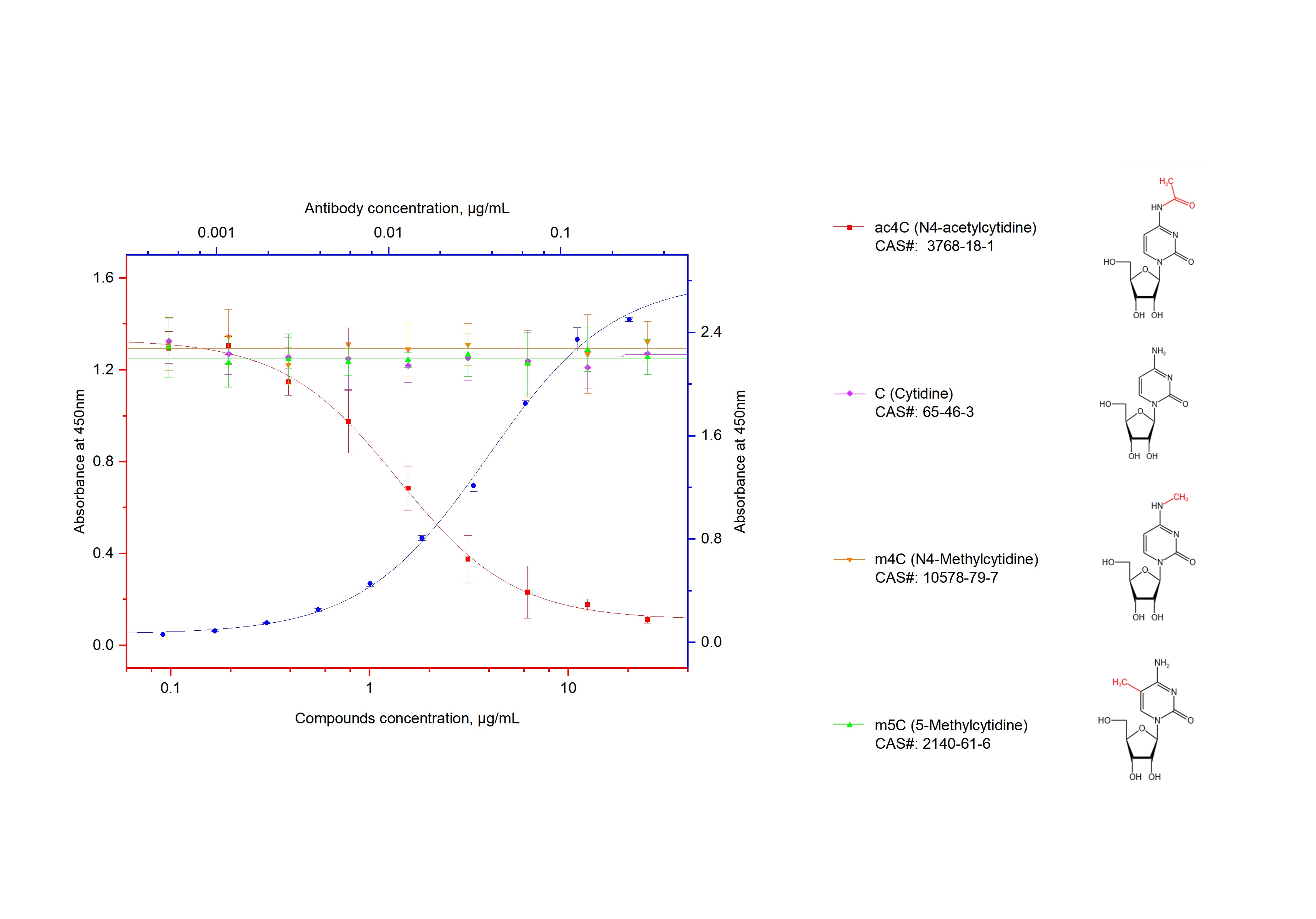
| Positive ELISA detected in | N4-acetylcytidine |
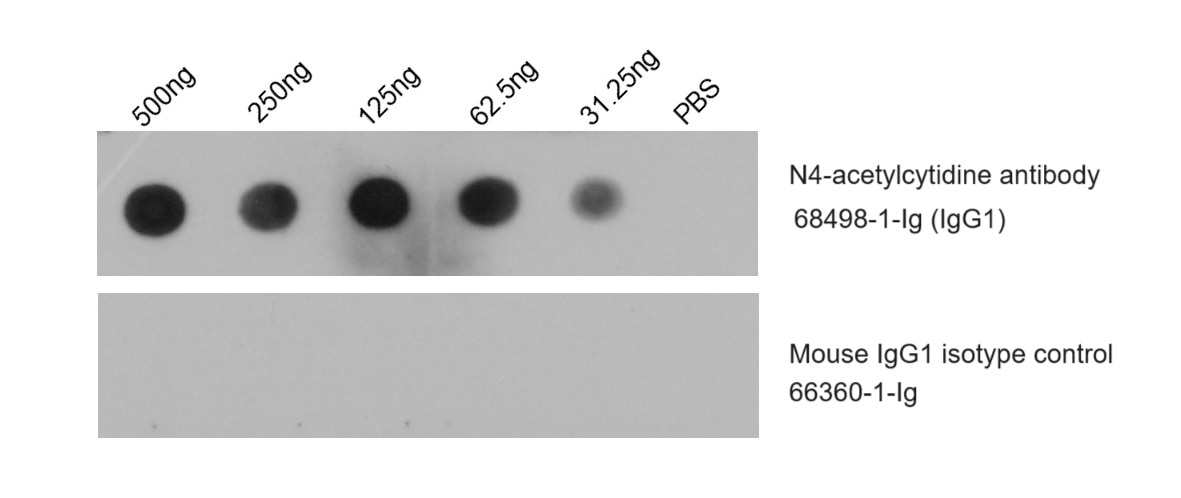
| Positive Dot Blot detected in | RNA isolate HeLa cells |
Recommended dilution
| Application | Dilution |
|---|---|
| Enzyme-linked Immunosorbent Assay (ELISA) | ELISA : |
| DOT BLOT | DOT BLOT : 1:1000-1:4000 |
| It is recommended that this reagent should be titrated in each testing system to obtain optimal results. | |
| Sample-dependent, Check data in validation data gallery. | |
Product Information
68498-1-Ig targets N4-acetylcytidine in WB, RIP, Dot Blot, ELISA applications and shows reactivity with chemical compound samples.
| Tested Reactivity | chemical compound |
| Cited Reactivity | human, mouse |
| Host / Isotype | Mouse / IgG1 |
| Class | Monoclonal |
| Type | Antibody |
| Immunogen |
Compound Predict reactive species |
| Full Name | N4-acetylcytidine |
| Gene Symbol | |
| Gene ID (NCBI) | |
| RRID | AB_3085209 |
| Conjugate | Unconjugated |
| Form | Liquid |
| Purification Method | Protein G purification |
| Storage Buffer | PBS with 0.02% sodium azide and 50% glycerol, pH 7.3. |
| Storage Conditions | Store at -20°C. Stable for one year after shipment. Aliquoting is unnecessary for -20oC storage. 20ul sizes contain 0.1% BSA. |
Background Information
N4-Acetylcytidine, CasNo. 3768-18-1, is a modified nucleoside and endogenous urinary nucleoside product of the degradation of tRNA, 18s rRNA and mRNA. N4-Acetylcytidine is a biological marker for various cancers with elevated concentrations present in urine. N4-Acetylcytidine is also a partially protected cytidine and therefore can be used as a synthetic building block to prepare further derivatized nucleosides such as 2',3'-dideoxycytidine. NAT10 catalyzes the formation of N4-acetylcytidine (ac4C) modification on mRNAs, 18S rRNA and tRNAs.
Protocol for Dot Blot:
https://www.ptglab.com/protocol/68498-1-IgDotBlot.pdf
Publications
What published studies show
The N4-acetylcytidine monoclonal antibody (catalog 68498-1-Ig) has 8 citations. It appears in Advanced Science (twice), Journal of Hazardous Materials, International Journal of Biological Macromolecules, Clinical and Translational Medicine, Cell Biology and Toxicology, Chemico-Biological Interactions, and Gene. Research fields span epitranscriptomics (ac4C acetylation mediated by NAT10) in lung adenocarcinoma, esophageal cancer, intrauterine growth restriction, lung cancer autophagy, diabetic wound healing, cardiac fibrosis, hepatocellular carcinoma, and osteogenic differentiation in scoliosis.
| Species | Application | Title |
|---|---|---|
Adv Sci (Weinh) NAT10 Increases Lysosomal Acidification to Promote Esophageal Cancer Metastasis via ac4C Acetylation of ATP6V0E1 mRNA | ||
Adv Sci (Weinh) Cuproptosis and Mitophagy Mediated by the THUMPD1/IGF2R-Dependent Suppression of AKT and Activation of AMPK Signaling Suppress Lung Adenocarcinoma Progression. | ||
J Hazard Mater Decabromodiphenyl ethane induces intrauterine growth restriction by suppressing placental angiogenesis via TWIST2/NAT10-mediated ac4C-dependent TGF-β1 mRNA stabilization | ||
Int J Biol Macromol N-acetyltransferase 10 impedes EZH2/H3K27me3/GABARAP axis mediated autophagy and facilitates lung cancer tumorigenesis through enhancing SGK2 mRNA acetylation | ||
Clin Transl Med NAT10-mediated N4-acetylcytidine modification drives RNA splicing of PML to alleviate adipose-derived stem cell senescence and promote diabetic wound healing. | ||
Cell Biol Toxicol NAT10 Mediates Cardiac Fibrosis Induced by Myocardial Infarction Through ac4C Modification of TGFBR1 mRNA |



