


Tested Applications
| Positive WB detected in | NCCIT cell, NCCIT cells |
Recommended dilution
| Application | Dilution |
|---|---|
| Western Blot (WB) | WB : 1:500-1:1000 |
| It is recommended that this reagent should be titrated in each testing system to obtain optimal results. | |
| Sample-dependent, Check data in validation data gallery. | |
Product Information
20570-1-AP targets PAX7 in WB, IHC, IF, ELISA, Cell treatment applications and shows reactivity with human samples.
| Tested Reactivity | human |
| Cited Reactivity | human, rat, pig, chicken, bovine, sheep, goat, duck |
| Host / Isotype | Rabbit / IgG |
| Class | Polyclonal |
| Type | Antibody |
| Immunogen |
Peptide Predict reactive species |
| Full Name | paired box 7 |
| Calculated Molecular Weight | 57 kDa |
| Observed Molecular Weight | 57 kDa |
| GenBank Accession Number | NM_002584 |
| Gene Symbol | PAX7 |
| Gene ID (NCBI) | 5081 |
| RRID | AB_2878703 |
| Conjugate | Unconjugated |
| Form | Liquid |
| Purification Method | Antigen affinity purification |
| UNIPROT ID | P23759 |
| Storage Buffer | PBS with 0.02% sodium azide and 50% glycerol, pH 7.3. |
| Storage Conditions | Store at -20°C. Stable for one year after shipment. Aliquoting is unnecessary for -20oC storage. 20ul sizes contain 0.1% BSA. |
Background Information
Pax7 is a highly conserved transcription factor involved in early development of the neural crest and gastrulation and is a commonly used marker for satellite cells in muscle tissue. This antibody is specific to PAX7. It will not cross-react with other PAX protein family members.
What is the molecular weight of Pax7?
57 kDa
What is the role of Pax7?
One of the Paired Box (Pax) transcription factors, which are key in early development and organogenesis in vertebrates, Pax7 binds directly to DNA and is key in neural crest induction (PMID: 26410165). One of the earlier markers in this phase of embryogenesis, Pax7 therefore influences the migration and proliferation of multiple lineages of cells (PMID: 22848431).
In adult tissue, Pax7 is expressed by the quiescent resident muscle stem cells, also known as satellite cells, making it a useful marker for this cell type. It is essential for their formation and maintenance in their niche. When activated, these cells can proliferate in the normal maintenance of muscle tissue or respond to injury in repair. The co-expression of Pax7 with MyoD in these activated satellite cells regulates muscle cell proliferation (PMID: 16608873).
What proteins does Pax7 interact with?
An orthologue of Pax7, another transcription factor of the same family, is Pax3. These two proteins can form a heterodimer, binding to DNA to work together in myogenesis but can also function independently and have overlapping roles (PMID: 16380438).
What is the role of Pax7 in disease?
Pax7 and Pax 3 have both been identified in tumor tissue from the childhood cancer alveolar rhabdomyosarcoma (ARMS), which affects skeletal muscle (PMID: 23206814).
Protocols
| Product Specific Protocols | |
|---|---|
| WB protocol for PAX7 antibody 20570-1-AP | Download protocol |
| Standard Protocols | |
|---|---|
| Click here to view our Standard Protocols |
Publications
What published studies show
The PAX7 Polyclonal antibody (Cat# 20570-1-AP) has 48 citations. These appear across journals including J Extracell Vesicles, Theranostics, Brain, Oncogene, NPJ Regen Med, Cells, Int J Mol Sci, Sci Rep, Am J Sports Med, BMC Genomics, Calcif Tissue Int, and Aging. Research fields center on skeletal muscle biology—myogenesis, satellite cell proliferation/differentiation, muscle regeneration and atrophy—alongside cancer (oesophageal, breast, rhabdomyosarcoma), neuromuscular disease, and developmental biology, spanning human, mouse, rat, goat, bovine, pig, sheep, duck, and chicken models.
| Species | Application | Title |
|---|---|---|
J Extracell Vesicles Extracellular vesicles derived from oesophageal cancer containing P4HB promote muscle wasting via regulating PHGDH/Bcl-2/caspase-3 pathway. | ||
Theranostics Trio cooperates with Myh9 to regulate neural crest-derived craniofacial development. | ||
Brain AAV-based TCAP delivery rescues mitochondria dislocation in limb-girdle muscular dystrophy R7 | ||
Adv Healthc Mater A Peritoneum-Inspired Biomimetic Asymmetric Patch for Functional Repair and Anti-Adhesion in Abdominal Wall Defects. | ||
J Cachexia Sarcopenia Muscle circRNAome profiling reveals circFgfr2 regulates myogenesis and muscle regeneration via a feedback loop. | ||
J Orthop Translat Neuromuscular electrical stimulation alleviates stroke-related sarcopenia by promoting satellite cells myogenic differentiation via AMPK-ULK1-Autophagy axis |
Reviews
What customers say
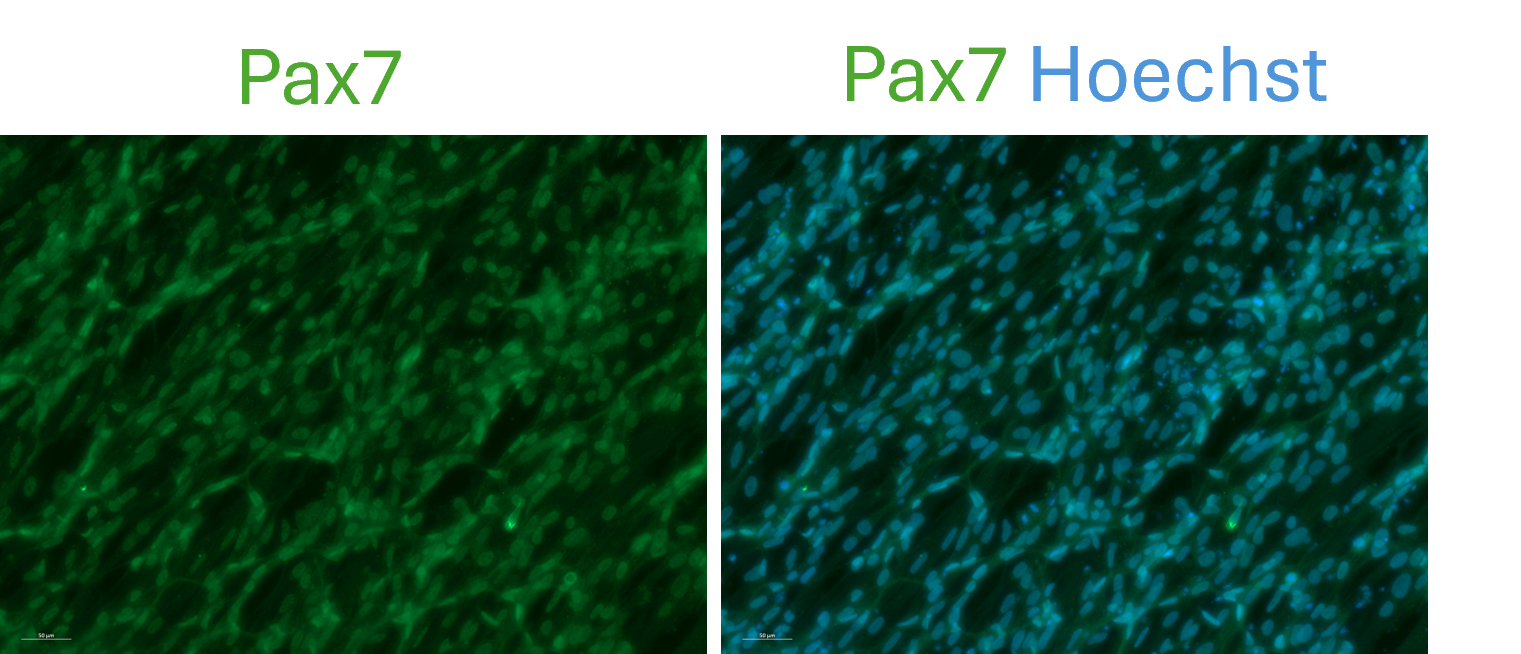
Both reviews highlight successful use of this antibody for immunofluorescence. One user achieved clear nuclear staining at a 1:100 dilution in myogenic progenitors and nascent myotubes, rating it 5 stars. The other user tested dilutions of 1:100 and 1:200 on skeletal muscle satellite cells using a 1-hour primary antibody incubation followed by PBS wash and 1-hour secondary antibody step, rating it 4 stars. Overall, the antibody performs well for IF applications at low dilutions, producing specific nuclear signals in muscle-related cell types.
The reviews below have been submitted by verified Proteintech customers who received an incentive for providing their feedback.
Pavithra (Verified Customer) (08-21-2026) | Immunufluorescence using 1:100 dilution, nuclear signal
 |
Sahya (Verified Customer) (08-13-2018) | Protocol - Primary Antibody - 1 hourPBS washSecondary Antibody - 1 hour
|


