

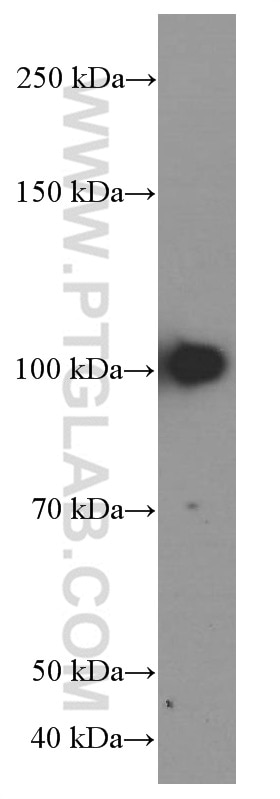



Tested Applications
| Positive WB detected in | RAW 264.7 cells, J774A.1 cells, NIH/3T3 cells, pig liver tissue, rat liver tissue |
| Positive IHC detected in | human tonsillitis tissue Note: suggested antigen retrieval with TE buffer pH 9.0; (*) Alternatively, antigen retrieval may be performed with citrate buffer pH 6.0 |
Recommended dilution
| Application | Dilution |
|---|---|
| Western Blot (WB) | WB : 1:1000-1:8000 |
| Immunohistochemistry (IHC) | IHC : 1:50-1:500 |
| It is recommended that this reagent should be titrated in each testing system to obtain optimal results. | |
| Sample-dependent, Check data in validation data gallery. | |
Product Information
66350-1-Ig targets TLR4 in WB, IHC, IF, IP, CoIP, ELISA, Blocking assay applications and shows reactivity with human, mouse, rat, pig samples.
| Tested Reactivity | human, mouse, rat, pig |
| Cited Reactivity | human, mouse, rat, pig, rabbit, canine, zebrafish, sheep, goat |
| Host / Isotype | Mouse / IgG2b |
| Class | Monoclonal |
| Type | Antibody |
| Immunogen |
CatNo: Ag13857 Product name: Recombinant human TLR4 protein Source: e coli.-derived, PET28a Tag: 6*His Domain: 653-839 aa of BC117422 Sequence: KFYFHLMLLAGCIKYGRGENIYDAFVIYSSQDEDWVRNELVKNLEEGVPPFQLCLHYRDFIPGVAIAANIIHEGFHKSRKVIVVVSQHFIQSRWCIFEYEIAQTWQFLSSRAGIIFIVLQKVEKTLLRQQVELYRLLSRNTYLEWEDSVLGRHIFWRRLRKALLDGKSWNPEGTVGTGCNWQEATSI Predict reactive species |
| Full Name | toll-like receptor 4 |
| Calculated Molecular Weight | 839 aa, 96 kDa |
| Observed Molecular Weight | 100-110 kDa |
| GenBank Accession Number | BC117422 |
| Gene Symbol | TLR4 |
| Gene ID (NCBI) | 7099 |
| RRID | AB_2881730 |
| Conjugate | Unconjugated |
| Form | Liquid |
| Purification Method | Protein A purification |
| UNIPROT ID | O00206 |
| Storage Buffer | PBS with 0.02% sodium azide and 50% glycerol, pH 7.3. |
| Storage Conditions | Store at -20°C. Stable for one year after shipment. Aliquoting is unnecessary for -20oC storage. 20ul sizes contain 0.1% BSA. |
Background Information
TLR4, also named CD284, belongs to the Toll-like receptor family. TLR4 interacts with LY96 and CD14 to mediate the innate immune response to bacterial lipopolysaccharide (LPS). TLR4 acts via MYD88, TIRAP and TRAF6, leading to NF-kB activation, cytokine secretion, and the inflammatory response. Three alternatively spliced transcript variants that encode different protein isoforms have been described.
Protocols
| Product Specific Protocols | |
|---|---|
| IHC protocol for TLR4 antibody 66350-1-Ig | Download protocol |
| WB protocol for TLR4 antibody 66350-1-Ig | Download protocol |
| Standard Protocols | |
|---|---|
| Click here to view our Standard Protocols |
Publications
What published studies show
TLR4 Monoclonal antibody (Mouse, cat# 66350-1-Ig) has 387 total citations. It is cited in leading journals including Signal Transduction and Targeted Therapy, Cell, Molecular Cell, Journal of Clinical Investigation, Cell Reports, Brain Behavior and Immunity, Theranostics, Advanced Science, Phytomedicine, Free Radical Biology and Medicine, Journal of Ethnopharmacology, European Journal of Pharmacology, Frontiers in Immunology, International Immunopharmacology, and many others. Research fields span inflammation/innate immunity, neuroinflammation (Alzheimer's, stroke, neuropathic pain), metabolic disorders (obesity, diabetes, NAFLD), colitis/IBD, acute lung injury, kidney injury, cardiovascular disease, and cancer.
| Species | Application | Title |
|---|---|---|
Signal Transduct Target Ther Innovative peptide-loaded hybrid membrane nanovaccine enables precise personalized immunotherapy for HPV-related cervical diseases. | ||
Imeta Akkermansia muciniphila-derived hypoacylated rough-type lipopolysaccharides alleviate diet-induced obesity via activation of TLR4-IL-23-IL-22 immune axis. | ||
J Natl Cancer Cent S100A8 promotes tumor progression by inducing phenotypic polarization of microglia through the TLR4/IL-10 signaling pathway in glioma | ||
Int J Oral Sci Fibroblast membrane-camouflaged nanoparticles for inflammation treatment in the early stage. | ||
Exp Mol Med Neutrophil extracellular traps mediate the crosstalk between plaque microenvironment and unstable carotid plaque formation |




