

Tested Applications
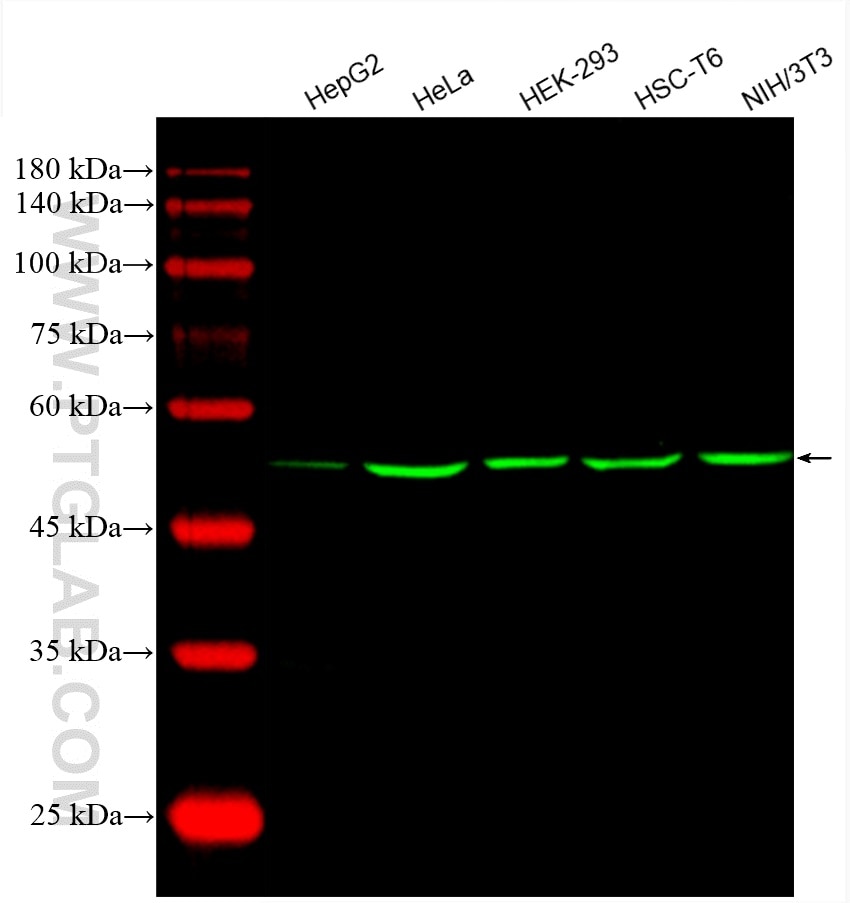
| Positive WB detected in | HepG2 cells, HeLa cells, HEK-293 cells, HSC-T6 cells, NIH/3T3 cells |
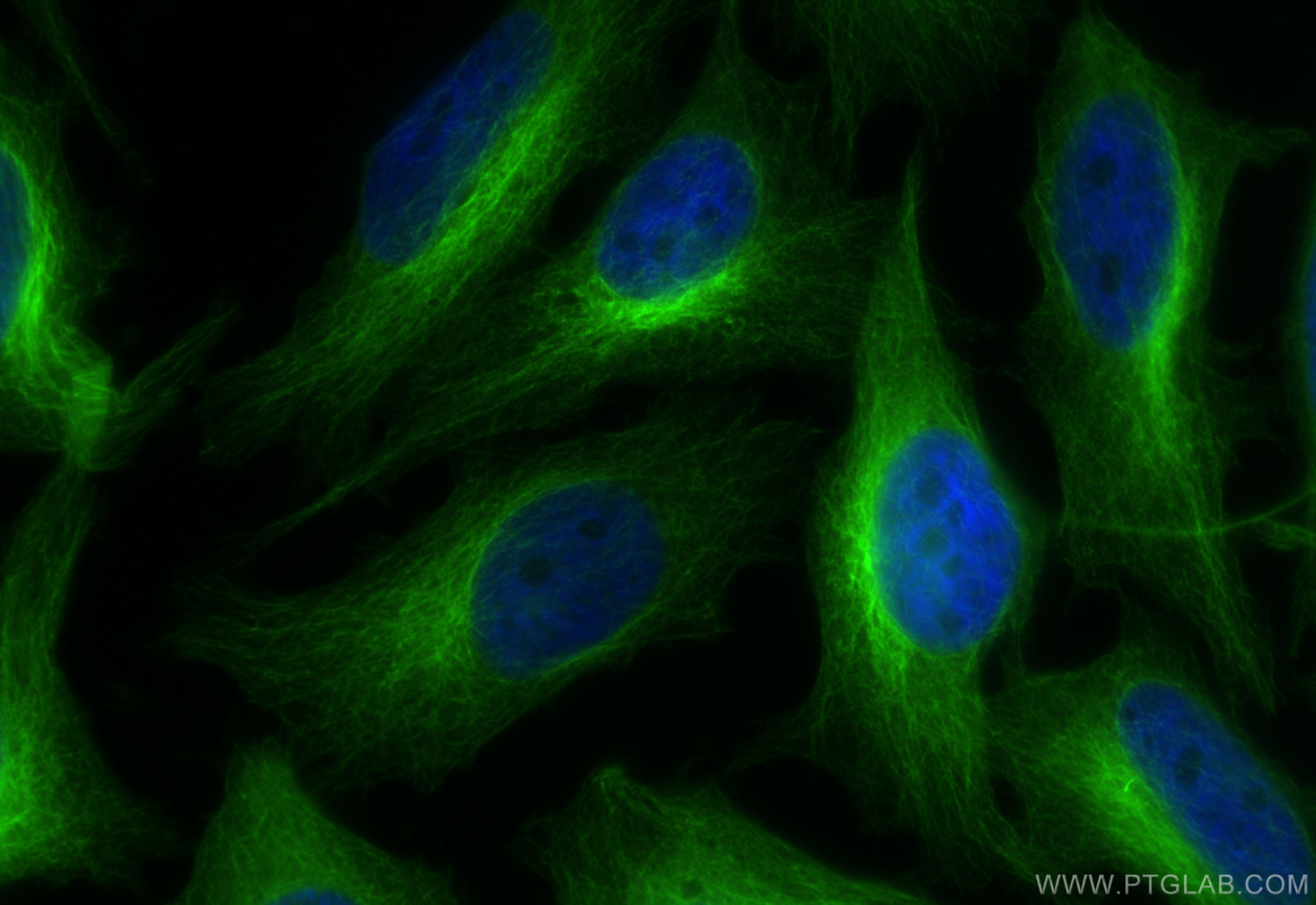
| Positive IF/ICC detected in | HeLa cells |
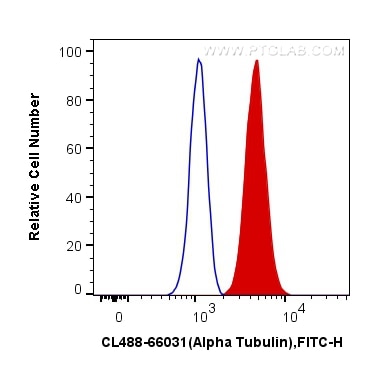
| Positive FC (Intra) detected in | HeLa cells |
Recommended dilution
| Application | Dilution |
|---|---|
| Western Blot (WB) | WB : 1:300-1:600 |
| Immunofluorescence (IF)/ICC | IF/ICC : 1:50-1:500 |
| Flow Cytometry (FC) (INTRA) | FC (INTRA) : 0.40 ug per 10^6 cells in a 100 µl suspension |
| It is recommended that this reagent should be titrated in each testing system to obtain optimal results. | |
| Sample-dependent, Check data in validation data gallery. | |
Product Information
CL488-66031 targets Alpha Tubulin in WB, IF/ICC, FC (Intra) applications and shows reactivity with human, mouse, rat, canine samples.
| Tested Reactivity | human, mouse, rat, canine |
| Cited Reactivity | human, mouse |
| Host / Isotype | Mouse / IgG2b |
| Class | Monoclonal |
| Type | Antibody |
| Immunogen |
CatNo: Ag18034 Product name: Recombinant human Tubulin-Alpha protein Source: e coli.-derived, PET28a Tag: 6*His Domain: 1-451 aa of BC009314 Sequence: MRECISIHVGQAGVQIGNACWELYCLEHGIQPDGQMPSDKTIGGGDDSFNTFFSETGAGKHVPRAVFVDLEPTVIDEVRTGTYRQLFHPEQLITGKEDAANNYARGHYTIGKEIIDLVLDRIRKLADQCTGLQGFLVFHSFGGGTGSGFTSLLMERLSVDYGKKSKLEFSIYPAPQVSTAVVEPYNSILTTHTTLEHSDCAFMVDNEAIYDICRRNLDIERPTYTNLNRLISQIVSSITASLRFDGALNVDLTEFQTNLVPYPRIHFPLATYAPVISAEKAYHEQLSVAEITNACFEPANQMVKCDPRHGKYMACCLLYRGDVVPKDVNAAIATIKTKRSIQFVDWCPTGFKVGINYQPPTVVPGGDLAKVQRAVCMLSNTTAIAEAWARLDHKFDLMYAKRAFVHWYVGEGMEEGEFSEAREDMAALEKDYEEVGVDSVEGEGEEEGEEY Predict reactive species |
| Full Name | tubulin, alpha 1b |
| Calculated Molecular Weight | 50 kDa |
| Observed Molecular Weight | 50-55 kDa |
| GenBank Accession Number | BC009314 |
| Gene Symbol | Alpha Tubulin |
| Gene ID (NCBI) | 10376 |
| RRID | AB_2883232 |
| Conjugate | CoraLite® Plus 488 Fluorescent Dye |
| Excitation/Emission Maxima Wavelengths | 493 nm / 522 nm |
| Excitation Laser | Blue laser (488 nm) |
| Form | Liquid |
| Purification Method | Protein A purification |
| UNIPROT ID | P68363 |
| Storage Buffer | PBS with 50% glycerol, 0.05% Proclin300, 0.5% BSA, pH 7.3. |
| Storage Conditions | Store at -20°C. Avoid exposure to light. Stable for one year after shipment. Aliquoting is unnecessary for -20oC storage. |
Background Information
What is the function of alpha tubulin?
Alpha-tubulin belongs to a large superfamily of tubulin proteins. There are a number of different subtypes that have a molecular weight of ~50kDa and are able to bind to beta-tubulin, forming a heterodimer that polymerises to microtubules as part of the cytoskeleton. These maintain cell structure, provide platforms for intracellular transport and are also involved in cell division.
Where is alpha-tubulin expressed?
Alpha tubulin is highly conserved and is present in nearly all eukaryotic cells as one of the building blocks of microtubules. The ubiquitous nature of this protein has led to its common use as a control protein for many tissue types as well as highlighting the structure of the cytoskeleton.
What are the post-translational modifications of alpha tubulin?
The function and properties of microtubules are drastically affected by the post-translational modifications undergone by tubulin, which may occur to the tubulin dimer directly or to the polymerised mictotubule. For example, the first modification to be identified was detyrosination1, as most alpha-tubulins have a tyrosine at their terminus. This process affects microtubules more than dimers and leads to patches of detyronisation along the structure, regulating protein interactions and allowing subcellular compartments to be defined.2,3 Polyglutamylation also occurs on several sites within the carboxy-terminal tails. However, to date, the most-studied alpha tubulin modification is related to acetylation of lysine 40 (K40).
1. Gundersen, G. G., Khawaja, S. & Bulinski, J. C. Postpolymerization detyrosination of alpha-tubulin: a mechanism for subcellular differentiation of microtubules. J. Cell Biol. 105, 251-64 (1987).
2. Galjart, N. Plus-End-Tracking Proteins and Their Interactions at Microtubule Ends. Curr. Biol. 20, R528-R537 (2010).
3. Jiang, K. & Akhmanova, A. Microtubule tip-interacting proteins: a view from both ends. Curr. Opin. Cell Biol. 23, 94-101 (2011).
Protocols
| Product Specific Protocols | |
|---|---|
| FC protocol for CL Plus 488 Alpha Tubulin antibody CL488-66031 | Download protocol |
| IF protocol for CL Plus 488 Alpha Tubulin antibody CL488-66031 | Download protocol |
| WB protocol for CL Plus 488 Alpha Tubulin antibody CL488-66031 | Download protocol |
| Standard Protocols | |
|---|---|
| Click here to view our Standard Protocols |
Publications
What published studies show
CL488-66031 is the Alpha Tubulin Monoclonal antibody (1E4C11) conjugated with CoraLite® Plus 488. It has 8 citations published in journals including Cell Death & Differentiation, Free Radical Biology and Medicine, Cellular and Molecular Life Sciences, American Journal of Physiology – Cell Physiology, Cell Signaling, Reproductive Toxicology, Clinical Genetics, and Translational Andrology and Urology. Research fields span cell death/necroptosis, oxidative stress signaling, oocyte maturation and reproductive biology, and male infertility related to sperm flagellar defects.
| Species | Application | Title |
|---|---|---|
Cell Death Differ GEF-H1 upon microtubule destabilization drives ZBP1-dependent necroptosis. | ||
Free Radic Biol Med Iron overload modulates follicular microenvironment via ROS/HIF-1α/FSHR signaling | ||
Cell Mol Life Sci Maternal MLH3 dysfunction drives unexplained recurrent pregnancy loss via impaired oocyte maturation and defective decidualization. | ||
Am J Physiol Cell Physiol Melatonin partially rescues defects induced by tranexamic acid exposure during oocyte maturation in mice | ||
Cell Signal Salidroside alleviates age-related metaphase II oocyte aging by enhancing mitochondrial complex I-mediated oxidative phosphorylation. | ||
Reprod Toxicol Bisphenol M inhibits mouse oocyte maturation in vitro by disrupting cytoskeleton architecture and cell cycle processes |
Reviews
What customers say
One reviewer (Pierre D.) rated CL488-66031 four out of five stars in September 2025. They used it for immunofluorescence on T cells (lot 21004035) and reported that it "worked well." Overall, the limited feedback suggests satisfactory performance for IF applications on T cell samples.
The reviews below have been submitted by verified Proteintech customers who received an incentive for providing their feedback.
Pierre (Verified Customer) (09-24-2025) | Worked well
|






