FlexAble Oligo-Ready Antibody Labeling Kits
FlexAble Oligo-Ready Labeling Kits are used for generating Oligo-FlexLinker conjugates, which enable species specific and high-affinity labeling of antibodies, providing an easy, fast and reliable way to label primary antibodies with Oligos.
-

Label 1 or up to 2 oligos per antibody
-
Same species multiplexing
-
Label 100 µg antibody per kit
-
60 – 80% recovery rate
-
Label as little as 0.5 µg antibody per reaction
-
Wide buffer compatibility range
How does it work?
1. Preparation of Oligo-FlexLinkers:
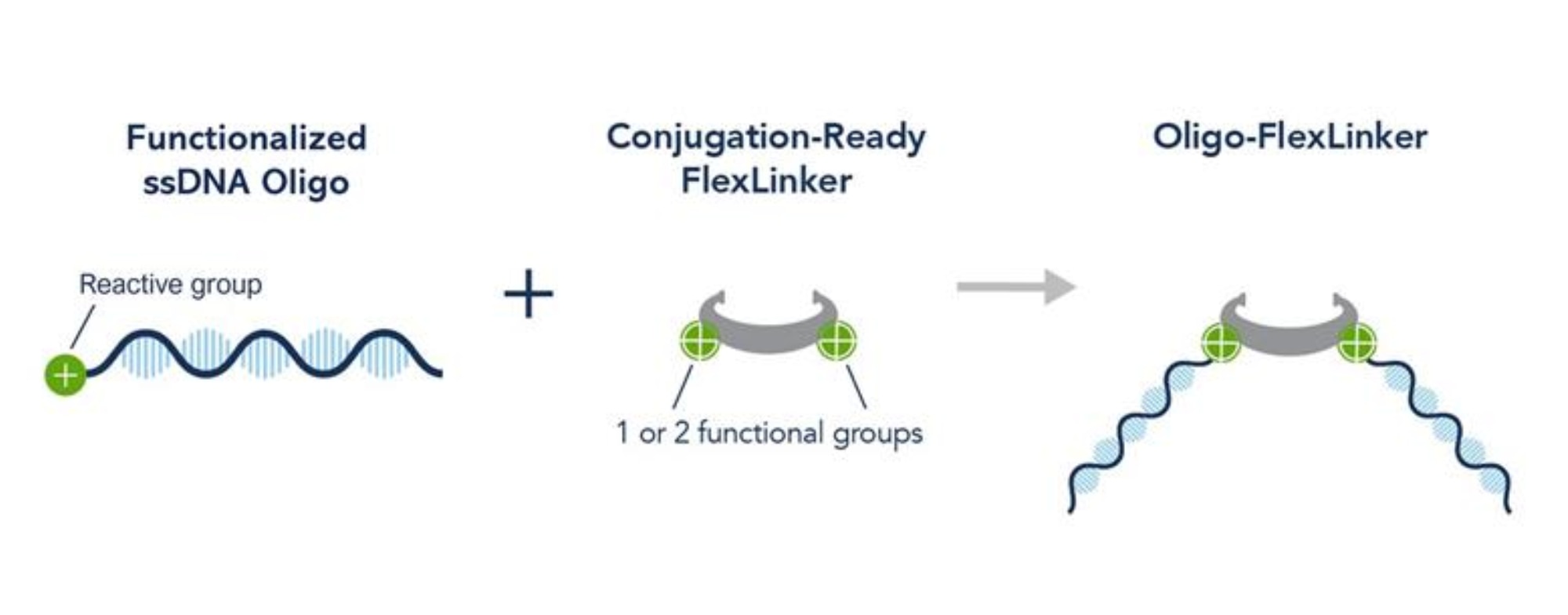
Functionalized ssDNA oligo (e.g., DBCO) reacts with conjugation-ready FlexLinkers (e.g., carrying azide groups for azide-DBCO click conjugation) to yield Oligo-FlexLinkers.
- 1 Kit provides enough conjugation-ready FlexLinker to generate up to 3 different Oligo-FlexLinkers (scalable from 3x 33 µg – 1x 100 µg).
- This part of the protocol includes a clean-up step to remove excess oligo.
- This intermediate product is stable and can be stored at -20°C for up to 6 months.
Note: FlexLinkers are IgG species and subtype specific.
2. Antibody Labeling
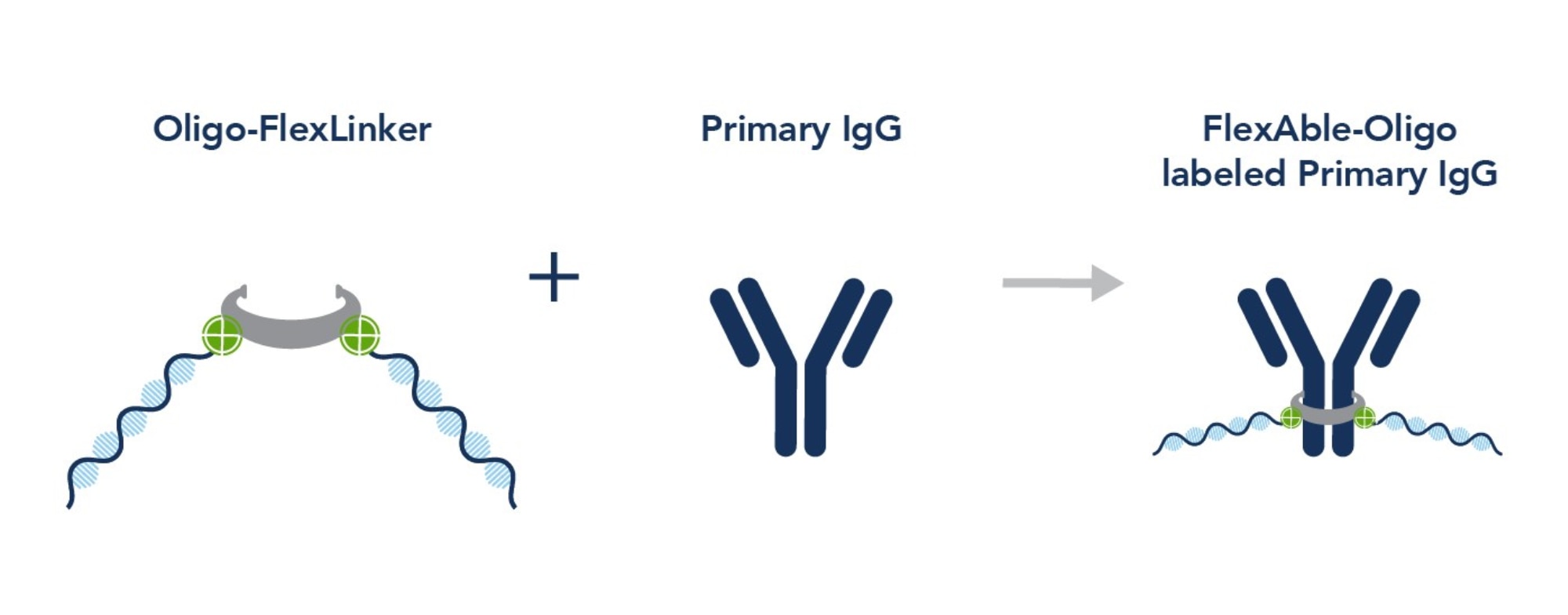
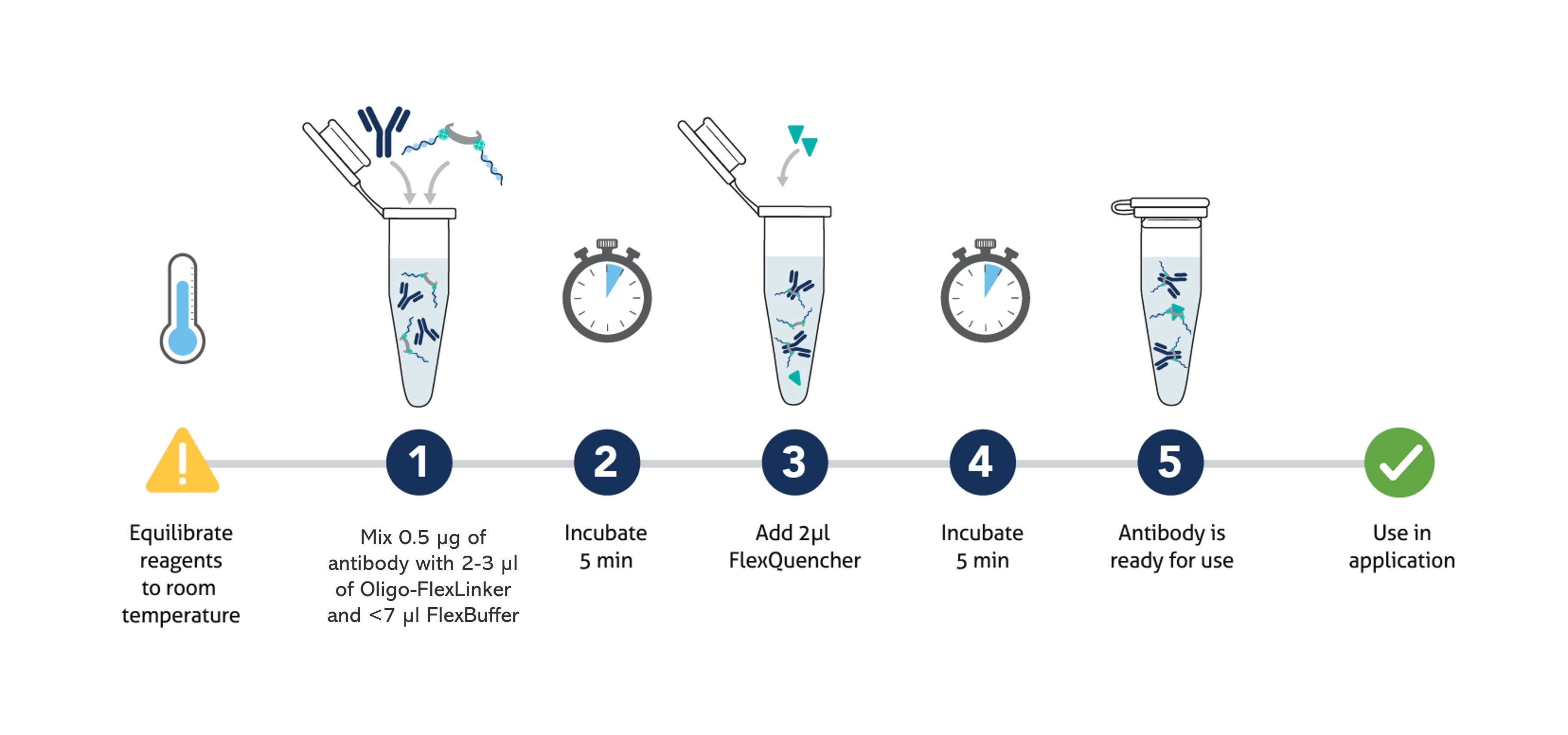
Oligo-FlexLinkers are then used to label primary antibodies in a simple 15 min protocol with minimal hands-on time.
- 1 Kit yields sufficient Oligo-FlexLinker to label a total of up to 100 µg of primary antibody (or small amounts of up to 200 different antibodies.)
- The minimum amount of antibody per reaction is 0.5 µg primary antibody.
Note: We recommend integrating the quick labeling process into your workflow and label the antibody shortly before use in the end-application.
Available FlexAble Oligo-Ready Kits
| Target | DBCO – Azide | Kit Size |
|---|---|---|
| Rabbit IgG | 1x DBCO-Ready 2x DBCO-Ready |
Labels up to 100 µg of primary antibody |
| Mouse IgG1 | 1x DBCO-Ready 2x DBCO-Ready |
Labels up to 100 µg of primary antibody |
| Mouse IgG2a | 1x DBCO-Ready 2x DBCO-Ready |
Labels up to 100 µg of primary antibody |
| Mouse IgG2b | 1x DBCO-Ready 2x DBCO-Ready |
Labels up to 100 µg of primary antibody |
| Human IgG | 1x DBCO-Ready 2x DBCO-Ready |
Labels up to 100 µg of primary antibody |
| Rat Kappa Light Chain | 1x DBCO-Ready 2x DBCO-Ready |
Labels up to 100 µg of primary antibody |
Important note: The list below gives an overview about additional material needed for the conjugation of the FlexLinker.
Oligo Conjugation of Oligo-Ready FlexLinkers
Maximum FlexAble-ity
Label only what you really need. Many commercial labeling kits require processing 100 µg of antibody at once, even though for example typical immunofluorescence (or other) workflows use only a few micrograms. With our kit, you gain full flexibility: prepare your FlexLinkers, select the antibodies you want to modify, and label as little as 0.5 µg of antibody.
Multiplexing
Our FlexAble technology allows for easy multiplexing, even with same species antibodies.
Build your own barcode library
A single FlexAble Oligo-Ready Antibody Labeling Kit allows you to prepare up to three Oligo-FlexLinkers with three different oligos, enabling you to create your own custom barcode library. The resulting Oligo-FlexLinkers are stable and can be stored long-term at −20 °C. From there, labeling antibodies with your barcode takes only 15 minutes.
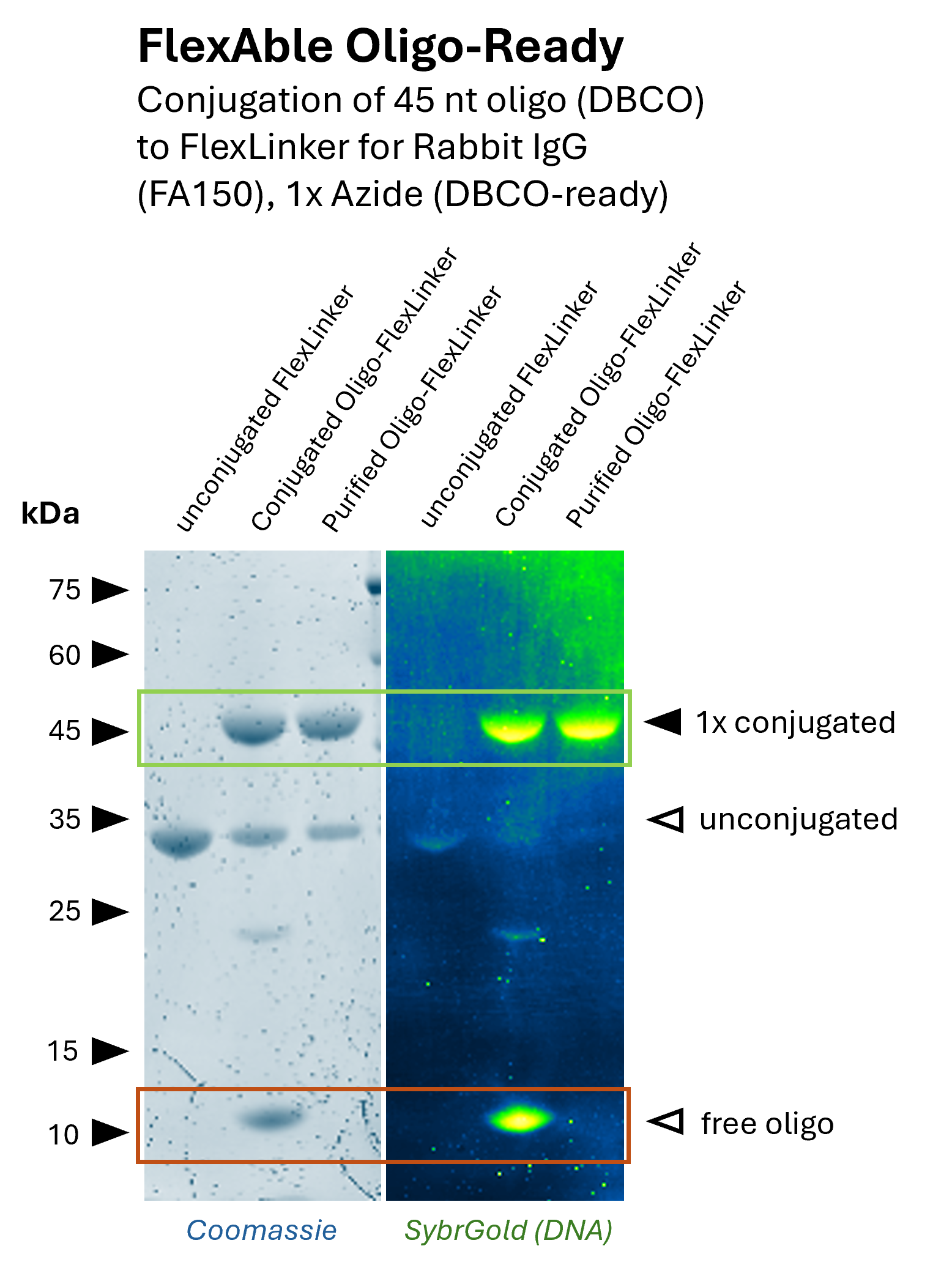
Oligo-Ready FlexLinker for rabbit IgG carrying 1 azide groups (FA150) was conjugated with a 45 nt long DBCO functionalized oligonucleotide to generate an Oligo-FlexLinker. Lane 1 shows unconjugated FlexLinker. Lane 2 shows successfully conjugated FlexLinker, the SybrSafe stain shows both conjugated Linker and excess oligo in this fraction. Lane 3 shows the purified Oligo-FlexLinker after removal of excess DNA. Absence of free oligo indicates a clean Oligo-FlexLinker that is ready for antibody labeling.
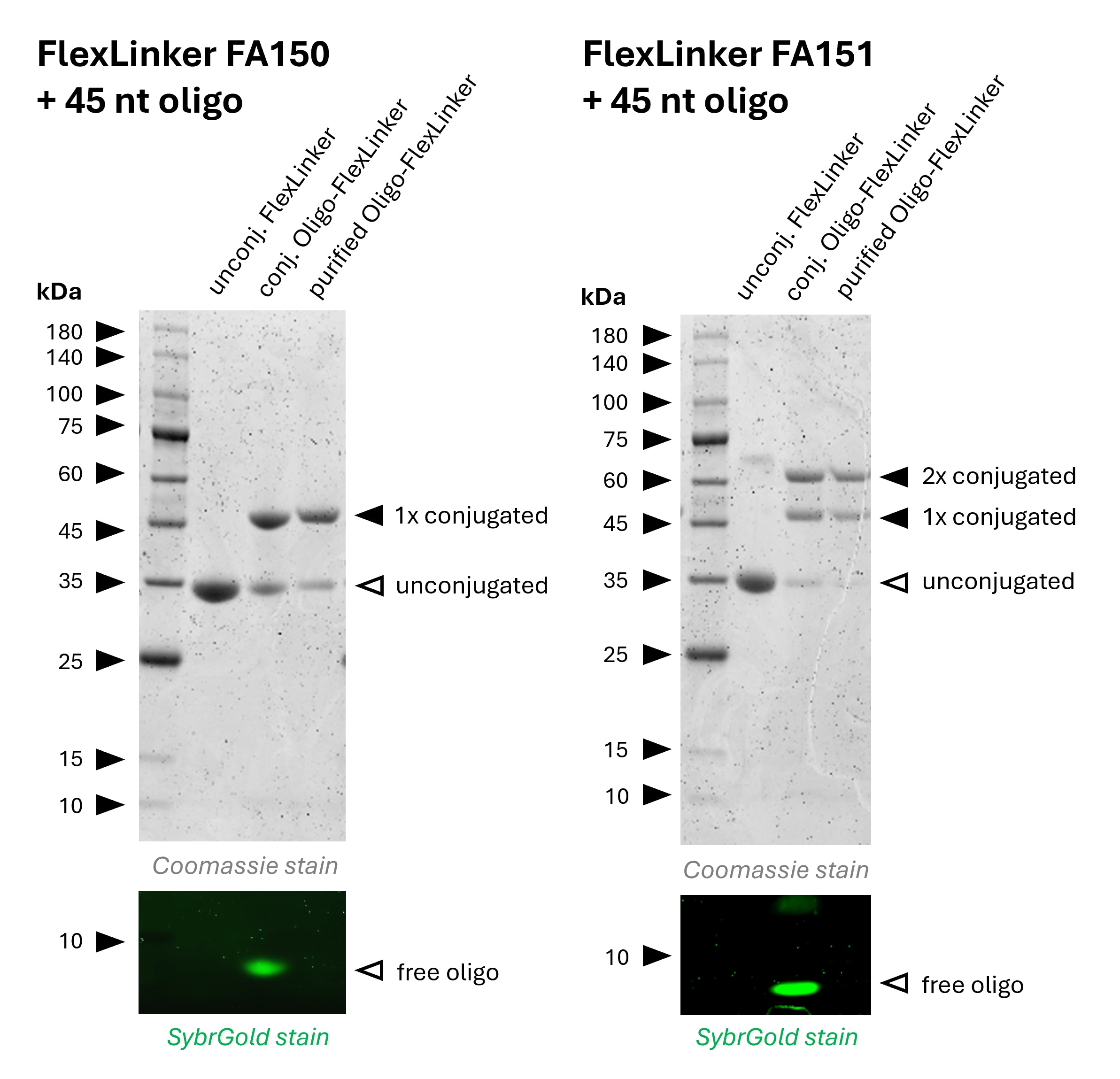
Oligo-Ready FlexLinkers for rabbit IgG carrying 1 or 2 azide groups (FA150 & FA151 respectively) were conjugated with a 45 nt long DBCO functionalized oligonucleotide to generate Oligo-FlexLinkers. Lane 1 shows unconjugated FlexLinker. Lane 2 shows successfully conjugated FlexLinker, the SybrGold stain shows excess oligo in this fraction. Lane 3 shows the purified Oligo-FlexLinker after removal of excess DNA. Absence of free oligo indicates a clean Oligo-FlexLinker that is ready for antibody labeling.
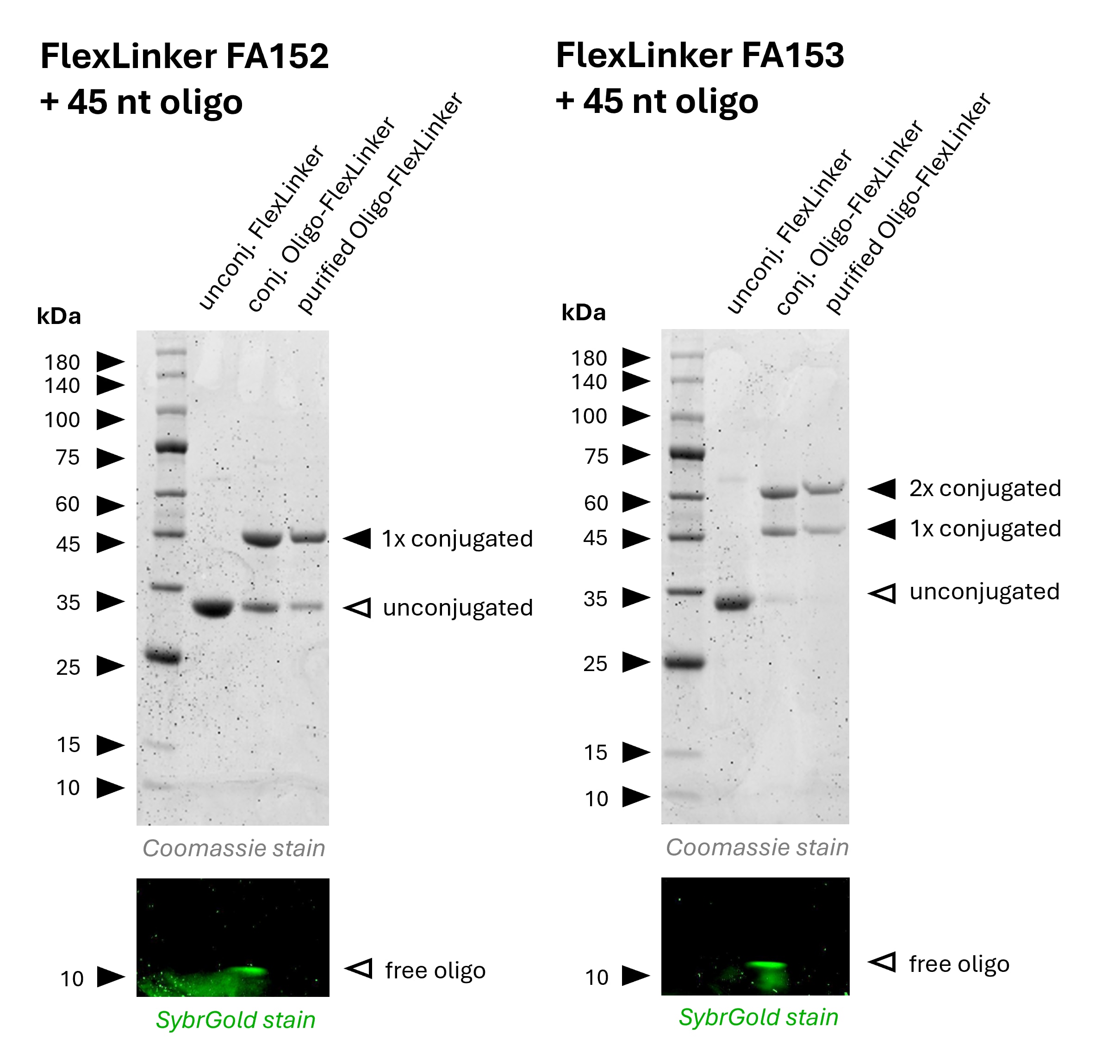
Oligo-Ready FlexLinkers for mouse IgG1 carrying 1 or 2 azide groups (FA152 & FA153 respectively) were conjugated with a 45 nt long DBCO functionalized oligonucleotide to generate Oligo-FlexLinkers. Lane 1 shows unconjugated FlexLinker. Lane 2 shows successfully conjugated FlexLinker, the SybrGold stain shows excess oligo in this fraction. Lane 3 shows the purified Oligo-FlexLinker after removal of excess DNA. Absence of free oligo indicates a clean Oligo-FlexLinker that is ready for antibody labeling.
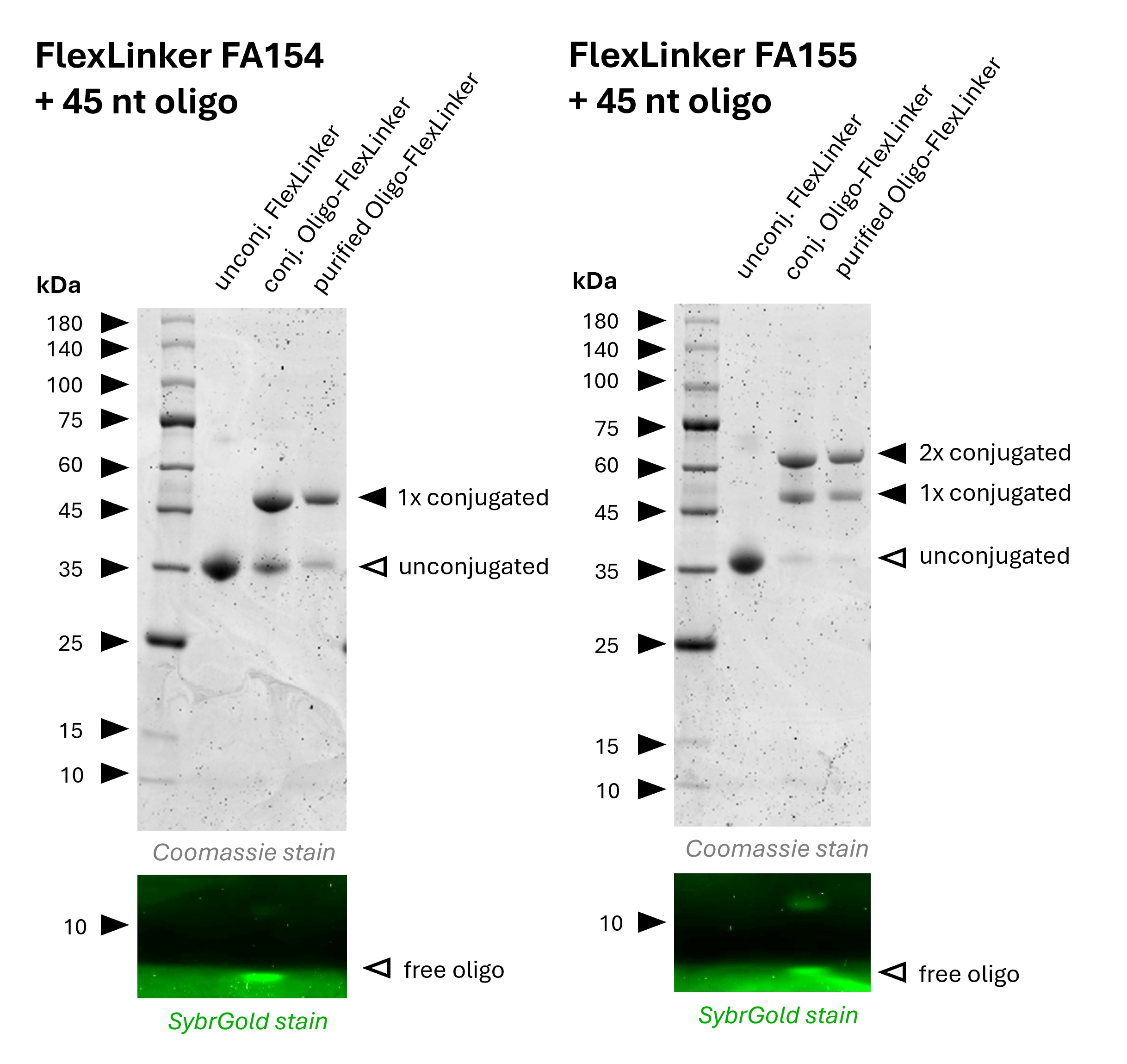
Oligo-Ready FlexLinkers for mouse IgG2a carrying 1 or 2 azide groups (FA154 & FA155 respectively) were conjugated with a 45 nt long DBCO functionalized oligonucleotide to generate Oligo-FlexLinkers. Lane 1 shows unconjugated FlexLinker. Lane 2 shows successfully conjugated FlexLinker, the SybrGold stain shows excess oligo in this fraction. Lane 3 shows the purified Oligo-FlexLinker after removal of excess DNA. Absence of free oligo indicates a clean Oligo-FlexLinker that is ready for antibody labeling.
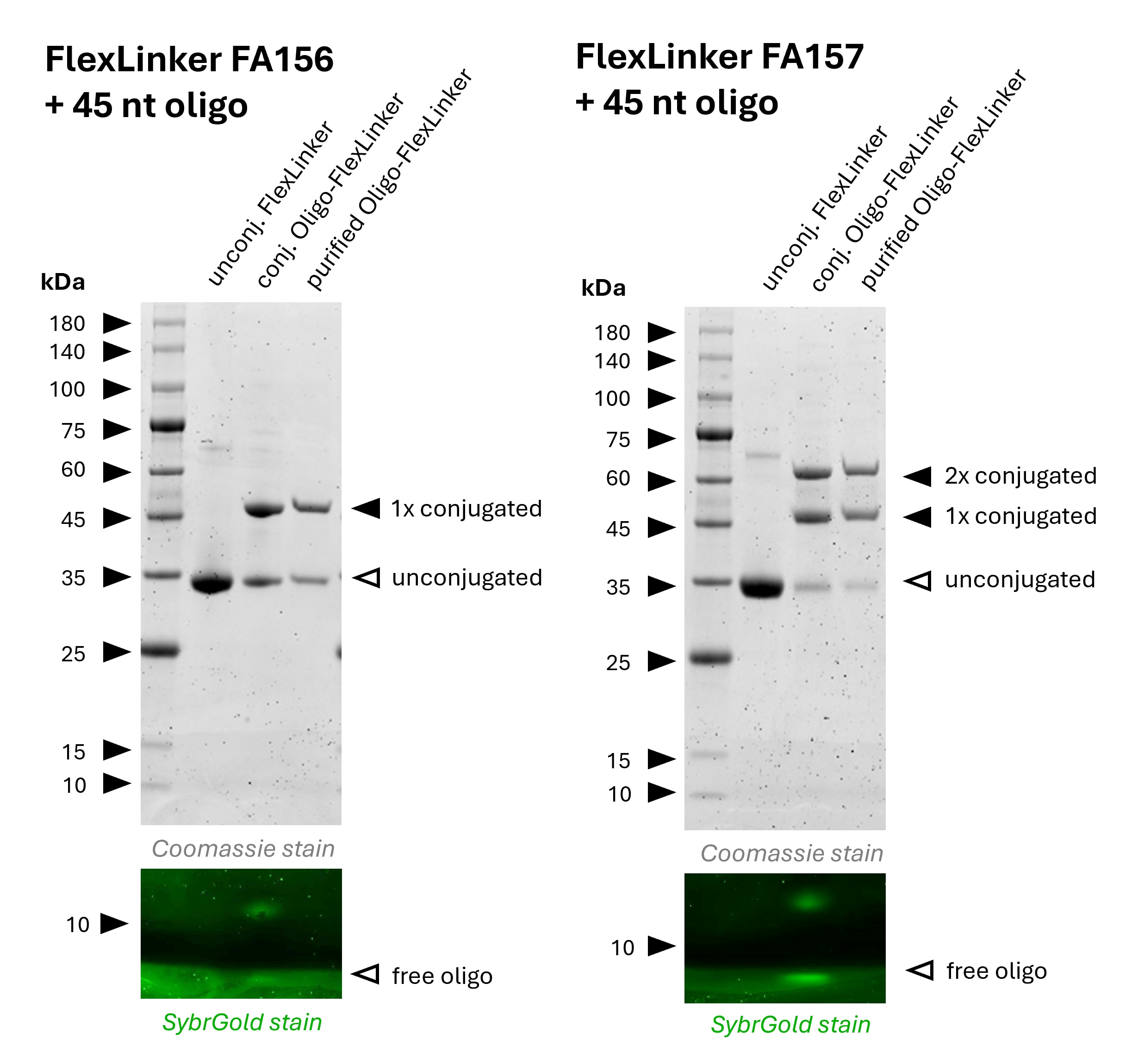
Oligo-Ready FlexLinkers for mouse IgG2b carrying 1 or 2 azide groups (FA156 & FA157 respectively) were conjugated with a 45 nt long DBCO functionalized oligonucleotide to generate Oligo-FlexLinkers. Lane 1 shows unconjugated FlexLinker. Lane 2 shows successfully conjugated FlexLinker, the SybrGold stain shows excess oligo in this fraction. Lane 3 shows the purified Oligo-FlexLinker after removal of excess DNA. Absence of free oligo indicates a clean Oligo-FlexLinker that is ready for antibody labeling.
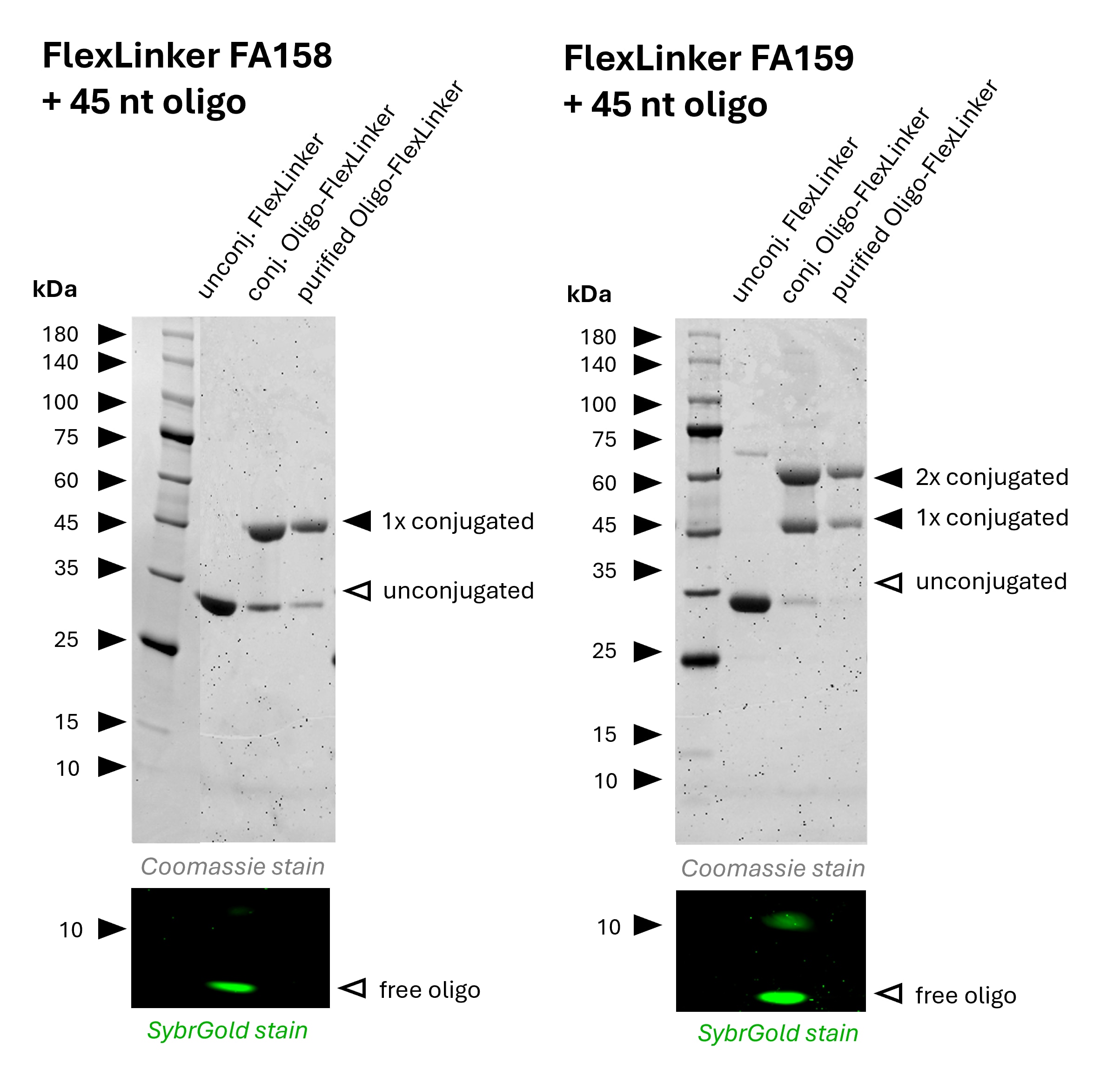
Oligo-Ready FlexLinkers for human IgG carrying 1 or 2 azide groups (FA158 & FA159 respectively) were conjugated with a 45 nt long DBCO functionalized oligonucleotide to generate Oligo-FlexLinkers. Lane 1 shows unconjugated FlexLinker. Lane 2 shows successfully conjugated FlexLinker, the SybrGold stain shows excess oligo in this fraction. Lane 3 shows the purified Oligo-FlexLinker after removal of excess DNA. Absence of free oligo indicates a clean Oligo-FlexLinker that is ready for antibody labeling.
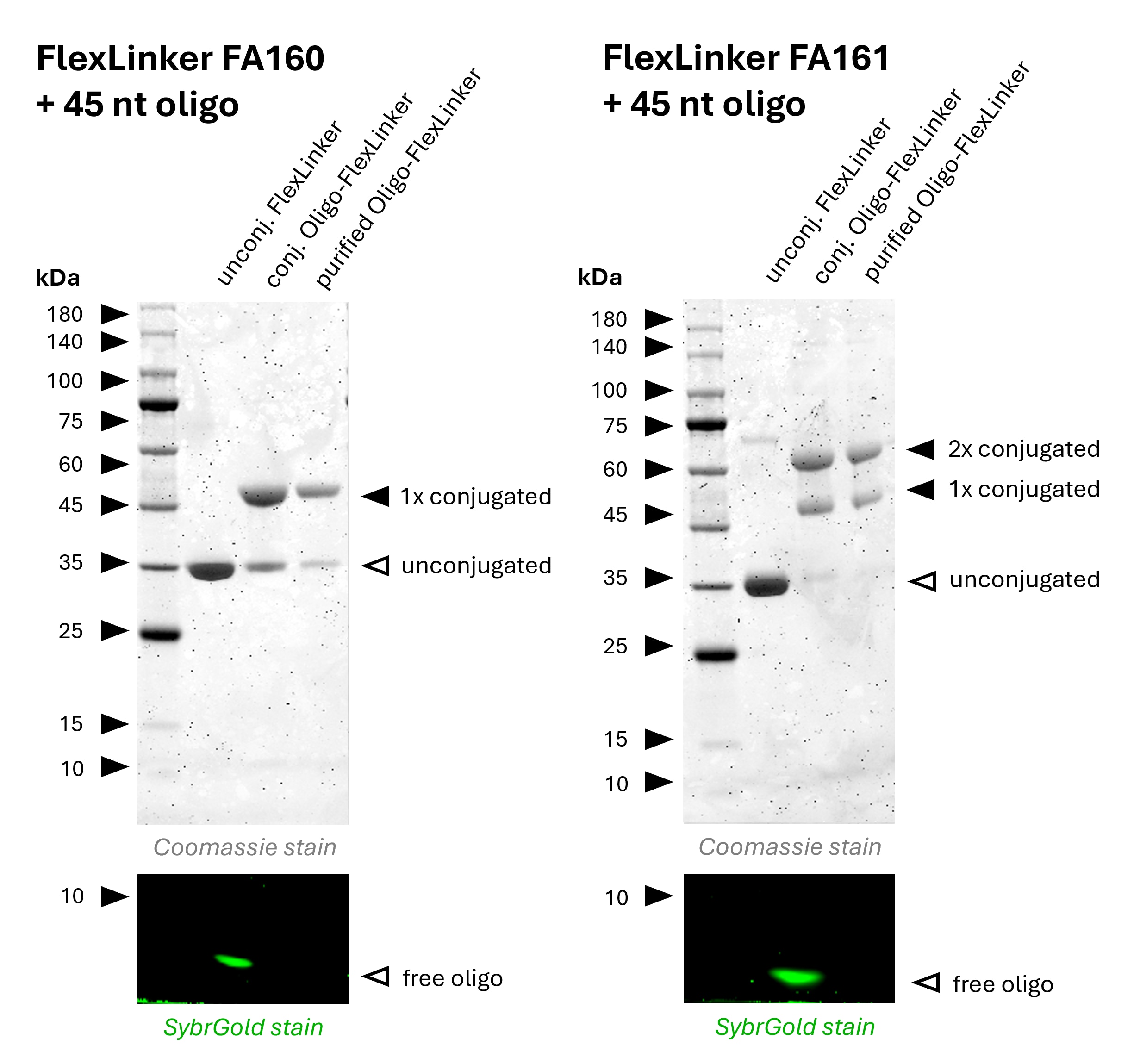
Oligo-Ready FlexLinkers for rat kappa light chain carrying 1 or 2 azide groups (FA160 & FA161 respectively) were conjugated with a 45 nt long DBCO functionalized oligonucleotide to generate Oligo-FlexLinkers. Lane 1 shows unconjugated FlexLinker. Lane 2 shows successfully conjugated FlexLinker, the SybrGold stain shows excess oligo in this fraction. Lane 3 shows the purified Oligo-FlexLinker after removal of excess DNA. Absence of free oligo indicates a clean Oligo-FlexLinker that is ready for antibody labeling.
Use the Oligo-FlexLinker to label your antibody in only 15 min
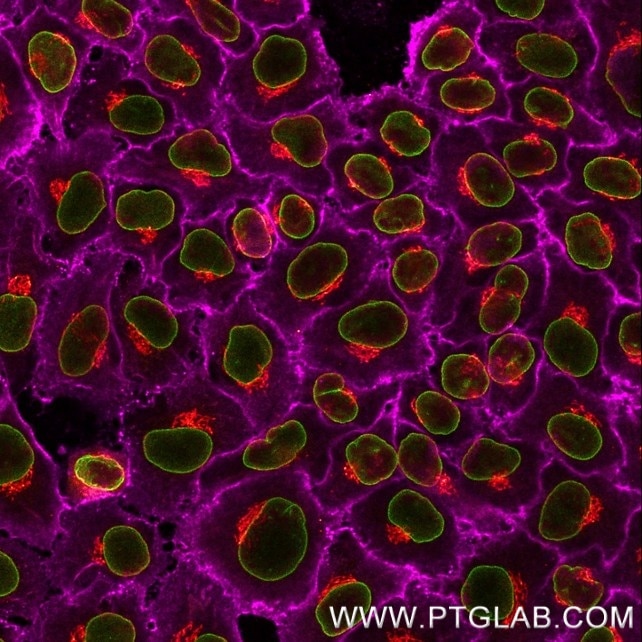
Immunostaining of HeLa cells with three rabbit antibodies - anti-CD147 (11989-1-AP, 1:200, magenta), anti-Lamin B1 (12987-1-AP, 1:200, green), and anti-GM130 (11308-1-AP, 1:200, red) - each labeled with a different 15-nt DNA oligonucleotide separately using KFA150 and KFA151 Kits. Detection was performed by hybridization with imaging DNA strands, carrying ATTO643/488/565 respectively.
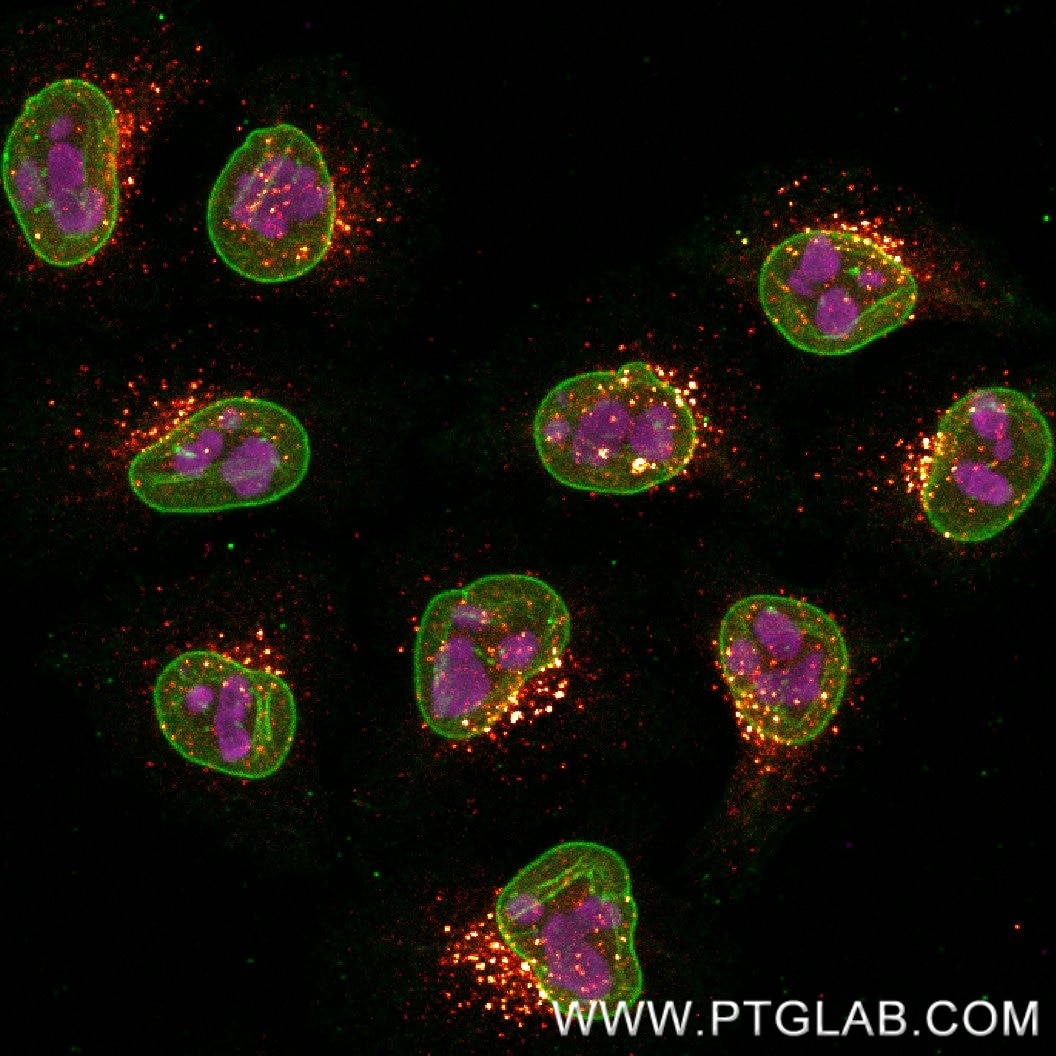
Immunostaining of HeLa cells with three mouse IgG1 antibodies - anti-B23 (60096-1-Ig, 1:500, magenta), anti-Lamin B1 (66095-1-Ig, 1:200, green), and anti-EEA1 (68065-1-Ig, 1:200, orange hot) - each labeled with a different 15-nt DNA oligonucleotide separately using KFA152 and KFA153 Kits. Detection was performed by hybridization with imaging DNA strands, carrying ATTO643/565/488 respectively. Confocal z-stack animation is shown.
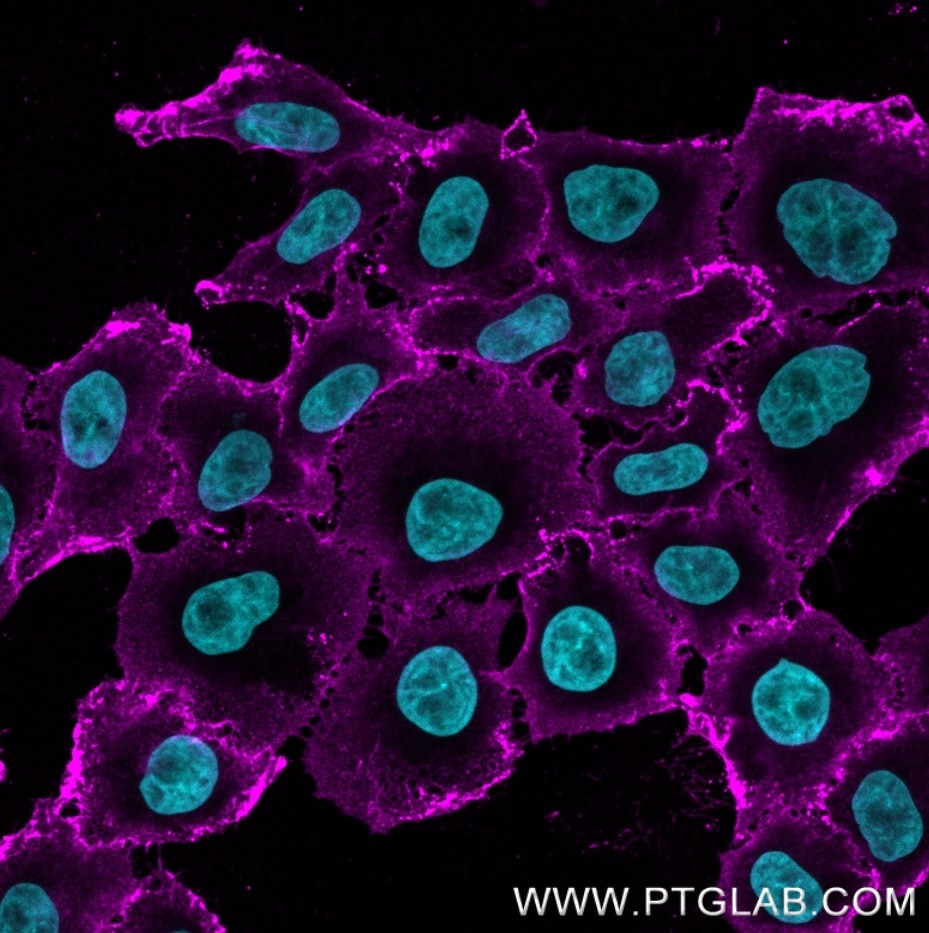
Immunostaining of HeLa cells with rabbit anti-CD147 antibody (11989-1-AP, 1:200, magenta), which was labeled with a 15-nt DNA oligonucleotide using the KFA150 Kit. Detection was performed by hybridization with an imaging DNA strand carrying ATTO643. Nuclei are stained with DAPI (cyan).
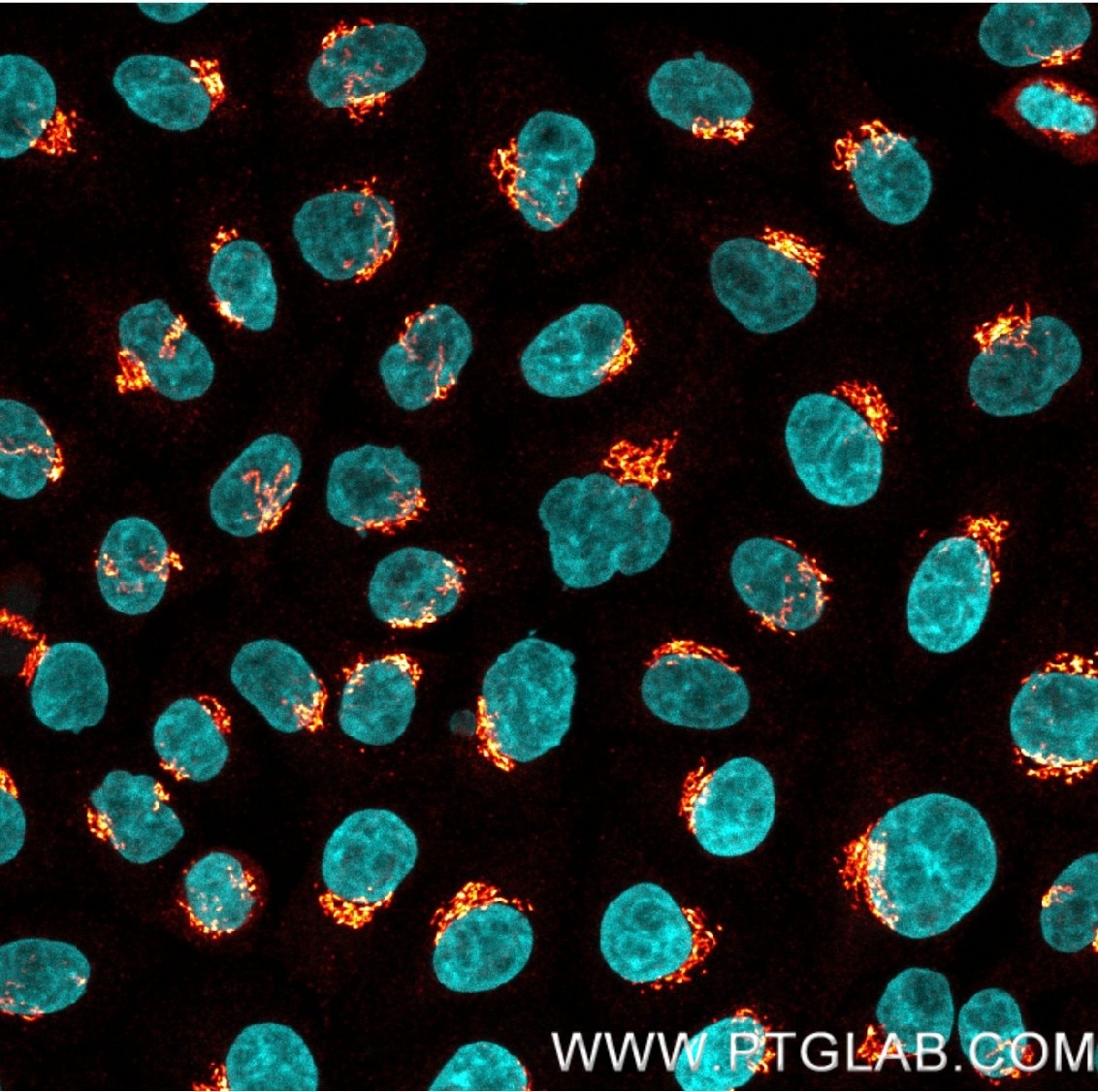
Immunostaining of HeLa cells with rabbit anti-GM130 antibody (11308-1-AP, 1:200, hot orange), which was labeled with a 15-nt DNA oligonucleotide using the KFA151 Kit. Detection was performed by hybridization with an imaging DNA strand carrying ATTO643. Nuclei are stained with DAPI (cyan).
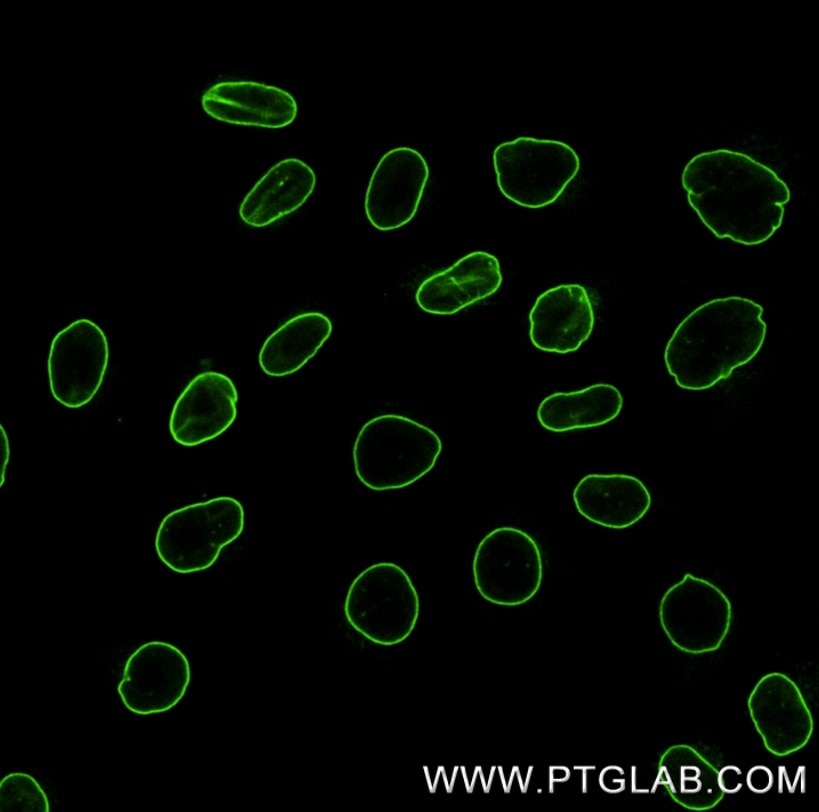
Immunostaining of HeLa cells with rabbit anti-Lamin antibody (12987-1-AP, 1:200, green), which was labeled with a 15-nt DNA oligonucleotide using the KFA151 Kit. Detection was performed by hybridization with an imaging DNA strand carrying ATTO488.
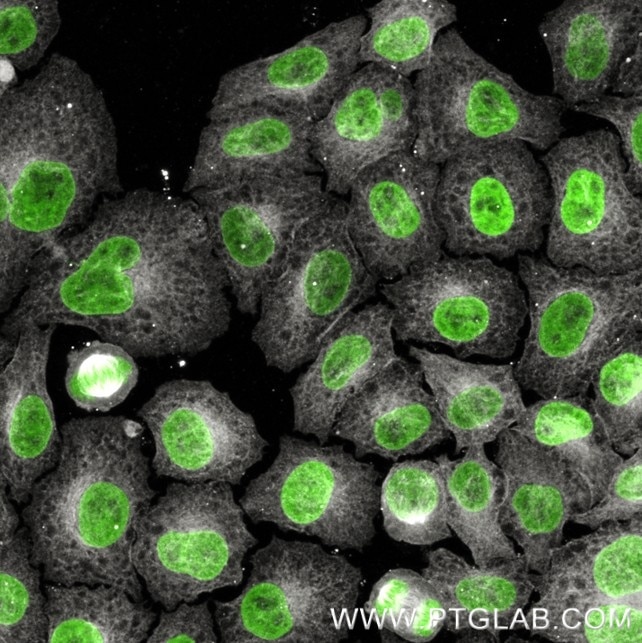
Immunostaining of HeLa cells with mouse IgG2b anti-Tubulin antibodies (66031-1-Ig, 1:100, grey), which was labeled with a 15-nt DNA oligonucleotide using the KFA157 Kit. Detection was performed by hybridization with imaging DNA strands carrying ATTO643. Nuclei are in green.
Oligo-FlexLinker conjugated antibodies in IF
Efficient Conjugation of 1 or 2 oligos per Linker
Oligo-Ready FlexLinkers are available with either one or two reactive groups (e.g.,, azides) and can be conjugated to functionalized oligos (e.g.,, DBCO-modified) via click chemistry. FlexLinkers with a single reactive group yield Oligo-FlexLinkers with a precise degree of labeling (DOL) of 1. FlexLinkers containing two reactive groups provide a DOL between 1 and 2.
Removal of free oligo
The workflow includes a dedicated clean-up step to ensure that unbound oligos do not carry over into downstream applications. Each FlexLinker carries a His-tag for selective binding to Ni-NTA resin: excess DNA oligos are washed away, and the linker is eluted with imidazole. A subsequent buffer-exchange step removes imidazole, yielding a clean and ready-to-use Oligo-FlexLinker.
High yield
Chemical conjugation often results in substantial sample loss during both reaction and purification. Our optimized process minimizes these losses, routinely achieving ~60 - 80% recovery of input material.
Kit components
| Component | Amount | Use For |
|---|---|---|
| FlexLinker | 100 µg in 50 µl | Oligo conjugation |
| FlexQuencher | 400 µl | Quenching unbound Oligo-FlexLinker |
| FlexBuffer | 2 ml | Dilution Buffer for antibody labeling reaction |
| Spin columns | 3 pcs | Purification of Oligo-FlexLinker |
Not included
| Item | Amount required | Use for |
|---|---|---|
| Oligonucleotides | 30 or 60 nmol (or 10 or 20 nmol per 33 µg) for 1x or 2x DBCO-ready respectively | Conjugation to FlexLinker |
| Ni-NTA Agarose | 300 µl (or 100 µl per 33 µg) | for clean-up step, binds His tag on FlexLinker |
| PBS (DNase free) | 5 ml per oligo-conjugation | for washing steps |
| Imidazole (1M stock) (DNase free) | 1 ml per oligo-conjugation | for elution buffer |
| Desalting columns | 1x per oligo-conjugation | for imidazole removal after elution |
How many Oligos can I attach to one FlexLinker?
We offer options for conjugation with either 1 or 2 Oligos per FlexLinker / Antibody. The 2x Oligo-Ready version will yield a Linker with a DOL between 1-2, depending on the conjugation efficiency. Custom options (e.g. 5 Oligos) are available upon request. Please contact our Tech-Support.
What kind of antibodies can I label with these Kits?
There are almost no limitations to the antibody you can use. The FlexAble labeling protocol tolerates low concentrations, a wide range of buffer conditions, BSA, and glycerol. This makes our Oligo-Ready kit compatible with Antibodies from most vendors and works without prior buffer exchange.
Do I need any additional reagents or equipment?
Yes. For this basic FlexAble Oligo-Ready Antibody Conjugation Kit you will need to source some of the material (like Ni²⁺ beads, Imidazole, desalting columns) from other sources. Please refer to the tables above or the Manual – each chapter will provide you with detailed information about the required components. You might have most of it in your lab already!
What’s the minimum amount of antibody I can label with this kit?
Our 100 μg kits can be used for generation of up to 3 different Oligo-FlexLinkers (intermediate product). After preparation of the Oligo-labeled FlexLinker, you can use this product to label up to 100 μg of primary antibody in total. As little as 0.5 μg of primary antibody are required per reaction, giving you maximum flexibility to label small amounts of antibody (up to 200x 0.5 μg antibody per kit).
How can I scale this reaction up or down?
Intermediate product: Conjugations of your desired oligo to the Oligo-Ready FlexLinker; the conjugation can be scaled up from 3 × 33 μg of FlexLinker to 1 × 100 μg of FlexLinker in steps that suit your experimental needs.
Final labeling of antibody: Labeling of primary antibody with Oligo-FlexLinker; the labeling can be scaled up in multiples of 0.5 μg of primary antibody. With a 100 μg Kit, you can label up to 100 μg of antibody in one reaction, or 200 different antibodies in 200 small reactions (0.5 μg of antibody per reaction).
Can I use the Kit to create more than 3 different Oligo-FlexLinkers?
Our protocols were validated and optimized for conjugation of minimum 10 nmol of oligo to 33 μg of Oligo-Ready FlexLinker. Using less can have disproportional impact on efficiency and yield.
Is purification required after conjugation?
After the final conjugation of the antibody with the Oligo-FlexLinker, no purification is needed. Remaining unbound FlexLinker is quenched by the FlexQuencher that is provided with the Kit. The protocol contains a clean-up step for removal of free oligo from the FlexLinker.
How can I verify successful conjugation?
We recommend taking samples during the conjugation protocol. Running an SDS PAGE can help you to estimate the conjugation efficiency and the yield of the Oligo-FlexLinker. We recommend doing a BCA assay to measure the concentration of the final product. Unfortunately, classical photometry will not give you precise results, as the oligo interferes with the measurement.
How stable are the products after preparation?
Oligo-FlexLinkers: After conjugation of the oligo to the FlexLinkers, this intermediate product is stable and can be stored for up to 6 months at -20°C, or up to 2 years at -80°C.
Labeled Antibodies after labeling a primary antibody with an Oligo-FlexLinker, complex stability strongly depends on the antibody that is labeled. We recommend labeling the antibody when you need it, the labeling process only takes 15 min. If you need to store the labeled antibody for longer, we recommend testing the product after storage to ensure proper functionality.
What storage conditions are recommended?
See above for recommended storage conditions for Oligo-FlexLinkers and labeled antibodies.
Is my oligo compatible with this technology?
FlexAble Oligo-Ready Kits are valid for a variety of different oligo lengths and types.
What are the FlexLinker, FlexQuencher and FlexBuffer?
The FlexLinker is a small polypeptide to which dyes are covalently conjugated that can label unconjugated primary antibodies. The FlexQuencher is a recombinant IgG or Fc fragment that neutralizes the excess FlexLinker. The FlexBuffer is a PBS-based buffer.
Do I need to remove unbound FlexLinker?
Unbound FlexLinker is neutralized by adding FlexQuencher. No additional removal step (e.g., by ultrafiltration) is required during the labeling process.
Will I observe cross-reactivity/leaking when I use two FlexAble-labeled antibodies from the same species during multiplexing?
FlexAble labels primary antibodies with a high affinity FlexLinker. Dissociation of FlexLinker from one antibody and association to another antibody is rare. If you observe leaking, we recommend adding more FlexQuencher to remove unbound FlexLinker, or you can try sequential staining of the labeled antibodies.
Does FlexAble Antibody Labeling Kit for Mouse IgG1 work with other mouse primary antibodies?
No, FlexAble Antibody Labeling Kit for Mouse IgG1 can only label mouse IgG1 primary antibodies since our kit is isotype specific.
What can I do to decrease background?
You can reduce the FlexQuencher amount or increase your washes after staining.
What is the highest concentration of my primary antibody that I can use?
There is no limitation for high concentrations of primary antibodies. If the concentration is very high and the volume to be pipetted is too small, you can dilute the antibody in PBS buffer to 0.5-1 mg/mL.
What is the lowest concentration of my primary antibody that I can use?
Our protocol uses 0.5 µg of primary antibody in 7 µL, which ends up at 0.07 mg/mL. If the concentration of your antibody is lower, you can also use a larger volume than 7 µL while using the same amount of FlexLinker and FlexQuencher.
Is it fine to freeze-thaw the reagents 50 times?
FlexAble kits remain functional, and the signal remains robust through freeze-thaw cycles, although aliquoting may increase shelf life.