
A Practical Step-by-Step Guide to Subcellular Fractionation in Mammalian Cells
By Alexandra-Teodora Szabo, Postgraduate Researcher in Mitochondrial Biology at University of Tübingen
Subcellular fractionation is a biochemical technique used to separate cellular components based on their size, density, or other properties. Usually, cells are first lysed to preserve organellar identity, and then centrifuged in a stepwise manner, either through differential centrifugation or density gradient centrifugation. The result is an enriched preparation of specific fractions such as the cytosol, nucleus, mitochondria, and endoplasmic reticulum (microsomes), which can then be analyzed independently.
This is a very useful approach when investigating protein localization, distribution, and/or function of the protein of interest. The isolation of specific organellar fractions leads additionally to enrichment of low-abundance proteins and enables downstream analyses such as Western Blot, mass spectrometry, enzymatic assays, and more (Williamson et al., 2015; Senichkin et al., 2021; Zhou et al., 2023).
Isolation of Mitochondrial and Post-Mitochondrial Fractions
The initial step in subcellular fractionation involves isolating the mitochondrial and post-mitochondrial fractions. This requires cell harvesting, homogenization, and sequential centrifugation, as illustrated in Figure 1.
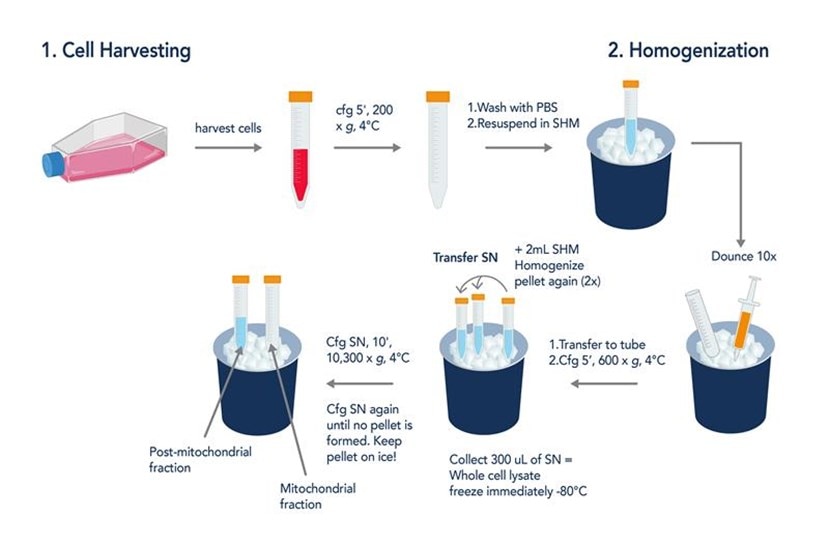
Figure 1: Cell harvesting and homogenization of mammalian cells for subcellular fractionation. Cfg – centrifuge; PBS – phosphate-buffered saline; SHM – sucrose homogenization medium; SN – supernatant.
Important things to keep in mind for a successful subcellular fractionation
-
After washing with phosphate-buffered saline (PBS), maintain all samples and reagents at 4°C to minimize proteolytic activity. Additionally, supplement all buffers with phenylmethylsulfonyl fluoride (PMSF), a serine protease inhibitor that helps prevent protein degradation by blocking enzymatic activity released during cell lysis. This step is crucial to preserve the integrity of proteins for downstream analyses.
-
During douncing, avoid introducing air bubbles to preserve organellar integrity.
-
To increase the yield of the mitochondrial fraction, repeat the homogenization process and the centrifugation for 5 min, at 600 x g, 4°C, and separate the supernatant from the pellet each time. Combine all supernatant fractions after each centrifugation.
-
Collect the whole cell lysate fraction after the homogenization steps have been completed
-
If the only downstream application is Western blot, the samples can be frozen at -80°C. For other applications, it is recommended to isolate the fractions fresh.
Isolation of the Cytosolic and Microsomal Fractions
Following isolation of the post-mitochondrial fraction, ultracentrifugation is performed to separate the cytosolic and microsomal fractions. The microsomal fraction comprises vesicles originating from the rough and smooth endoplasmic reticulum, Golgi apparatus, and plasma membrane. The cytosol remains in the supernatant, while the microsomal fraction sediments as the pellet. This step is shown in Figure 2.
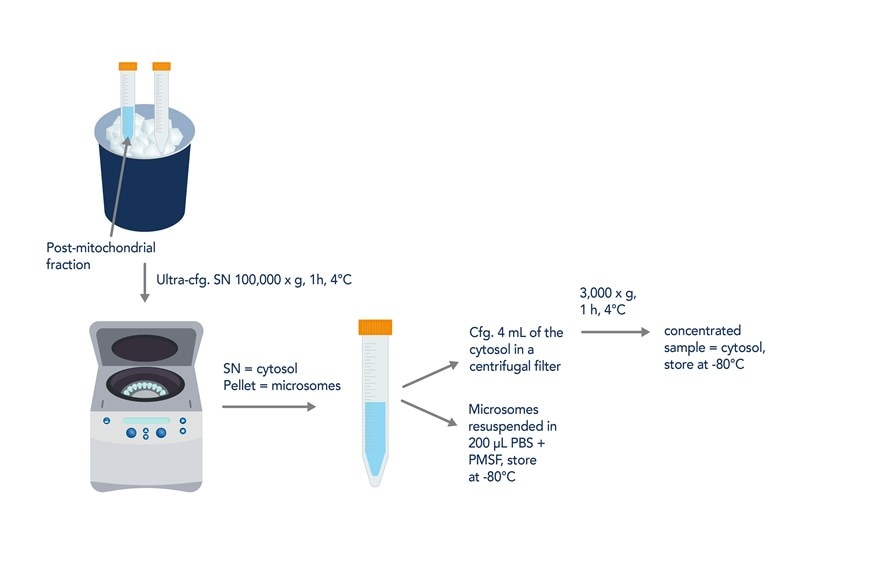
Figure 2: Workflow for isolating the cytosolic and microsomal fractions using ultracentrifugation. Cfg – centrifuge; PBS – phosphate-buffered saline; SHM – sucrose homogenization medium; SN – supernatant.
Tips for the isolation of the cytosol and microsomes
-
When using the ultracentrifuge, it is important to fill up the tubes to prevent collapse under high centrifugal force. If the sample volume is insufficient, top up the tubes with sucrose homogenization medium (SHM) to reach the required fill level. Additionally, be sure to balance opposing tubes by weight to prevent rotor imbalance, which can cause damage to the equipment or compromise the integrity of your samples.
-
For the ultracentrifugation of the cytosolic and microsomal fractions, maximal acceleration and deceleration should be applied.
-
The cytosolic fraction can be concentrated with a centrifugal filter, which is a device that uses centrifugal force to separate components based on molecular weight. The filter is a semi-permeable membrane with a defined molecular weight cutoff, allowing small molecules, like salts, to pass through while retaining larger molecules, such as proteins. By spinning the sample at high speed, the volume is reduced, thereby concentrating the proteins of interest.
Isolation of Mitochondria
Following collection, the mitochondrial pellet is washed in sucrose homogenization buffer and resuspended in Mannitol Buffer A before being layered onto a Percoll gradient. Ultracentrifugation and subsequent wash steps yield a purified mitochondrial fraction suitable for downstream applications, as shown in Figure 3.
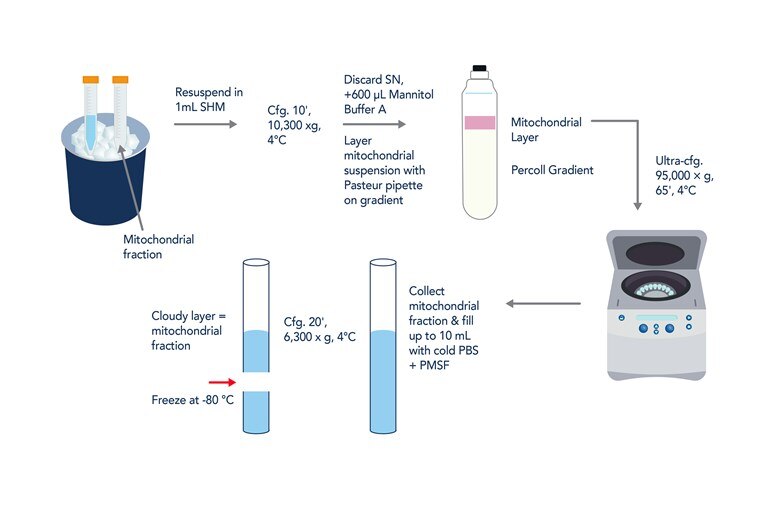
Figure 3: Workflow for isolation of the mitochondrial fraction. Cfg – centrifuge; PBS – phosphate-buffered saline; SHM – sucrose homogenization medium; SN – supernatant; PMSF – phenylmethylsulfonyl fluoride.
Tips for the isolation of mitochondria
-
When working with mitochondrial isolation, it is recommended to use Mannitol A buffer during homogenization and centrifugation steps. This isotonic buffer helps maintain mitochondrial integrity by preventing osmotic swelling, ensuring better preservation of structure and function throughout the fractionation process.
-
For the ultracentrifugation of the mitochondrial fraction, make sure to set the acceleration and deceleration to minimum, to maintain the structural integrity of mitochondria.
-
The mitochondrial fraction is resuspended in Mannitol A Buffer for ultracentrifugation, so it can also be used to balance the tubes if needed.
-
After ultracentrifugation, when collecting the mitochondrial fraction, it is important to pass the sample through a 20-gauge needle. This mechanical shearing helps keep mitochondria and other organelles intact, ensuring efficient release of cellular contents without over-disrupting delicate structures.
-
After isolating the mitochondrial fraction, add PBS supplemented with phenylmethylsulfonyl fluoride (PMSF). The sample is then centrifuged to pellet the intact mitochondria, allowing for removal of remaining debris and supernatant, and yielding a cleaner, more concentrated mitochondrial fraction.
-
During the final stages of mitochondrial isolation using a Percoll gradient, the pure mitochondrial fraction appears as a distinct cloudy layer, typically located above the denser Percoll layer after centrifugation. This layer contains intact, highly enriched mitochondria. The pellet at the bottom of the tube consists primarily of Percoll and cellular debris and should not be collected. Careful extraction of the cloudy mitochondrial layer—without disturbing the underlying Percoll—is essential to maintain the purity of the fraction for downstream applications.
Downstream analysis of subcellular fractions
Western Blot can be used to detect and quantify organelle-specific protein expression using Proteintech’s extensive antibody catalog, including organelle markers (Table 1).
Table 1: Organelle marker antibodies for Western Blot application.
|
Mitochondria |
ER |
Cytosol |
Golgi |
Peroxisomes |
|
Tom40 (OMM) |
||||
|
Tom20 (OMM) |
|
|||
|
Tim23 (IMM) |
||||
|
Cox IV (IMM) |
|
|||
|
|
|
Immunofluorescence (IF) can be used as an alternative validation method for examining the subcellular localization of proteins in the cell under a fluorescence microscope. For this application, Proteintech’s CoraLite conjugated antibodies can be used to stain for the proteins of interest.
Conclusion:
Subcellular fractionation is a powerful technique for dissecting the complex architecture of mammalian cells and investigating the specific localization and function of proteins within distinct cellular compartments. By carefully optimizing each step—from cell lysis to ultracentrifugation—researchers can generate high-purity organelle fractions suitable for detailed molecular analyses. The ability to isolate mitochondria, cytosol, ER, and other compartments opens up a wide range of experimental possibilities, especially when combined with reliable antibodies and reagents (Williamson et al., 2015; Senichkin et al., 2021; Zhou et al., 2023)
Proteintech offers a comprehensive portfolio of validated antibodies, organelle markers, and protein analysis tools that support each stage of subcellular fractionation workflows. Whether you're verifying organelle purity, quantifying protein expression, or mapping protein-protein interactions, Proteintech’s products enable reproducibility and confidence in your results.
References:
Senichkin, V.V., E.A. Prokhorova, B. Zhivostovsky, and G.S. Kopeina. (2021) ‘Simple and Efficient Protocol for Subcellular Fractionation of Normal and Apoptotic Cells,’ Cells, 10(4), p. 852. Available at: https://doi.org/10.3390/cells10040852.
Williamson, C.D., D.S. Wong, P. Bozidis, A. Zhang, and A.M. Colberg-Poley. (2015) ‘Isolation of Endoplasmic Reticulum, Mitochondria, and Mitochondria-Associated Membrane and Detergent Resistant Membrane Fractions from Transfected Cells and from Human Cytomegalovirus-Infected Primary Fibroblasts,’ Current Protocols in Cell Biology, 68(1), p. 3.27.1-3.27.33. Available at: https://doi.org/10.1002/0471143030.cb0327s68.
Zhou, D., S. Zhong, X. Han, D. Liu, H. Fang, and Y. Wang. (2023) ‘Protocol for mitochondrial isolation and sub-cellular localization assay for mitochondrial proteins,’ STAR Protocols, 4(1), p. 102088. Available at: https://doi.org/10.1016/j.xpro.2023.102088.

Related Content
Mitochondria: more than just the powerhouse of the cell
Organelle and Sub-Cellular Markers
Decoding the Mitochondrial Unfolded Protein Response
Support
Newsletter Signup
Stay up-to-date with our latest news and events. New to Proteintech? Get 10% off your first order when you sign up.