
Recombinant Human BTN3A1 protein (His Tag)
Species
Human
Purity
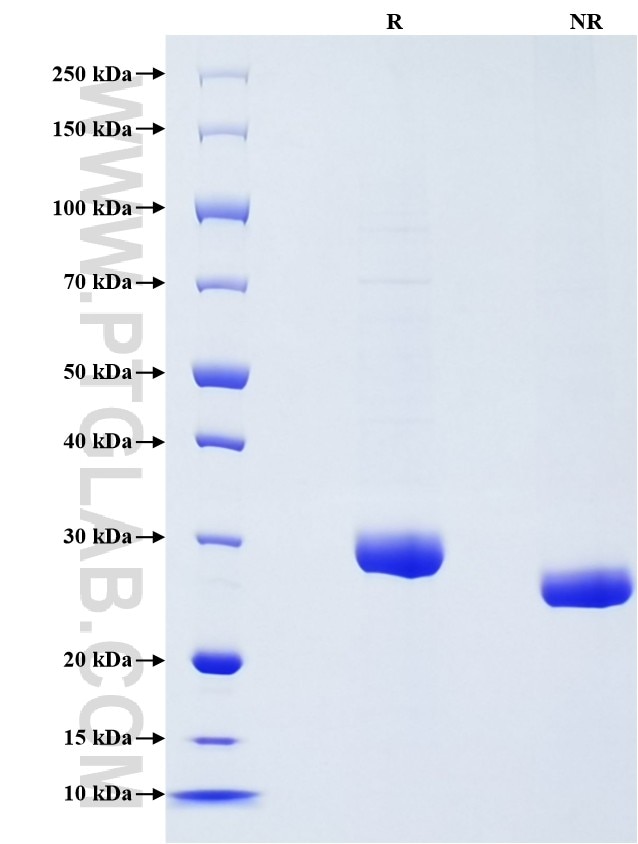
>90 %, SDS-PAGE
Tag
His Tag
Activity
not tested
Cat no : Eg1915
Validation Data Gallery
Product Information
| Purity | >90 %, SDS-PAGE |
| Endotoxin | <0.1 EU/μg protein, LAL method |
| Activity |
Not tested |
| Expression | HEK293-derived Human BTN3A1 protein Gln30-Gly254 (Accession# O00481-1) with a his tag at the C-terminus. |
| GeneID | 11119 |
| Accession | O00481-1 |
| PredictedSize | 25.2 kDa |
| SDS-PAGE | 27-30 kDa, reducing (R) conditions |
| Formulation | Lyophilized from 0.22 μm filtered solution in PBS, pH 7.4. Normally 5% trehalose and 5% mannitol are added as protectants before lyophilization. |
| Reconstitution | Briefly centrifuge the tube before opening. Reconstitute at 0.1-0.5 mg/mL in sterile water. |
| Storage Conditions |
It is recommended that the protein be aliquoted for optimal storage. Avoid repeated freeze-thaw cycles.
|
| Shipping | The product is shipped at ambient temperature. Upon receipt, store it immediately at the recommended temperature. |
Background
BTN3A1, also named as Butyrophilin subfamily 3 member A1, BTF5 or CD277, is a 513 amino acid protein ,which contains one B30.2/SPRY domain and two Ig-like V-type (immunoglobulin-like) domains. BTN3A1 is involved in immunomodulation and binds to various receptors such as the γδ T cell receptor (γδTCR) and small molecules, fulfilling a wide range of functions including immunomodulation, (PMID: 35371078; 32820120). BTN3A1 is also involved in the process of antigen presentation, influencing the recognition and response of immune cells to infections and tumors (PMID: 37989744).
References:
1. Herrmann T. et al. (2022). Front Immunol. 13:876493.
2. Payne KK. et al. (2020). Science. 369(6506):942-949.
3. Hu Y. et al. (2023). Signal Transduct Target Ther. 8(1):434.