
Recombinant Human P21 protein (rFc Tag)
Species
Human
Purity
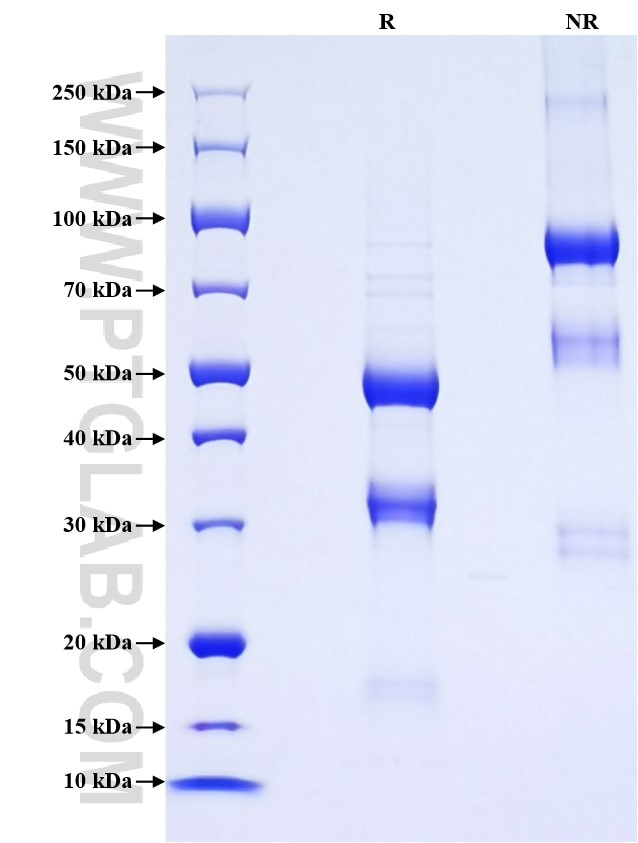
>90 %, SDS-PAGE
Tag
C-rFc
Activity
not tested
Cat no : Eg4802
Validation Data Gallery
Product Information
| Purity | >90 %, SDS-PAGE |
| Endotoxin | <0.1 EU/μg protein, LAL method |
| Activity |
Not tested |
| Expression | HEK293-derived Human P21 protein Met1-Pro164 (Accession# P38936) with a rabbit IgG Fc tag at the C-terminus |
| GeneID | 1026 |
| Accession | P38936 |
| PredictedSize | 44.4 kDa |
| SDS-PAGE | 17 kDa & 30-32 kDa & 45-50 kDa, reducing (R) condition |
| Formulation | Lyophilized from 0.22 μm filtered solution in PBS, pH 7.4. Normally 5% trehalose and 5% mannitol are added as protectants before lyophilization. |
| Reconstitution | Briefly centrifuge the tube before opening. Reconstitute at 0.1-0.5 mg/mL in sterile water. |
| Storage Conditions |
It is recommended that the protein be aliquoted for optimal storage. Avoid repeated freeze-thaw cycles.
|
| Shipping | The product is shipped at ambient temperature. Upon receipt, store it immediately at the recommended temperature. |
Background
P21 (also known as CIP1, WAF1) is a cyclin-dependent kinase inhibitor. P21 binds to and inhibits the activity of cyclin-CDK2 or -CDK4 complexes, and thus functions as a regulator of cell cycle progression at the G1 phase. The expression of P21 is induced by wild-type but not mutant p53 protein, through which P21 mediates the p53-dependent cell cycle G1 phase arrest in response to a variety of stress stimuli. P21 can interact with proliferating cell nuclear antigen (PCNA), and plays a regulatory role in S phase DNA replication and DNA damage repair. P21 was reported to be specifically cleaved by CASP3-like caspases, which thus leads to a dramatic activation of CDK2, and may be instrumental in the execution of apoptosis following caspase activation.
References:
1. Deiry WS. et al.(1994). Cancer Res. 54: 1169-74.
2. Daniel Lew. et al. (2008). Mol Biol Cell. 19: 65-77.
3. Abbas T. et al. (2009). Nat. Rev. Cancer. 9: 400-414.
4. Chang BD. et al. (2002). Proc. Natl. Acad. Sci. U. S. A. 99: 389-394.
5. provided by RefSeq, Jul 2008.