

Product Information
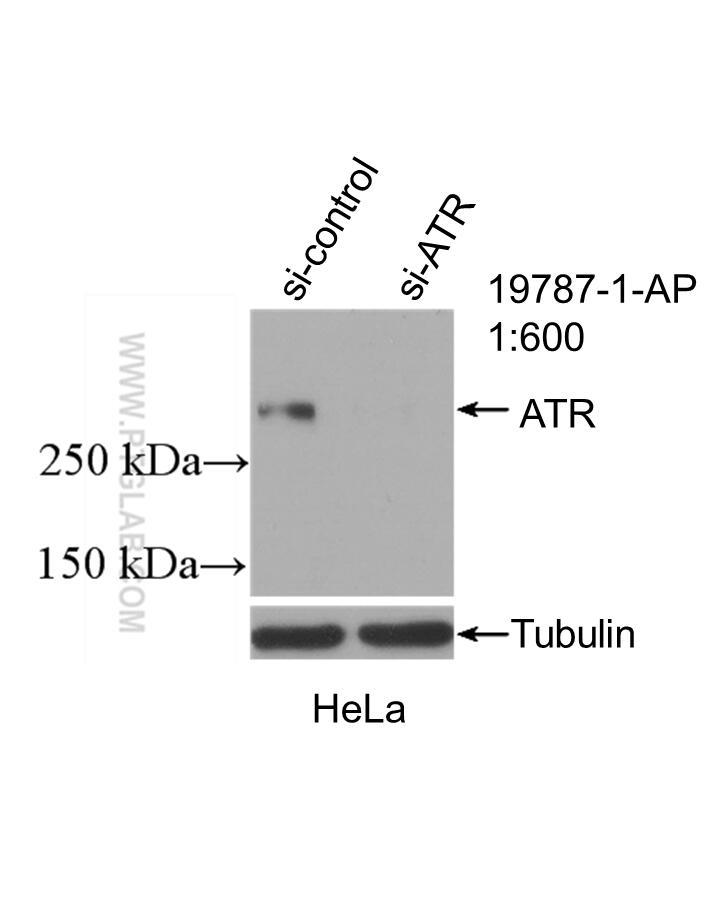
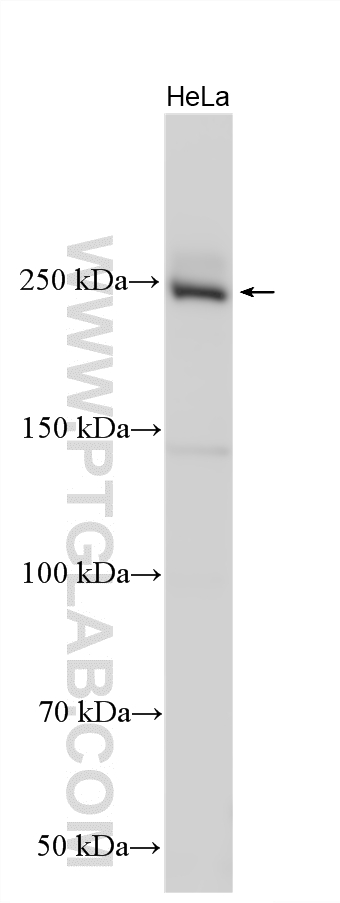
19787-1-PBS targets ATR in WB, Indirect ELISA applications and shows reactivity with human samples.
| Tested Reactivity | human |
| Host / Isotype | Rabbit / IgG |
| Class | Polyclonal |
| Type | Antibody |
| Immunogen |
Peptide Predict reactive species |
| Full Name | ataxia telangiectasia and Rad3 related |
| Calculated Molecular Weight | 301 kDa |
| Observed Molecular Weight | 250-290 kDa |
| GenBank Accession Number | NM_001184 |
| Gene Symbol | ATR |
| Gene ID (NCBI) | 545 |
| RRID | AB_10639516 |
| Conjugate | Unconjugated |
| Form | Liquid |
| Purification Method | Antigen affinity purification |
| UNIPROT ID | Q13535 |
| Storage Buffer | PBS only, pH 7.3. |
| Storage Conditions | Store at -80°C. |
Background Information
ATR, also named as FRP1, belongs to the PI3/PI4-kinase family and ATM subfamily. ATR is a serine/threonine protein kinase which activates checkpoint signaling upon genotoxic stresses such as ionizing radiation (IR), ultraviolet light (UV), or DNA replication stalling, thereby acting as a DNA damage sensor. ATR recognizes the substrate consensus sequence [ST]-Q. ATR phosphorylates BRCA1, CHEK1, MCM2, RAD17, RPA2, SMC1 and TP53/p53, which collectively inhibit DNA replication and mitosis and promote DNA repair, recombination and apoptosis. ATR phosphorylates 'Ser-139' of histone variant H2AX/H2AFX at sites of DNA damage, thereby regulating DNA damage response mechanism. It is required for FANCD2 ubiquitination. It is critical for maintenance of fragile site stability and efficient regulation of centrosome duplication. ATR catalyze the reaction: ATP + a protein = ADP + a phosphoprotein. Defects in ATR are a cause of Seckel syndrome type 1 (SCKL1) which is a rare autosomal recessive disorder characterized by growth retardation, microcephaly with mental retardation, and a characteristic 'bird-headed' facial appearance. The antibody can recognize all the isoforms of ATR.



