
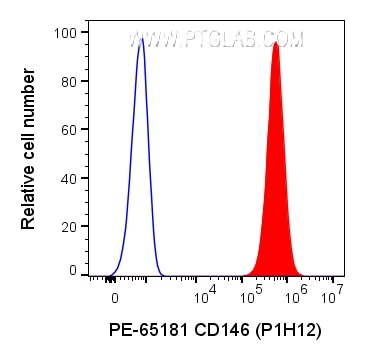
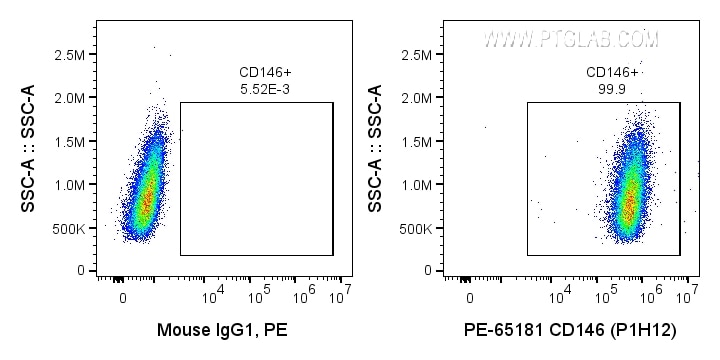

Tested Applications
| Positive FC detected in | A375 cells |
Recommended dilution
| Application | Dilution |
|---|---|
| Flow Cytometry (FC) | FC : 5 ul per 10^6 cells in 100 μl suspension |
| This reagent has been pre-titrated and tested for flow cytometric analysis. The suggested use of this reagent is 5 µl per 10^6 cells in a 100 µl suspension or 5 µl per 100 µl of whole blood. | |
| Sample-dependent, Check data in validation data gallery. | |
Product Information
PE-65181 targets CD146/MCAM in FC applications and shows reactivity with human, mouse, rabbit, canine samples.
| Tested Reactivity | human, mouse, rabbit, canine |
| Cited Reactivity | human |
| Host / Isotype | Mouse / IgG1, kappa |
| Class | Monoclonal |
| Type | Antibody |
| Immunogen |
cultured human umbilical cells Predict reactive species |
| Full Name | melanoma cell adhesion molecule |
| Calculated Molecular Weight | 646 aa, 72 kDa |
| GenBank Accession Number | BC056418 |
| Gene Symbol | CD146 |
| Gene ID (NCBI) | 4162 |
| RRID | AB_2883952 |
| Conjugate | PE Fluorescent Dye |
| Excitation/Emission Maxima Wavelengths | 496 nm, 565 nm / 578 nm |
| Excitation Laser | Blue Laser (488 nm), Green Laser (532 nm), Yellow-Green Laser (561 nm) |
| Form | Liquid |
| Purification Method | The purified antibody is conjugated with R-phycoerythrin (PE) under optimum conditions. The conjugate is purified by size-exclusion chromatography. |
| UNIPROT ID | P43121 |
| Storage Buffer | PBS with 0.09% sodium azide and 0.5% BSA, pH 7.3. |
| Storage Conditions | Store at 2-8°C. Avoid exposure to light. Stable for one year after shipment. |
Background Information
CD146, also known as melanoma cell adhesion molecule (MCAM) or MUC18, originally identified as a biomarker of melanoma progression, is a transmembrane glycoprotein of 113-130 kDa, belonging to the immunoglobulin (Ig) superfamily (PMID: 8378324; 25993332). Structurally, it consists of five Ig domains, a transmembrane domain, and a cytoplasmic region. In normal adult tissue, CD146 is primarily expressed by vascular endothelium and smooth muscle. CD146 is a key cell adhesion protein in vascular endothelial cell activity and angiogenesis, and has been used as marker of circulating endothelium cells (CECs) (PMID: 19356677). In addition to the membrane-anchored form of CD146, a soluble form of CD146 (sCD146, 105 kDa) has also been found in human plasma and in the supernatant of cultured human endothelial cells (PMID: 9462829; 19229070; 16374253; 14597988).
Protocols
| Product Specific Protocols | |
|---|---|
| FC protocol for PE CD146/MCAM antibody PE-65181 | Download protocol |
| Standard Protocols | |
|---|---|
| Click here to view our Standard Protocols |
Publications
What published studies show
PE-65181 is an Anti-Human CD146/MCAM monoclonal antibody (clone P1H12). It has 3 citations appearing in Bioactive Materials, Journal of Tissue Engineering, and Journal of Dental Sciences. The associated research fields include dental pulp stem cell biology, Schwann cell pyroptosis and facial nerve regeneration, odontogenic differentiation, and osteogenic differentiation of periodontal ligament stem cells, collectively spanning oral/dental tissue engineering and regenerative medicine.
| Species | Application | Title |
|---|---|---|
Bioact Mater Dental pulp stem cells alleviate Schwann cell pyroptosis via mitochondrial transfer to enhance facial nerve regeneration | ||
J Tissue Eng Enhanced effects of antagomiR-3074-3p-conjugated PEI-AuNPs on the odontogenic differentiation by targeting FKBP9 | ||
J Dent Sci N-acetylcysteine promotes cyclic mechanical stress-induced osteogenic differentiation of periodontal ligament stem cells by down-regulating Nrf2 expression. |



