
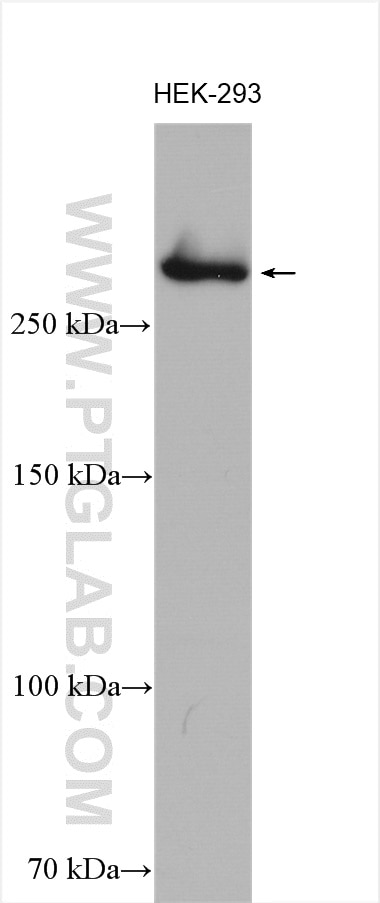
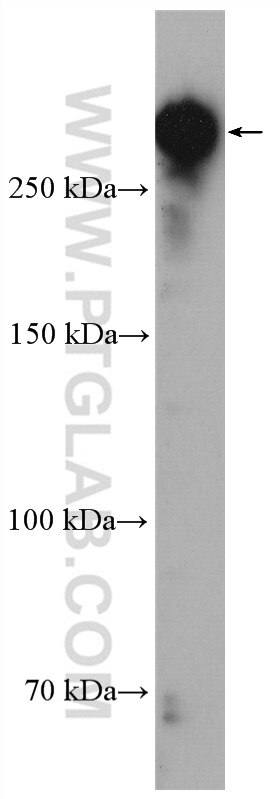
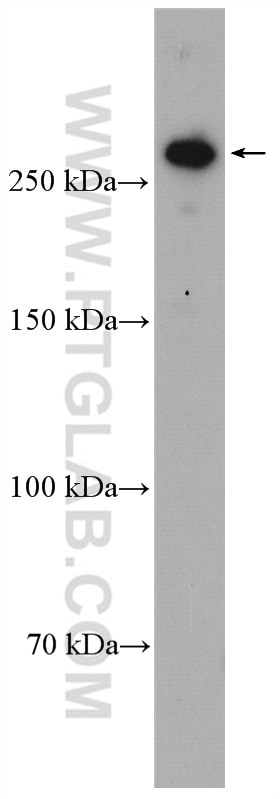
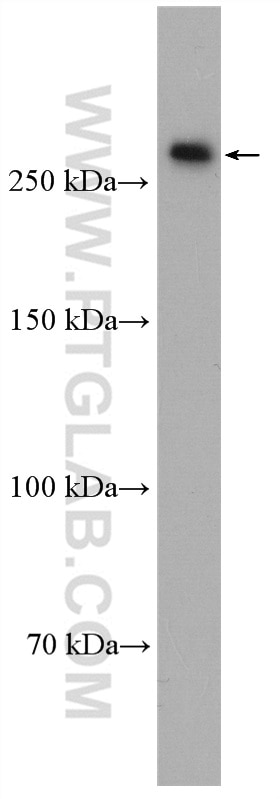
Tested Applications
| Positive WB detected in | HEK-293 cells, HeLa cells, HepG2 cells |
Recommended dilution
| Application | Dilution |
|---|---|
| Western Blot (WB) | WB : 1:1000-1:4000 |
| It is recommended that this reagent should be titrated in each testing system to obtain optimal results. | |
| Sample-dependent, Check data in validation data gallery. | |
Published Applications
| WB | See 5 publications below |
| IHC | See 5 publications below |
Product Information
28142-1-AP targets CENPE in WB, IHC, ELISA applications and shows reactivity with human samples.
| Tested Reactivity | human |
| Cited Reactivity | human, mouse |
| Host / Isotype | Rabbit / IgG |
| Class | Polyclonal |
| Type | Antibody |
| Immunogen |
CatNo: Ag27230 Product name: Recombinant human CENPE protein Source: e coli.-derived, PGEX-4T Tag: GST Domain: 2401-2500 aa of NM_001286734 Sequence: MESKIIKMQKELEVTNDIIAKLQAKVHESNKCLEKTKETIQVLQDKVALGAKPYKEEIEDLKMKLVKIDLEKMKNAKEFEKEISATKATVEYQKEVIRLLR Predict reactive species |
| Full Name | centromere protein E, 312kDa |
| Calculated Molecular Weight | 316 kDa |
| Observed Molecular Weight | 300-316 kDa |
| GenBank Accession Number | NM_001286734 |
| Gene Symbol | CENPE |
| Gene ID (NCBI) | 1062 |
| RRID | AB_2881072 |
| Conjugate | Unconjugated |
| Form | Liquid |
| Purification Method | Antigen affinity purification |
| UNIPROT ID | Q02224 |
| Storage Buffer | PBS with 0.02% sodium azide and 50% glycerol, pH 7.3. |
| Storage Conditions | Store at -20°C. Stable for one year after shipment. Aliquoting is unnecessary for -20oC storage. 20ul sizes contain 0.1% BSA. |
Background Information
Centromeric protein E (CENPE) is also named Kinesin-7. CENPE, a member of the centromere protein (CENP) family, functions as a microtubule plus-end directed motor protein that is upregulated during the G2 phase (PMID: 31115500, PMID: 7851898, PMID: 38560520). It plays a crucial role in the spindle assembly checkpoint (SAC), chromosome alignment, and microtubule capture at kinetochores during mitosis (PMID: 30784092). CENPE is essential for mitotic white matter, which accumulates during the G2 phase of the cell cycle, is consumed throughout mitosis and degrades later in the cell cycle (PMID: 33862458). CENPE regulates the cell cycle by targeting the transcription of CDK1 in the nucleus (PMID: 33862458). Studies on tumor cells have shown that CENPE plays an important role in the regulation of cell proliferation, apoptosis, migration and other activities (PMID: 33862458).
Protocols
| Product Specific Protocols | |
|---|---|
| WB protocol for CENPE antibody 28142-1-AP | Download protocol |
| Standard Protocols | |
|---|---|
| Click here to view our Standard Protocols |
Publications
| Species | Application | Title |
|---|---|---|
Biochim Biophys Acta Mol Cell Res Kinesin-7 CENP-E is essential for chromosome alignment and spindle assembly of mouse spermatocytes. | ||
Am J Transl Res Kinesin family members KIF2C/4A/10/11/14/18B/20A/23 predict poor prognosis and promote cell proliferation in hepatocellular carcinoma. | ||
Curr Res Transl Med Identifying potential prognosis markers in relapsed multiple myeloma via integrated bioinformatics analysis and biological experiments | ||
Cancer Cell Int Characterization of G2/M checkpoint classifier for personalized treatment in uterine corpus endometrial carcinoma | ||
J Cancer Development and Validation of the novel Cuproptosis- and Immune-related Signature for Predicting Prognosis in Hepatocellular Carcinoma | ||
IET Syst Biol Mechanistic Investigation of Nitidine Chloride-Mediated Anti-Colorectal Cancer Activity: Centromere-Associated Protein E Targeting via Integrated Molecular Dynamics, Spatial Transcriptomic and Single-Cell Approaches. |





