
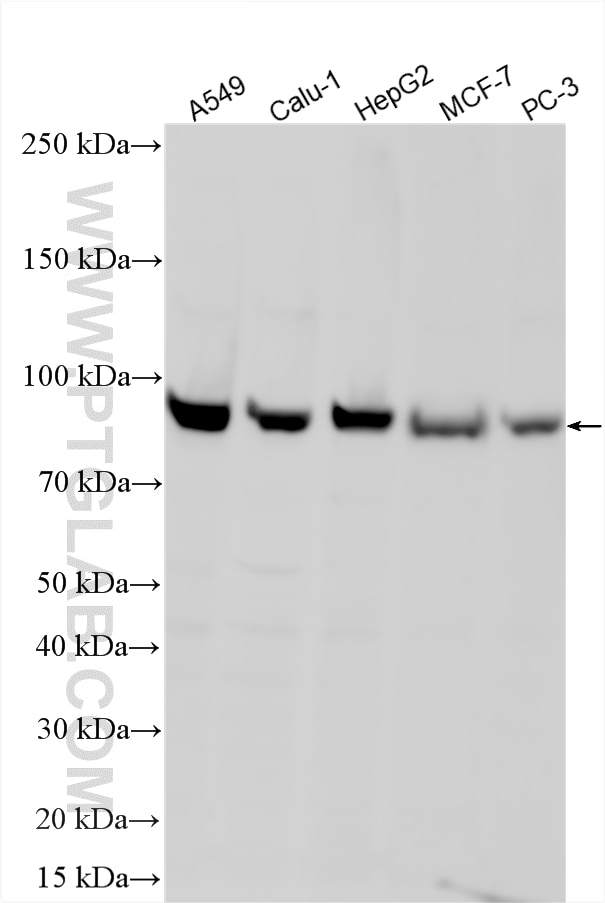



Tested Applications
| Positive WB detected in | A549 cells, HeLa cells, Calu-1 cells, HepG2 cells, MCF-7 cells, PC-3 cells, Jurkat cells |
| Positive IF/ICC detected in | HepG2 cells |
Recommended dilution
| Application | Dilution |
|---|---|
| Western Blot (WB) | WB : 1:1000-1:6000 |
| Immunofluorescence (IF)/ICC | IF/ICC : 1:50-1:500 |
| It is recommended that this reagent should be titrated in each testing system to obtain optimal results. | |
| Sample-dependent, Check data in validation data gallery. | |
Product Information
26466-1-AP targets GLE1 in WB, IF/ICC, ELISA applications and shows reactivity with human samples.
| Tested Reactivity | human |
| Cited Reactivity | human |
| Host / Isotype | Rabbit / IgG |
| Class | Polyclonal |
| Type | Antibody |
| Immunogen |
CatNo: Ag24208 Product name: Recombinant human GLE1 protein Source: e coli.-derived, PGEX-4T Tag: GST Domain: 1-118 aa of BC030012 Sequence: MPSEGRCWETLKALRSSDKGRLCYYRDWLLRREDVLEECMSLPKLSSYSGWVVEHVLPHMQENQPLSETSPSSTSASALDQPSFVPKSPDASSAFSPASPATPNGTKGKDESQHTESM Predict reactive species |
| Full Name | GLE1 RNA export mediator homolog (yeast) |
| Calculated Molecular Weight | 80 kDa |
| Observed Molecular Weight | 79-80 kDa |
| GenBank Accession Number | BC030012 |
| Gene Symbol | GLE1 |
| Gene ID (NCBI) | 2733 |
| RRID | AB_2880525 |
| Conjugate | Unconjugated |
| Form | Liquid |
| Purification Method | Antigen affinity purification |
| UNIPROT ID | Q53GS7 |
| Storage Buffer | PBS with 0.02% sodium azide and 50% glycerol, pH 7.3. |
| Storage Conditions | Store at -20°C. Stable for one year after shipment. Aliquoting is unnecessary for -20oC storage. 20ul sizes contain 0.1% BSA. |
Protocols
| Product Specific Protocols | |
|---|---|
| IF protocol for GLE1 antibody 26466-1-AP | Download protocol |
| WB protocol for GLE1 antibody 26466-1-AP | Download protocol |
| Standard Protocols | |
|---|---|
| Click here to view our Standard Protocols |
Publications
What published studies show
The GLE1 Polyclonal antibody (Cat# 26466-1-AP) has 2 total citations. One appears in Cancer Discovery (2025), studying the antitumor mechanism of a selective degrader of the nuclear pore complex, using WB in human samples. The other is in Journal of Inflammation Research (2025), developing a diagnostic model of hub genes related to lipid metabolism in chronic rhinosinusitis, using IF in human samples. The associated research fields are cancer biology/nuclear pore complex degradation and inflammatory disease/lipid metabolism.
| Species | Application | Title |
|---|---|---|
Cancer Discov Defining the Antitumor Mechanism of Action of a Clinical-stage Compound as a Selective Degrader of the Nuclear Pore Complex. | ||
J Inflamm Res An Integrated Machine Learning Framework for Developing and Validating a Diagnostic Model of Hub Genes Related to Lipid Metabolism in Chronic Rhinosinusitis |
Reviews
What customers say
Able is busy answering your previous question. Please try again later.
The reviews below have been submitted by verified Proteintech customers who received an incentive for providing their feedback.
Rashmi (Verified Customer) (09-25-2024) | Excellent Product
|



