
"GST Tag Antibodies" Comparison
View side-by-side comparison of GST Tag antibodies from other vendors to find the one that best suits your research needs.

Tested Applications
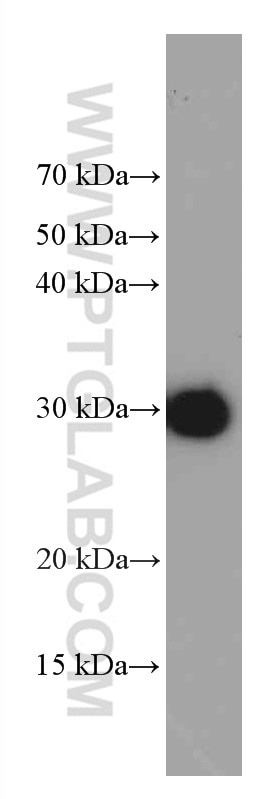
| Positive WB detected in | Recombinant protein |
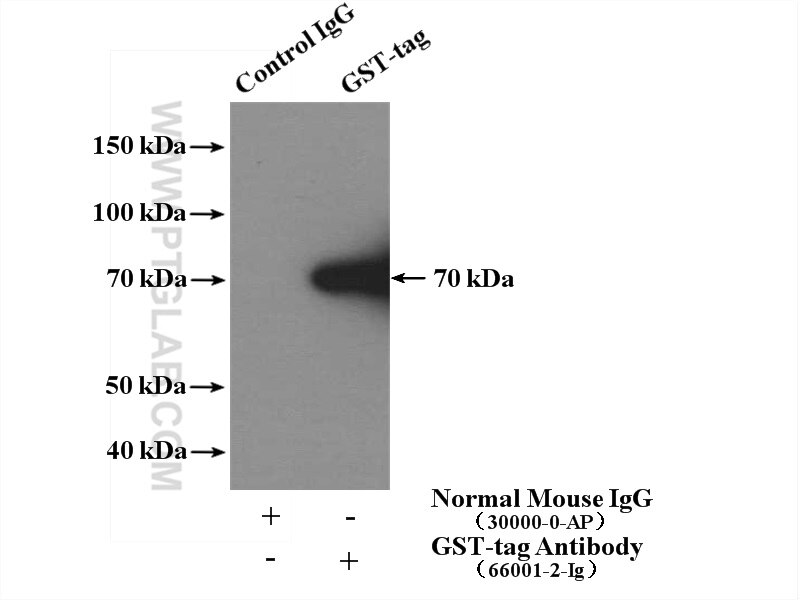
| Positive IP detected in | E. coli lysate |
Recommended dilution
| Application | Dilution |
|---|---|
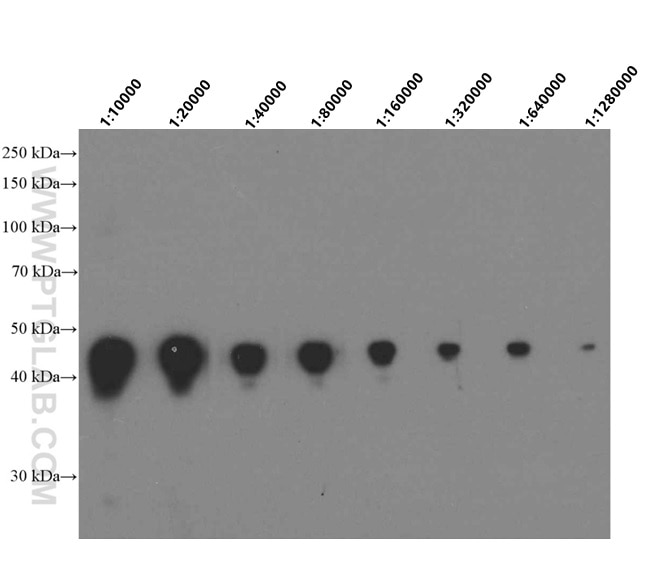
| Western Blot (WB) | WB : 1:5000-1:50000 |
| Immunoprecipitation (IP) | IP : 0.5-4.0 ug for 1.0-3.0 mg of total protein lysate |
| It is recommended that this reagent should be titrated in each testing system to obtain optimal results. | |
| Sample-dependent, Check data in validation data gallery. | |
Product Information
66001-2-Ig targets GST Tag in WB, IF, IP, CoIP, ChIP, ELISA applications and shows reactivity with Recombinant protein, Schistosoma japonicum samples.
| Tested Reactivity | Recombinant protein, Schistosoma japonicum |
| Cited Reactivity | human |
| Host / Isotype | Mouse / IgG2a |
| Class | Monoclonal |
| Type | Antibody |
| Immunogen |
Recombinant protein Predict reactive species |
| Full Name | GST Tag |
| Calculated Molecular Weight | 26 kDa |
| GenBank Accession Number | FN315687 |
| Gene Symbol | |
| Gene ID (NCBI) | |
| RRID | AB_2881488 |
| Conjugate | Unconjugated |
| Form | Liquid |
| Purification Method | Protein A purification |
| Storage Buffer | PBS with 0.02% sodium azide and 50% glycerol, pH 7.3. |
| Storage Conditions | Store at -20°C. Stable for one year after shipment. Aliquoting is unnecessary for -20oC storage. 20ul sizes contain 0.1% BSA. |
Background Information
Protein tags are protein or peptide sequences located either on the C- or N- terminal of the target protein, which facilitates one or several of the following characteristics: solubility, detection, purification, localization and expression. GST (Glutathione S-Transferase) is a widely used protein tag encoded by the Schistosoma japonicum. GST provides both an easily detectable tag and a simple purification process with little effect on the biological function of the protein of interest. Antibodies to GST are useful for checking protein expression both in plaques and on Western blots as well as for immunoaffinity purification of proteins expressed in cells. This antibody recognizes the GST-tag fused to either the N- or C-terminus of targeted proteins.
Protocols
| Product Specific Protocols | |
|---|---|
| IP protocol for GST Tag antibody 66001-2-Ig | Download protocol |
| WB protocol for GST Tag antibody 66001-2-Ig | Download protocol |
| Standard Protocols | |
|---|---|
| Click here to view our Standard Protocols |
Publications
What published studies show
The ATG7 antibody (catalog 66001-2-Ig) has 265 citations. These appear across high-impact journals including Cell Metabolism, Nature Communications, Nature Cell Biology, Cell Reports, Autophagy, Cell Death & Differentiation, Plant Cell, and Science Advances. Research fields span autophagy, cancer biology, plant physiology, neurodegeneration (Alzheimer's/Parkinson's), metabolism, and immunology. Applications are predominantly Western blot, with immunoprecipitation and co-IP also common, reflecting its broad utility as a reliable autophagy marker.
| Species | Application | Title |
|---|---|---|
Cell Metab Aerobic glycolysis promotes tumor immune evasion by hexokinase2-mediated phosphorylation of IκBα | ||
Cell Metab Foxp3 confers long-term efficacy of chimeric antigen receptor-T cells via metabolic reprogramming | ||
Cell Metab Hepatic FXR-FGF4 is required for bile acid homeostasis via an FGFR4-LRH-1 signal node under cholestatic stress | ||
Mol Plant The histone methyltransferase SUVR2 promotes DSB repair via chromatin remodeling and liquid-liquid phase separation. | ||
Cell Res Targeting PTPN13 with 11-amino-acid peptides of C-terminal APC prevents immune evasion of colorectal cancer. | ||
Immunity Lactate binds and inhibits the innate immune sensor STING to promote tumor immune evasion. |
Reviews
What customers say
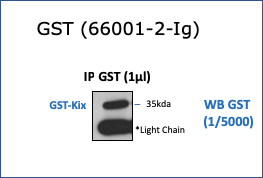
Customers report excellent performance for Western Blot and Immunoprecipitation applications. One user achieved clear signal with no background on E. coli lysate at a 1:30,000 dilution. Another provided a detailed WB protocol using a 1:5,000 dilution for GST protein detection on PVDF membranes. A third user confirmed successful use for both IP (1 µl) and WB (1:5,000) in in vitro experiments. Overall, reviewers highlight strong specificity, low background, and reliable detection of GST-tagged proteins across a wide dilution range.
The reviews below have been submitted by verified Proteintech customers who received an incentive for providing their feedback.
Lana (Verified Customer) (05-27-2022) | SDS-PAGE: 4-12% Bis-Tris gradient gel. Transfer: Immobilon-FL transfer membranes (Millipore) O/N at 30V, 4C. Blocking: SEA Block Blocking Buffer 1h, room T. Primary Ab: O/N incubation at 4C, 1:1000. Secondary Ab: IRDye 680LT Goat anti-Mouse, 1:15000. Lines of WB image: 1 – protein ladder, 2 and 3 – GST protein different amounts.
 |
Susanne (Verified Customer) (11-18-2021) | Clear Signal, no background on E.coli lysate with expressed GST blotted on PVDF membrane
|
Aurelie (Verified Customer) (12-11-2018) |
 |




