
Recombinant Human CCL13 protein (rFc Tag)
Species
Human
Purity
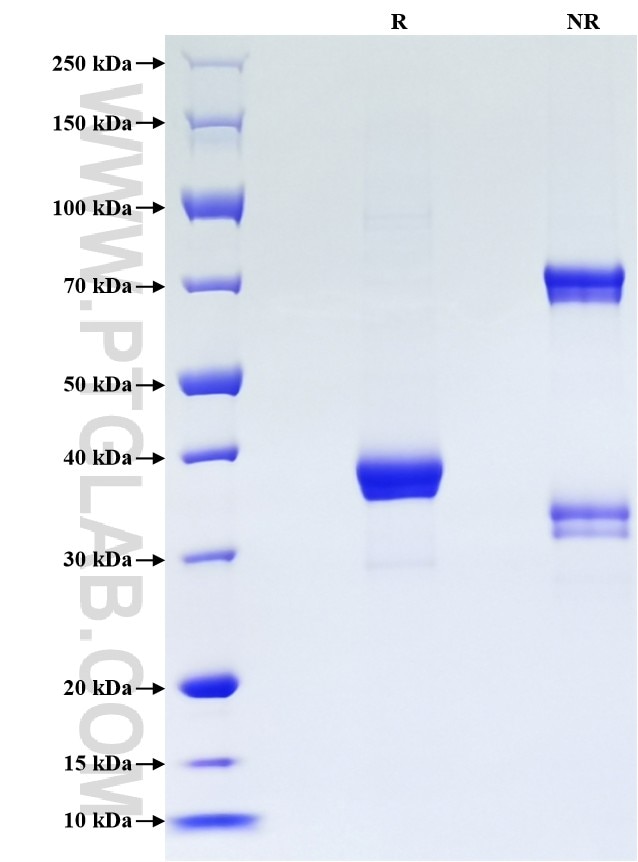
>90 %, SDS-PAGE
Tag
rFc Tag
Activity
not tested
Cat no : Eg2818
Validation Data Gallery
Product Information
| Purity | >90 %, SDS-PAGE |
| Endotoxin | <0.1 EU/μg protein, LAL method |
| Activity |
Not tested |
| Expression | HEK293-derived Human CCL13 protein Gln24-Thr98 (Accession# Q99616) with a rabbit IgG Fc tag at the C-terminus. |
| GeneID | 6357 |
| Accession | Q99616 |
| PredictedSize | 34.6 kDa |
| SDS-PAGE | 36-40 kDa, reducing (R) conditions |
| Formulation | Lyophilized from 0.22 μm filtered solution in 30mM Tris,500mM Arginine, pH 8.0. Normally 5% trehalose and 5% mannitol are added as protectants before lyophilization. |
| Reconstitution | Briefly centrifuge the tube before opening. Reconstitute at 0.1-0.5 mg/mL in sterile water. |
| Storage Conditions |
It is recommended that the protein be aliquoted for optimal storage. Avoid repeated freeze-thaw cycles.
|
| Shipping | The product is shipped at ambient temperature. Upon receipt, store it immediately at the recommended temperature. |
Background
CCL13 (MCP-4)is asecreted C–C chemokinethat recruitsmonocytes, eosinophils, and T cellsto inflammatory sites viaCCR2/CCR3/CCR5 signaling. It plays key roles inallergic inflammation,fibrosis, andimmune cell trafficking, linking innate and adaptive immune responses. Dysregulated CCL13 expression contributes toasthma, autoimmune inflammation, and tumor microenvironment remodeling, underscoring its function as both achemotactic mediatorandpro-fibrotic cytokine.
References:
1. Li, Laifu et al. Frontiers in immunology vol. 14 1176639. 19 Apr. 2023, doi:10.3389/fimmu.2023.1176639
2. Mendez-Enriquez, E, and E A García-Zepeda. Inflammopharmacology vol. 21,6 (2013): 397-406. doi:10.1007/s10787-013-0177-5
3. Wang, Dan et al. Experimental dermatology vol. 30,5 (2021): 723-732. doi:10.1111/exd.14293
4. Yanaba, K et al. The British journal of dermatology vol. 162,2 (2010): 332-6. doi:10.1111/j.1365-2133.2009.09507.x
5. Iwamoto, T et al. Rheumatology (Oxford, England) vol. 45,4 (2006): 421-4. doi:10.1093/rheumatology/kei209
6. Hintzen, Christoph et al. Arthritis and rheumatism vol. 60,7 (2009): 1932-43. doi:10.1002/art.24602