
Recombinant Human Complement component C7/C7 protein (His Tag)
Species
Human
Purity
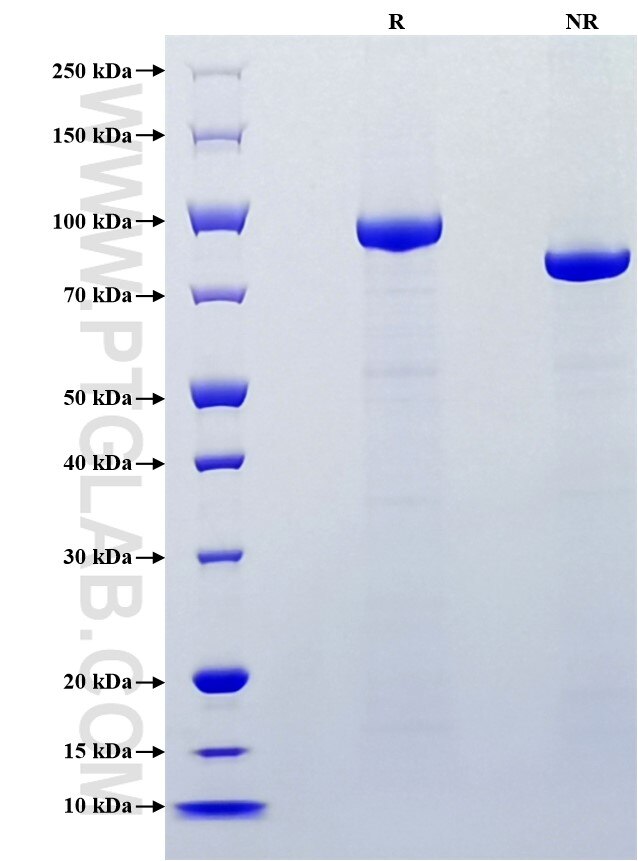
>90 %, SDS-PAGE
Tag
His Tag
Activity
not tested
Cat no : Eg1202
Validation Data Gallery
Product Information
| Purity | >90 %, SDS-PAGE |
| Endotoxin | <0.1 EU/μg protein, LAL method |
| Activity |
Not tested |
| Expression | HEK293-derived Human Complement component C7 protein Ser23-Gln843 (Accession# P10643) with a his tag at the C-terminus. |
| GeneID | 730 |
| Accession | P10643 |
| PredictedSize | 92.2 kDa |
| SDS-PAGE | 85-100 kDa, reducing (R) conditions |
| Formulation | Lyophilized from 0.22 μm filtered solution in PBS, pH 7.4. Normally 5% trehalose and 5% mannitol are added as protectants before lyophilization. |
| Reconstitution | Briefly centrifuge the tube before opening. Reconstitute at 0.1-0.5 mg/mL in sterile water. |
| Storage Conditions |
It is recommended that the protein be aliquoted for optimal storage. Avoid repeated freeze-thaw cycles.
|
| Shipping | The product is shipped at ambient temperature. Upon receipt, store it immediately at the recommended temperature. |
Background
The complement system is an important effector that bridges the innate and adaptive immune systems (PMID: 20010915). Complement component 7 (C7) is a single-chain plasma glycoprotein that is the final product of the complement cascade and plays a central role in the activation of the complement system. It is a constituent of the membrane attack complex (MAC) that plays a key role in the innate and adaptive immune response by forming pores in the plasma membrane of target cells (PMID: 10886232; PMID: 27852032). C7 is a potential tumor suppressor and a prognostic biomarker for prostate cancer and renal cell carcinoma (PMID: 32984006; PMID: 33158953). C7 serves as a membrane anchor. People with C7 deficiency are prone to bacterial infection (PMID: 19758139).
References:
1. Dunkelberger, Jason R, and Wen-Chao Song. Cell research vol. 20,1 (2010): 34-50.
2. Würzner, R. Clinical and experimental immunology vol. 121,1 (2000): 8-10.
3. Ying, Lisha et al. Oncotarget vol. 7,52 (2016): 86536-86546.
4. Chen, Zhao et al. Frontiers in oncology vol. 10 1532. 25 Aug. 2020
5. Reese, Britney et al. “Complement as Prognostic Biomarker and Potential Therapeutic Target in Renal Cell Carcinoma.” Journal of immunology (Baltimore, Md. : 1950) vol. 205,11 (2020): 3218-3229. doi:10.4049/jimmunol.2000511
6. Pettigrew, H David et al. “Clinical significance of complement deficiencies.” Annals of the New York Academy of Sciences vol. 1173 (2009): 108-23. doi:10.1111/j.1749-6632.2009.04633.x