
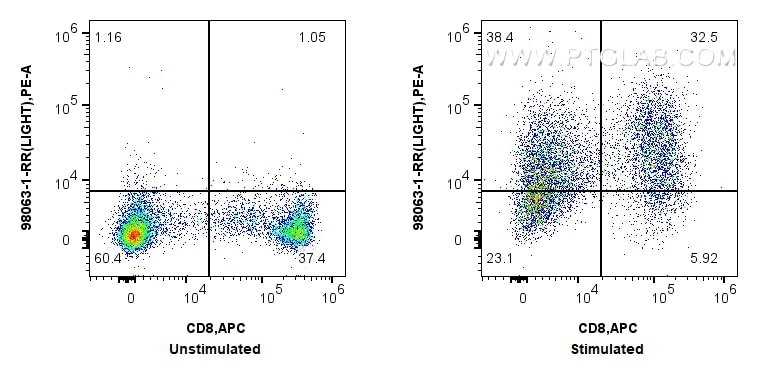
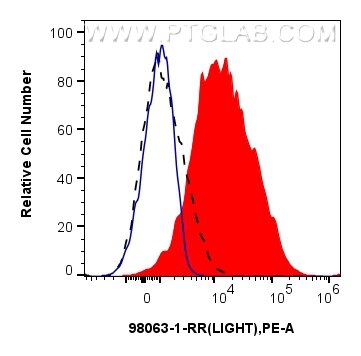

Tested Applications
| Positive FC detected in | PMA, Ionomycin and Brefeldin A treated human PBMCs |
Recommended dilution
| Application | Dilution |
|---|---|
| Flow Cytometry (FC) | FC : 0.25 ug per 10^6 cells in 100 μl suspension |
| This reagent has been tested for flow cytometric analysis. It is recommended that this reagent should be titrated in each testing system to obtain optimal results. | |
| Sample-dependent, Check data in validation data gallery. | |
Product Information
98063-1-RR targets LIGHT/CD258 in FC applications and shows reactivity with human samples.
| Tested Reactivity | human |
| Host / Isotype | Rabbit / IgG |
| Class | Recombinant |
| Type | Antibody |
| Immunogen |
Fusion Protein Predict reactive species |
| Full Name | tumor necrosis factor (ligand) superfamily, member 14 |
| Calculated Molecular Weight | 26KD |
| GenBank Accession Number | NM_003807 |
| Gene Symbol | LIGHT |
| Gene ID (NCBI) | 8740 |
| RRID | AB_3672210 |
| Conjugate | Unconjugated |
| Form | Liquid |
| Purification Method | Protein A purification |
| UNIPROT ID | O43557 |
| Storage Buffer | PBS with 0.09% sodium azide, pH 7.3. |
| Storage Conditions | Store at 2 - 8°C. Stable for one year after shipment. |
Background Information
LIGHT, also known as TNFSF14, HVEML, or CD258, is a type II transmembrane protein that belongs to the TNF superfamily (PMID: 9462508). It is predominantly expressed in lymphoid tissues and produced by activated T cells and immature dendritic cells (DCs) (PMID: 9462508; 10754304). Through its two primary functional receptors HVEM (TNFRSF14) and lymphotoxin β receptor (LTβR), LIGHT signaling is involved in development and maintenance of lymphoid tissues, as well as innate and adaptive immune responses (PMID: 24575096; 26720335). In addition to the membrane form, LIGHT can also exist as a soluble form generated by cleavage of the extracellular portion of the membrane form.
Protocols
| Product Specific Protocols | |
|---|---|
| FC protocol for LIGHT/CD258 antibody 98063-1-RR | Download protocol |
| Standard Protocols | |
|---|---|
| Click here to view our Standard Protocols |




