
Recombinant Mouse BMP-9 protein (rFc Tag)
Species
Mouse
Purity
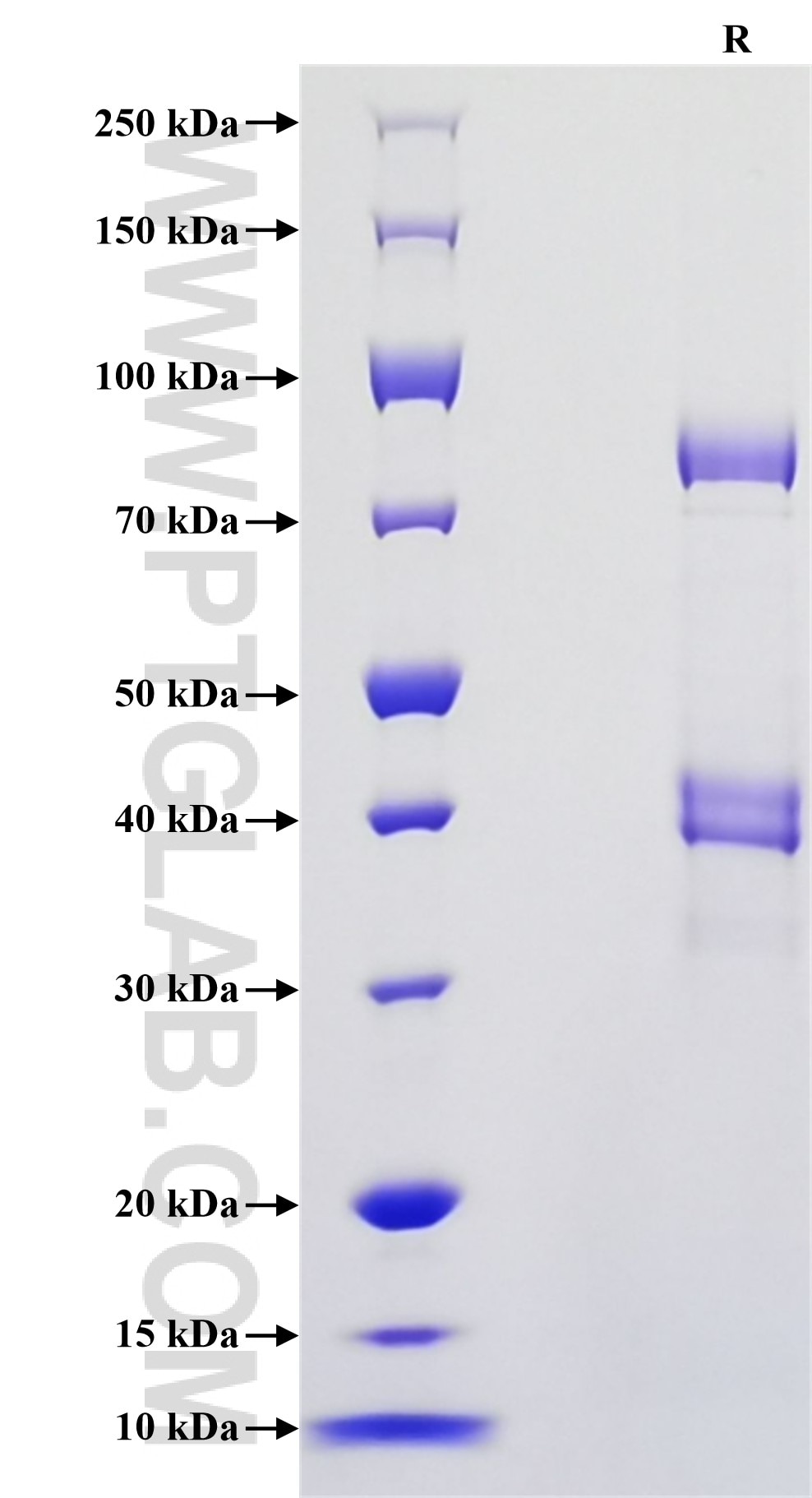
>90 %, SDS-PAGE
Tag
rFc Tag
Activity
not tested
Cat no : Eg2482
Validation Data Gallery
Product Information
| Purity | >90 %, SDS-PAGE |
| Endotoxin | <0.1 EU/μg protein, LAL method |
| Activity |
Not tested |
| Expression | HEK293-derived Mouse BMP-9 protein Lys23-Arg428 (Accession# Q9WV56) with a rabbit IgG Fc tag at the C-terminus. |
| GeneID | 12165 |
| Accession | Q9WV56 |
| PredictedSize | 70.9 kDa |
| SDS-PAGE | 38-44 kDa and 77-90 kDa, reducing (R) conditions |
| Formulation | Lyophilized from 0.22 μm filtered solution in PBS, pH 7.4. Normally 5% trehalose and 5% mannitol are added as protectants before lyophilization. |
| Reconstitution | Briefly centrifuge the tube before opening. Reconstitute at 0.1-0.5 mg/mL in sterile water. |
| Storage Conditions |
It is recommended that the protein be aliquoted for optimal storage. Avoid repeated freeze-thaw cycles.
|
| Shipping | The product is shipped at ambient temperature. Upon receipt, store it immediately at the recommended temperature. |
Background
Bone Morphogenetic Protein 9 (BMP9), also known as Growth Differentiation Factor 2 (GDF-2), is a cytokine belonging to the transforming growth factor-β (TGF-β) superfamily. BMP9 is mainly produced by hepatocytes and hepatic stellate cells in the liver and is secreted into the bloodstream, where it acts as a circulating factor involved in various physiological processes. BMP9 is synthesized as a precursor protein (pre-proBMP9) composed of 429 amino acids (aa) that includes a 22 aa signal peptide, a 297 aa prodomain (33 kDa) and a 110 aa mature protein (12.5 kDa). It is then cleaved by serine endoproteases, leading to a short dimeric mature form of 25 kDa, and the prodomain which can remain noncovalently associated with the mature short form, giving a size of about 100 kDa.
References:
1. Bidart, Marie et al. Cellular and molecular life sciences : CMLS vol. 69,2 (2012): 313-24.
2. Song, J J et al. Endocrinology vol. 136,10 (1995): 4293-7.
3. Nolan-Stevaux, Olivier et al. PloS one vol. 7,12 (2012): e50920.