

Product Information
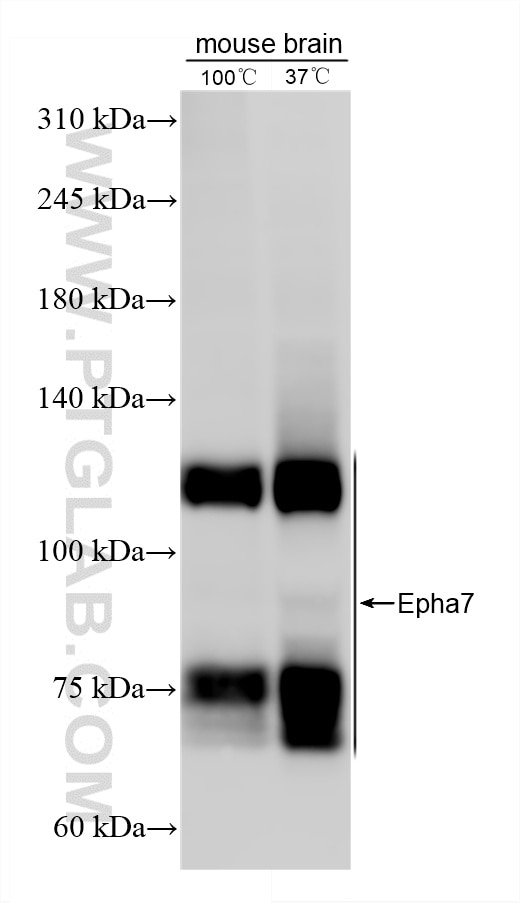
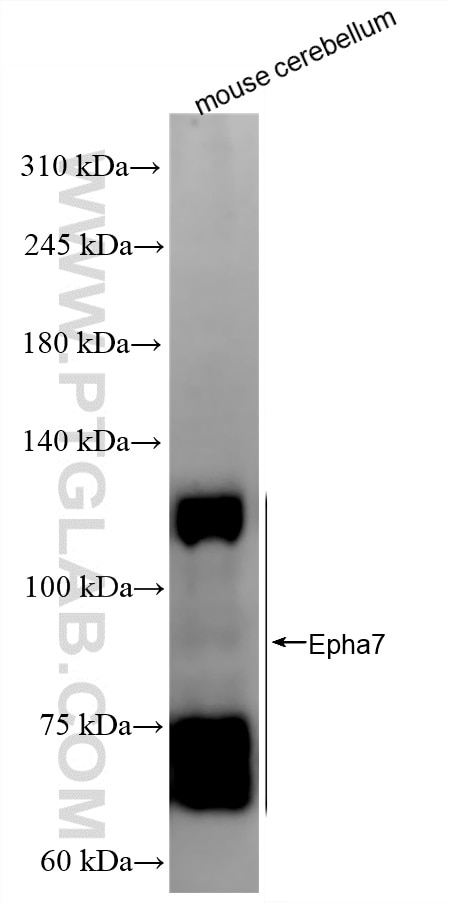
87966-1-PBS targets Epha7 in WB, Indirect ELISA applications and shows reactivity with mouse samples.
| Tested Reactivity | mouse |
| Host / Isotype | Rabbit / IgG |
| Class | Recombinant |
| Type | Antibody |
| Immunogen |
CatNo: Eg8773 Product name: Recombinant mouse Epha7 protein Source: mammalian cells-derived, V37 Tag: C-rFc Domain: 28-555 aa of NM_010141.4 Sequence: QAAKEVLLLDSKAQQTELEWISSPPSGWEEISGLDENYTPIRTYQVCQVMEPNQNNWLRTNWISKGNAQRIFVELKFTLRDCNSLPGVLGTCKETFNLYYYETDYDTGRNIRENLYVKIDTIAADESFTQGDLGERKMKLNTEVREIGPLSKKGFYLAFQDVGACIALVSVKVYYKKCWSIVENLAVFPDTVTGSEFSSLVEVRGTCVSSAEEEAENSPRMHCSAEGEWLVPIGKCICKAGYQQKGDTCEPCGRRFYKSSSQDLQCSRCPTHSFSDREGSSRCECEDGYYRAPSDPPYVACTRPPSAPQNLIFNINQTTVSLEWSPPADNGGRNDVTYRILCKRCSWEQGECVPCGSNIGYMPQQTGLEDNYVTVMDLLAHANYTFEVEAVNGVSDLSRSQRLFAAVSITTGQAAPSQVSGVMKERVLQRSVQLSWQEPEHPNGVITEYEIKYYEKDQRERTYSTLKTKSTSASINNLKPGTVYVFQIRAVTAAGYGNYSPRLDVATLEEASGKMFEATAVSSEQNPV Predict reactive species |
| Full Name | Eph receptor A7 |
| Calculated Molecular Weight | 112 kDa |
| Observed Molecular Weight | 75 kDa, 120 kDa |
| GenBank Accession Number | NM_010141.4 |
| Gene Symbol | Epha7 |
| Gene ID (NCBI) | 13841 |
| Conjugate | Unconjugated |
| Form | Liquid |
| Purification Method | Protein A purification |
| UNIPROT ID | Q61772-1 |
| Storage Buffer | PBS only, pH 7.3. |
| Storage Conditions | Store at -80°C. |
Background Information
EPH receptor A7 (EPHA7) is a member of the Eph receptor family of receptor tyrosine kinases (RTKs) that mediates contact-dependent cell-cell communication through binding to ephrin-A ligands. In mice, Epha7 is prominently expressed during embryonic development, particularly in the central nervous system, where it regulates axon guidance, neuronal connectivity, cortical patterning, and cell positioning. EPHA7 signaling can induce cell repulsion, boundary formation, and apoptosis, contributing to proper tissue organization. In addition to developmental roles, Epha7 is also detected in selected adult tissues, including brain and lymphoid compartments, although at lower levels. Functionally, EPHA7 has been implicated in neurodevelopmental processes, synaptic organization, and tissue morphogenesis. Emerging evidence suggests roles in tumor biology, where EPHA7 may act as a tumor suppressor or context-dependent regulator of cell proliferation and survival. Due to its involvement in developmental signaling and disease, EPHA7 is of interest in neuroscience, developmental biology, and cancer research.



