
Tested Applications
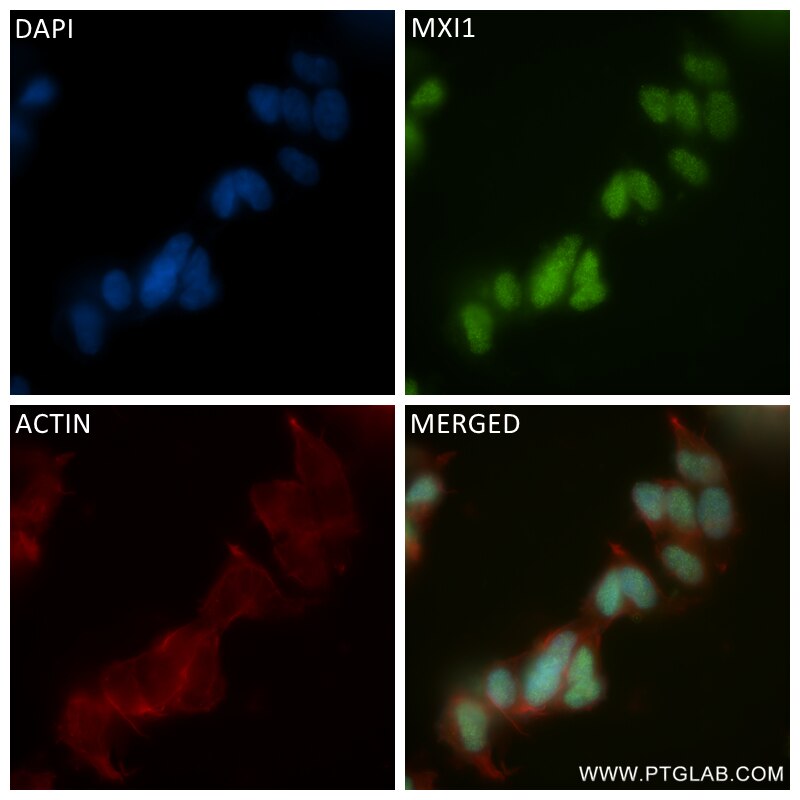
| Positive IF/ICC detected in | SH-SY5Y cells |
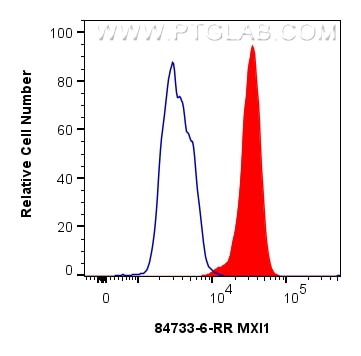
| Positive FC (Intra) detected in | HeLa cells |
Recommended dilution
| Application | Dilution |
|---|---|
| Immunofluorescence (IF)/ICC | IF/ICC : 1:200-1:800 |
| Flow Cytometry (FC) (INTRA) | FC (INTRA) : 0.25 ug per 10^6 cells in a 100 µl suspension |
| It is recommended that this reagent should be titrated in each testing system to obtain optimal results. | |
| Sample-dependent, Check data in validation data gallery. | |
Product Information
84733-6-RR targets MXI1 in IF/ICC, FC (Intra), ELISA applications and shows reactivity with human samples.
| Tested Reactivity | human |
| Host / Isotype | Rabbit / IgG |
| Class | Recombinant |
| Type | Antibody |
| Immunogen |
CatNo: Ag3024 Product name: Recombinant human MXI1 protein Source: e coli.-derived, PGEX-4T Tag: GST Domain: 1-182 aa of BC012907 Sequence: MPSPRLQHSKPPRRLSRAQKHSSGSSNTSTANRRAHLRLCLERLKVLIPLGPDCTRHTTLGLLNKAKAHIKKLEEAERKSQHQLENLEREQRFLKWRLEQLQGPQEMERIRMDSIGSTISSDRSDSEREEIEVDVESTEFSHGEVDNISTTSISDIDDHSSLPSIGSDEGYSSASVKLSFTS Predict reactive species |
| Full Name | MAX interactor 1 |
| Calculated Molecular Weight | 228 aa, 26 kDa |
| GenBank Accession Number | BC012907 |
| Gene Symbol | MXI1 |
| Gene ID (NCBI) | 4601 |
| RRID | AB_3743694 |
| Conjugate | Unconjugated |
| Form | Liquid |
| Purification Method | Protein A purfication |
| UNIPROT ID | P50539 |
| Storage Buffer | PBS with 0.02% sodium azide and 50% glycerol, pH 7.3. |
| Storage Conditions | Store at -20°C. Stable for one year after shipment. Aliquoting is unnecessary for -20oC storage. 20ul sizes contain 0.1% BSA. |
Background Information
MXI1 is a transcription factor containing a basic helix-loop-helix leucine zipper (bHLHzip) and belongs to the Myc-Max-Mad transcriptional network. It is a transcriptional repressor thought to negatively regulate MYC function, and is therefore a potential tumor suppressor. This protein inhibits the transcriptional activity of MYC by competing for MAX, another basic helix-loop-helix protein that binds to MYC and is required for its function. Defects in this gene are frequently found in patients with prostate tumors.
Protocols
| Product Specific Protocols | |
|---|---|
| FC protocol for MXI1 antibody 84733-6-RR | Download protocol |
| IF protocol for MXI1 antibody 84733-6-RR | Download protocol |
| Standard Protocols | |
|---|---|
| Click here to view our Standard Protocols |




