Primary VHHs
Primary VHHs are highly specific, recombinantly produced alpaca single domain nanobody VHHs against a range of protein tags, various intra- and extracellular targets, and immuno-oncology targets. Their small size and high affinity make them ideal tools for applications such as imaging and flow cytometry.
-
 Excellent tissue and cell penetration
-
Minimal epitope-label displacement
-
Recombinant production
Primary VHH Products by Target and Conjugation
Browse Primary VHH reagents by target, conjugation format, and application, including products for immuno-oncology, cytokine and growth factor targets, peptide and fluorescence tags and intracellular targets.
Immuno-Oncology, Growth Factor, and Cytokine Targets
| Target | Conjugates | Applications | ||
|---|---|---|---|---|
| CD4 | CoraLite® Plus 555 | CoraLite® Plus 647 | FITC | FC |
| CD16 | CoraLite® Plus 555 | CoraLite® Plus 647 | FITC | IF, FC |
| CD33 | CoraLite® Plus 555 | CoraLite® Plus 647 | FITC | FC |
| CTLA4 | CoraLite® Plus 555 | CoraLite® Plus 647 | FITC | IF, Live Cell Imaging, FC |
| FLT3 | CoraLite® Plus 555 | CoraLite® Plus 647 | FITC | IF, Live Cell Imaging, FC |
| LAG3 | CoraLite® Plus 555 | CoraLite® Plus 647 | FITC | IF, Live Cell Imaging, FC |
| MSLN | CoraLite® Plus 555 | CoraLite® Plus 647 | FITC | IF, Live Cell Imaging, FC |
| PD-1 | CoraLite® Plus 555 | CoraLite® Plus 647 | FITC | FC |
| PD-L1 | CoraLite® Plus 555 | CoraLite® Plus 647 | FITC | IF, Live Cell Imaging, FC |
| TIM3 | CoraLite® Plus 555 | CoraLite® Plus 647 | FITC | IF, Live Cell Imaging, FC |
| TIGIT | CoraLite® Plus 555 | CoraLite® Plus 647 | FITC | IF, Live Cell Imaging, FC |
| IFNy | CoraLite® Plus 555 | CoraLite® Plus 647 | FITC | IF, FC |
| Biotin | BLI, SPR, ELISA | |||
| IL6 | CoraLite® Plus 555 | CoraLite® Plus 647 | FITC | IF, FC |
| Biotin | BLI, SPR, ELISA | |||
| Cystatin-C | Biotin | BLI, SPR, ELISA | ||
| FGF-9 | Biotin | BLI, SPR, ELISA | ||
| FGF-basic | Biotin | BLI, SPR, ELISA | ||
| IL28a | ||||
| Biotin | BLI, SPR, ELISA | |||
| IL34 | Biotin | BLI, SPR, ELISA | ||
| OSM | Biotin | BLI, SPR, ELISA | ||
Note: Unconjugated versions of the listed VHHs can be found in the table below.
Conjugated VHHs
| Target | Conjugates | Applications | ||
|---|---|---|---|---|
| GFP (GFP-Booster) |
Alexa Fluor 488 ATTO488 Biotin |
Alexa Fluor 568 ATTO594 |
Alexa Fluor 647 ATTO647N |
IF, IHC, ICC |
| RFP (RFP-Booster) |
Alexa Fluor 488 |
Alexa Fluor 568 ATTO594 |
Alexa Fluor 647 ATTO647N |
IF, IHC, ICC |
|
HA (HA Label) | CoraLite® Plus 488 | CoraLite® Plus 555 | CoraLite® Plus 647 | IF, IHC, ICC |
| Histone (Histone Label) |
ATTO488 | IF, IHC, ICC | ||
| Spot (Spot Label) |
Alexa Fluor 488 ATTO488 |
Alexa Fluor 568 ATTO594 |
Alexa Fluor 647 | IF, IHC, ICC |
| Vimentin (Vimentin Label) |
ATTO488 | IF, IHC, ICC | ||
Unconjugated VHHs
Our unconjugated VHHs can be conjugated via:
NHS: Conjugation via NHS ester – Amine reaction
Maleimide: Conjugation via Maleimide – Thio reaction
| Peptide tags | |||||
|---|---|---|---|---|---|
| HA (NHS) | Myc (NHS) | Spot (NHS) | Strep (NHS) | V5 (NHS) | |
| Fluorescence tags | |||||
| GFP (NHS) | GFP (Maleimide) | mNeonGreen (NHS) | mEos (NHS) | RFP (NHS) | TurboGFP (NHS) |
| Solubility tags | |||||
| GST (NHS) | MBP (NHS) | ||||
| Other tags | |||||
| Halo (NHS) | SNAP/CLIP (NHS) | Ubiquitin (NHS) | |||
| Intracellular targets | |||||
| Histone (NHS) | MK2 (NHS) | PARP1 (NHS) | p53 N-term (NHS) | p53 C-term (NHS) | Vimentin (NHS) |
| Immuno-Oncology -, Growth Factors -, & Cytokine targets | |||||
|
CD4 (Maleimide)
FLT3 (Maleimide) LAG3 (Maleimide) TIM3 (Maleimide) |
CD33 (Maleimide)
IFNy (Maleimide) MSLN (Maleimide) |
CTLA4 (Maleimide)
IFNy (NHS) OSM (Maleimide) |
Cystatin-C (Maleimide)
IL6 (Maleimide) PD-1 (Maleimide) |
FGF-9 (Maleimide)
IL28a (Maleimide) PD-L1 (Maleimide) |
FGF-basic (Maleimide)
IL34 (Maleimide) TIGIT (Maleimide) |
Why use Primary VHHs?
Primary VHHs offer practical advantages over conventional antibodies, including improved imaging resolution, reduced experimental bias, and reproducible recombinant production. Explore how their small size, monovalent format, and controlled manufacturing support more reliable results across imaging and cell-based workflows.
Our nanobody VHH-based live cell imaging reagents are around one tenth the size of conventional primary antibodies or IgG. Their small size improves tissue penetration and reduces the distance between epitope and label, which can increase imaging resolution and produce less diffuse signals. These properties make them well suited to imaging applications, especially super-resolution microscopy.
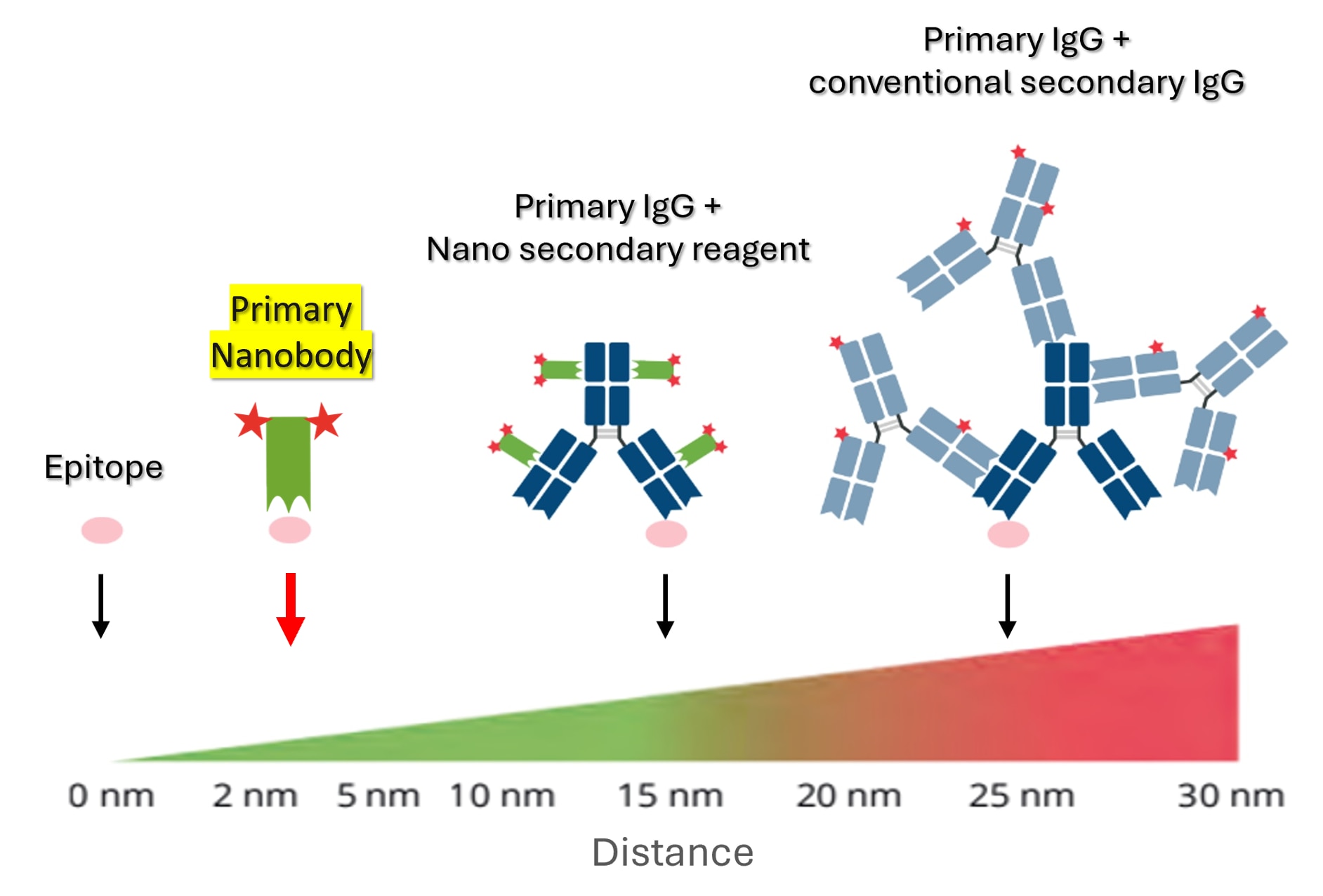
Bivalent antibodies can sometimes promote epitope cross-linking, target clustering, or receptor activation, which may distort experimental results. The monovalent nature of nanobody VHH reagents helps preserve a state closer to native biology and can reduce bias caused by dimerization, particularly for cell surface receptors.
Note: Not all VHHs listed on this page are monovalent. Bivalent formats are identified on the relevant product pages.
ChromoTek nanobody VHH reagents are recombinantly produced and characterized at both the DNA and protein sequence level. This supports high purity, controlled labeling, minimal batch-to-batch variation, and animal-free production, with validation across methods including UV/VIS spectroscopy, SDS-PAGE, immunofluorescence, and mass spectrometry.