
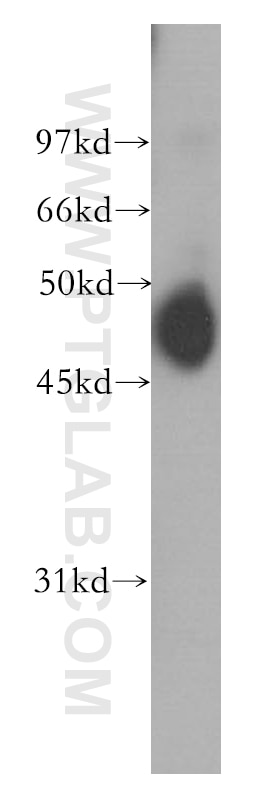

Tested Applications
| Positive WB detected in | A431 cells |
Recommended dilution
| Application | Dilution |
|---|---|
| Western Blot (WB) | WB : 1:500-1:2000 |
| It is recommended that this reagent should be titrated in each testing system to obtain optimal results. | |
| Sample-dependent, Check data in validation data gallery. | |
Product Information
13387-1-AP targets CCRL2 in WB, ELISA applications and shows reactivity with human samples.
| Tested Reactivity | human |
| Host / Isotype | Rabbit / IgG |
| Class | Polyclonal |
| Type | Antibody |
| Immunogen |
CatNo: Ag4045 Product name: Recombinant human CCRL2 protein Source: e coli.-derived, PGEX-4T Tag: GST Domain: 250-344 aa of BC025717 Sequence: MWAPYNIAFFLSTFKEHFSLSDCKSSYNLDKSVHITKLIATTHCCINPLLYAFLDGTFSKYLCRCFHLRSNTPLQPRGQSAQGTSREEPDHSTEV Predict reactive species |
| Full Name | chemokine (C-C motif) receptor-like 2 |
| Calculated Molecular Weight | 344 aa, 40 kDa |
| Observed Molecular Weight | 47 kDa |
| GenBank Accession Number | BC025717 |
| Gene Symbol | CCRL2 |
| Gene ID (NCBI) | 9034 |
| RRID | AB_2073388 |
| Conjugate | Unconjugated |
| Form | Liquid |
| Purification Method | Antigen affinity purification |
| UNIPROT ID | O00421 |
| Storage Buffer | PBS with 0.02% sodium azide and 50% glycerol, pH 7.3. |
| Storage Conditions | Store at -20°C. Stable for one year after shipment. Aliquoting is unnecessary for -20oC storage. 20ul sizes contain 0.1% BSA. |
Background Information
Chemokine CC motif receptor-like 2 (CCRL2) is a seven-transmembrane domain receptor that shares structural and functional similarities with the family of atypical chemokine receptors (ACKRs) (PMID: 28743719). CCRL2 does not appear to be a signaling receptor, but may have a role in modulating chemokine-triggered immune responses by capturing and internalizing CCL19 or by presenting RARRES2 ligand to CMKLR1, a functional signaling receptors. CCRL2 has been found on almost all hemopoietic cells, including monocytes, macrophages, polymorphonuclear neutrophils (PMNs), T cells, dendritic cells, natural killer cells, and CD34+ progenitor cells, with PMNs expressing the highest levels (PMID: 15188357). CCRL2 is also expressed by barrier cells, such as lymphatic and blood endothelial cells and bronchial and intestinal epithelial cells (PMID: 29056935).
Protocols
| Product Specific Protocols | |
|---|---|
| WB protocol for CCRL2 antibody 13387-1-AP | Download protocol |
| Standard Protocols | |
|---|---|
| Click here to view our Standard Protocols |
Publications
What published studies show
The CCRL2 Polyclonal antibody (Cat# 13387-1-AP) has 4 total citations published in Aging (Albany NY), International Immunopharmacology, Frontiers in Cellular and Infection Microbiology, and Pflügers Archiv. The associated research fields include cognitive impairment after cardiac arrest, diabetic adipose tissue inflammation via the SHP-1/STAT3 pathway, inflammatory response in oral mucositis through Th17/Treg imbalance, and chemerin-induced pulmonary arterial hypertension.
| Species | Application | Title |
|---|---|---|
Aging (Albany NY) RNA-seq analysis of the key long noncoding RNAs and mRNAs related to cognitive impairment after cardiac arrest and cardiopulmonary resuscitation. | ||
Int Immunopharmacol Vitamin D against diabetic adipose tissue inflammation through SHP-1/STAT3 pathway | ||
Front Cell Infect Microbiol Escherichia coli aggravates inflammatory response in mice oral mucositis through regulating Th17/Treg imbalance | ||
Pflugers Arch Chemerin-9-induced contraction was enhanced through the upregulation of smooth muscle chemokine-like receptor 1 in isolated pulmonary artery of pulmonary arterial hypertensive rats. |


