
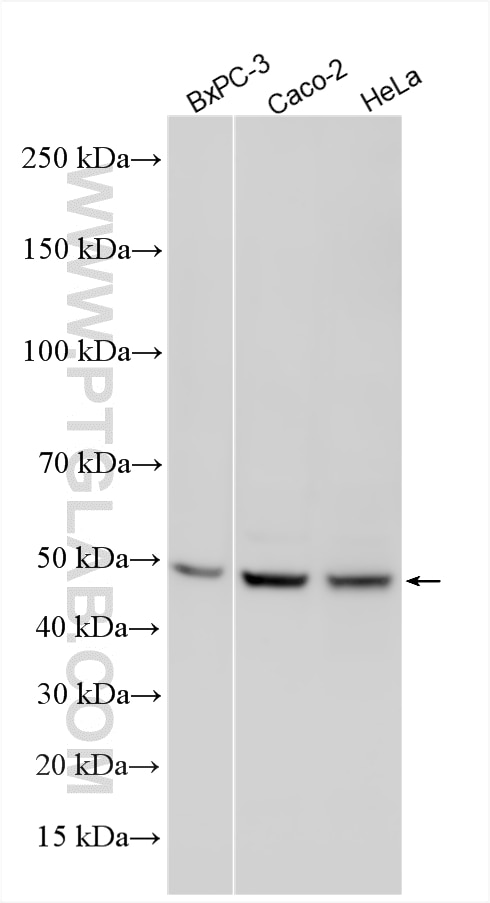
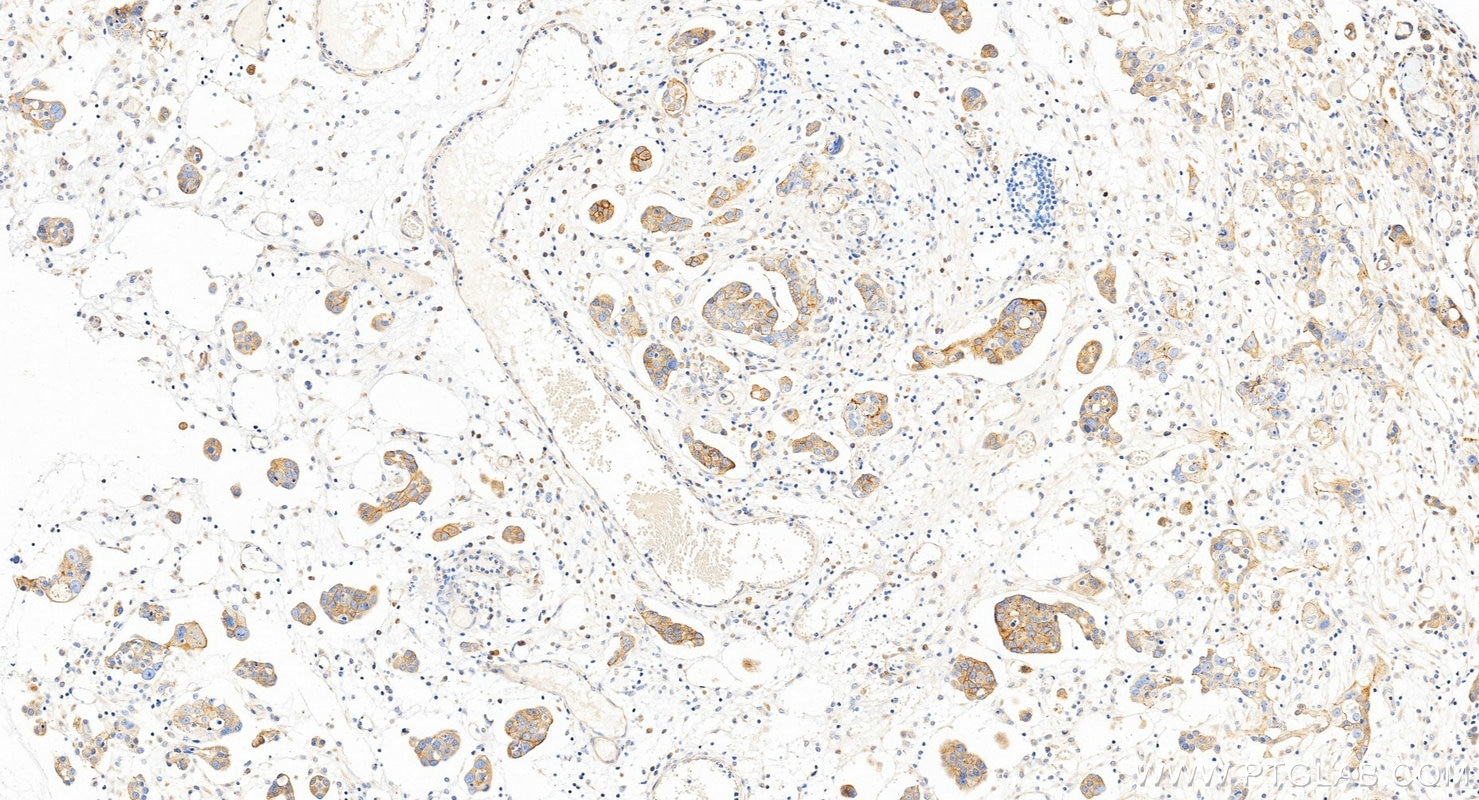
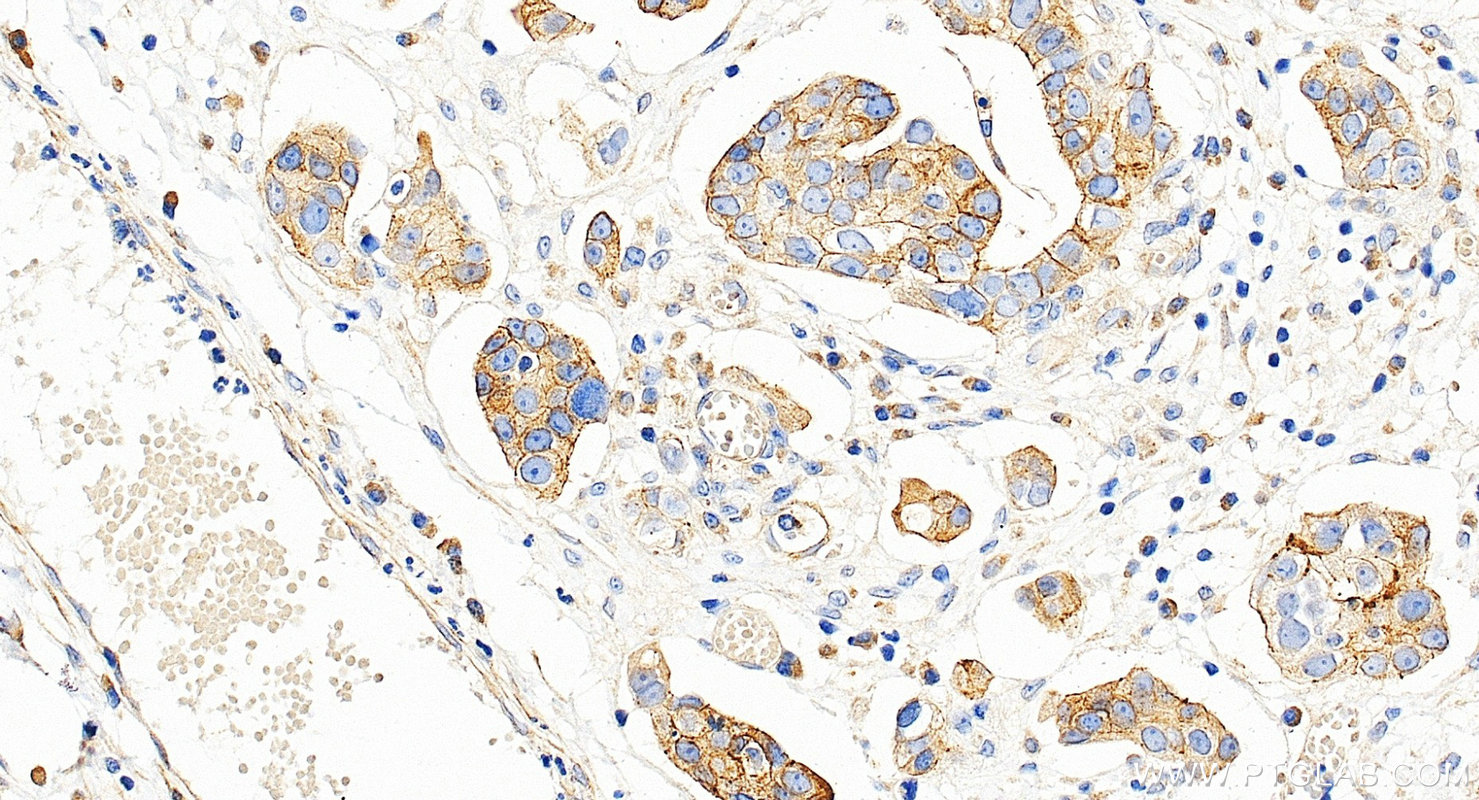

Tested Applications
| Positive WB detected in | Caco-2 cells, BxPC-3 cells, HeLa cells |
| Positive IHC detected in | human ovary cancer tissue Note: suggested antigen retrieval with TE buffer pH 9.0; (*) Alternatively, antigen retrieval may be performed with citrate buffer pH 6.0 |
Recommended dilution
| Application | Dilution |
|---|---|
| Western Blot (WB) | WB : 1:500-1:2000 |
| Immunohistochemistry (IHC) | IHC : 1:200-1:800 |
| It is recommended that this reagent should be titrated in each testing system to obtain optimal results. | |
| Sample-dependent, Check data in validation data gallery. | |
Product Information
11777-1-AP targets CXADR in WB, IHC, ELISA applications and shows reactivity with human samples.
| Tested Reactivity | human |
| Host / Isotype | Rabbit / IgG |
| Class | Polyclonal |
| Type | Antibody |
| Immunogen |
CatNo: Ag2369 Product name: Recombinant human CXADR protein Source: e coli.-derived, PGEX-4T Tag: GST Domain: 1-365 aa of BC003684 Sequence: MALLLCFVLLCGVVDFARSLSITTPEEMIEKAKGETAYLPCKFTLSPEDQGPLDIEWLISPADNQKVDQVIILYSGDKIYDDYYPDLKGRVHFTSNDLKSGDASINVTNLQLSDIGTYQCKVKKAPGVANKKIHLVVLVKPSGARCYVDGSEEIGSDFKIKCEPKEGSLPLQYEWQKLSDSQKMPTSWLAEMTSSVISVKNASSEYSGTYSCTVRNRVGSDQCLLRLNVVPPSNKAGLIAGAIIGTLLALALIGLIIFCCRKKRREEKYEKEVHHDIREDVPPPKSRTSTARSYIGSNHSSLGSMSPSNMEGYSKTQYNQVPSEDFERTPQSPTLPPAKVAAPNLSRMGAIPVMIPAQSKDGSIV Predict reactive species |
| Full Name | coxsackie virus and adenovirus receptor |
| Calculated Molecular Weight | 365 aa, 40 kDa |
| Observed Molecular Weight | 45-50 kDa |
| GenBank Accession Number | BC003684 |
| Gene Symbol | CXADR |
| Gene ID (NCBI) | 1525 |
| RRID | AB_2087443 |
| Conjugate | Unconjugated |
| Form | Liquid |
| Purification Method | Antigen affinity purification |
| UNIPROT ID | P78310 |
| Storage Buffer | PBS with 0.02% sodium azide and 50% glycerol, pH 7.3. |
| Storage Conditions | Store at -20°C. Stable for one year after shipment. Aliquoting is unnecessary for -20oC storage. 20ul sizes contain 0.1% BSA. |
Background Information
Coxsackievirus and adenovirus receptor (CXADR) is a member of junctional adhesion molecules, which are glycosylated transmembrane proteins that belong to the Ig superfamily (PMID: 17916321). CXADR plays essential roles in blastocyst formation, including cavitation and the proper subcellular localization of tight junction proteins into the apical edge of the outer blastomeres (PMID: 26729920). It is also involved in the transepithelial migration of leukocytes through adhesive interactions with junctional adhesion molecule-like protein (JAML) (PMID: 15800062).
Protocols
| Product Specific Protocols | |
|---|---|
| IHC protocol for CXADR antibody 11777-1-AP | Download protocol |
| WB protocol for CXADR antibody 11777-1-AP | Download protocol |
| Standard Protocols | |
|---|---|
| Click here to view our Standard Protocols |
Publications
What published studies show
The CXADR Polyclonal antibody (Cat# 11777-1-AP) has 2 citations. One appears in Advanced Science (2025), studying vitamin D binding protein's role in promoting perineural invasion in pancreatic ductal adenocarcinoma. The other is in Oncology Research (2025), investigating oncolytic adenovirus H101 enhancing anti-tumor effects of PD-1 blockade via CD47 downregulation, with the antibody used in WB. Both citations relate to cancer biology, specifically tumor microenvironment and immunotherapy research.
| Species | Application | Title |
|---|---|---|
Adv Sci (Weinh) Vitamin D Binding Protein, a Ligand of Integrin beta 1, Motivates Both Tumor Cells and Schwann Cells to Promote Perineural Invasion in Pancreatic Ductal Adenocarcinoma | ||
Oncol Res Oncolytic adenovirus H101 enhances the anti-tumor effects of PD-1 blockade via CD47 downregulation in tumor cells |
Reviews
What customers say
The single available review for this product reports a 1-star rating from an immunohistochemistry application on zebrafish retina tissue at a 1:100 dilution. No written comments were provided, and no images were attached. The reviewer did not elaborate on the specific issues encountered, so the low score lacks detailed context. Overall, the limited feedback suggests a negative experience with this lot in that particular application, though the absence of explanatory text makes it difficult to identify the underlying cause.
The reviews below have been submitted by verified Proteintech customers who received an incentive for providing their feedback.
Ryan (Verified Customer) (06-15-2018) |
|




