


Tested Applications
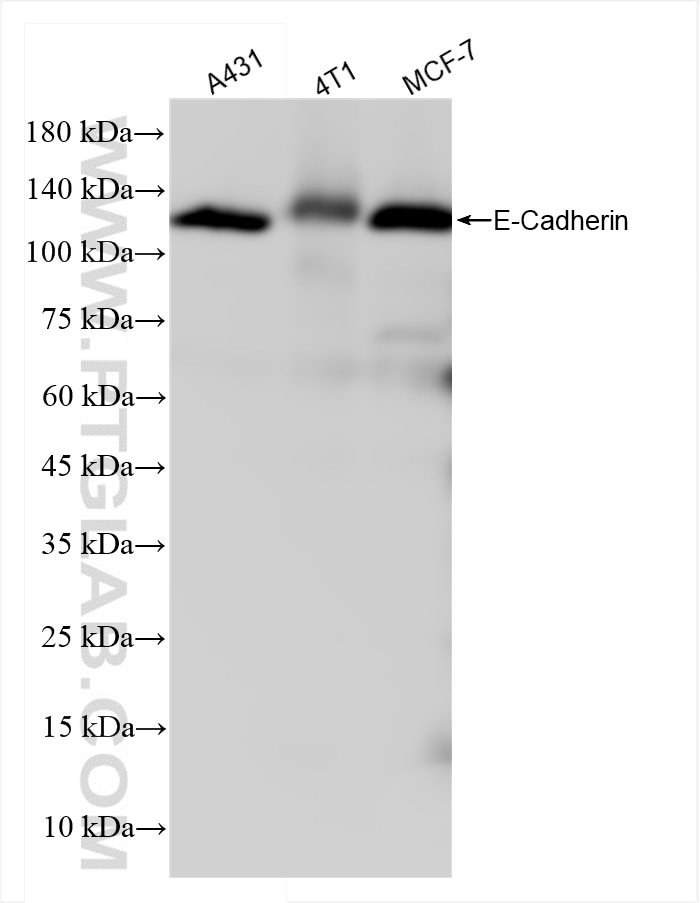
| Positive WB detected in | A431 cells, 4T1 cells, MCF-7 cells |
| Positive IF/ICC detected in | A431 cells |
Recommended dilution
| Application | Dilution |
|---|---|
| Western Blot (WB) | WB : 1:5000-1:50000 |
| Immunofluorescence (IF)/ICC | IF/ICC : 1:250-1:1000 |
| It is recommended that this reagent should be titrated in each testing system to obtain optimal results. | |
| Sample-dependent, Check data in validation data gallery. | |
Product Information
84111-2-RR targets E-cadherin in WB, IF/ICC, ELISA applications and shows reactivity with human, mouse samples.
| Tested Reactivity | human, mouse |
| Cited Reactivity | human |
| Host / Isotype | Rabbit / IgG |
| Class | Recombinant |
| Type | Antibody |
| Immunogen |
CatNo: Eg0975 Product name: Recombinant Mouse E-Cadherin protein (His Tag) Source: mammalian cells-derived, pHZ-KIsec-C-6*HIS Tag: C-6*HIS Domain: 157-709 aa of NM_009864.3 Sequence: DWVIPPISCPENEKGEFPKNLVQIKSNRDKETKVFYSITGQGADKPPVGVFIIERETGWLKVTQPLDREAIAKYILYSHAVSSNGEAVEDPMEIVITVTDQNDNRPEFTQEVFEGSVAEGAVPGTSVMKVSATDADDDVNTYNAAIAYTIVSQDPELPHKNMFTVNRDTGVISVLTSGLDRESYPTYTLVVQAADLQGEGLSTTAKAVITVKDINDNAPVFNPSTYQGQVPENEVNARIATLKVTDDDAPNTPAWKAVYTVVNDPDQQFVVVTDPTTNDGILKTAKGLDFEAKQQYILHVRVENEEPFEGSLVPSTATVTVDVVDVNEAPIFMPAERRVEVPEDFGVGQEITSYTAREPDTFMDQKITYRIWRDTANWLEINPETGAIFTRAEMDREDAEHVKNSTYVALIIATDDGSPIATGTGTLLLVLLDVNDNAPIPEPRNMQFCQRNPQPHIITILDPDLPPNTSPFTAELTHGASVNWTIEYNDAAQESLILQPRKDLEIGEYKIHLKLADNQNKDQVTTLDVHVCDCEGTVNNCMKAGIVAAGLQV Predict reactive species |
| Full Name | cadherin 1 |
| Calculated Molecular Weight | 98kDa |
| Observed Molecular Weight | 135 kDa |
| GenBank Accession Number | NM_009864.3 |
| Gene Symbol | E-cadherin |
| Gene ID (NCBI) | 12550 |
| RRID | AB_3671677 |
| Conjugate | Unconjugated |
| Form | Liquid |
| Purification Method | Protein A purification |
| UNIPROT ID | P09803 |
| Storage Buffer | PBS with 0.02% sodium azide and 50% glycerol, pH 7.3. |
| Storage Conditions | Store at -20°C. Stable for one year after shipment. Aliquoting is unnecessary for -20oC storage. 20ul sizes contain 0.1% BSA. |
Background Information
Cadherins are a family of transmembrane glycoproteins that mediate calcium-dependent cell-cell adhesion and play an important role in the maintenance of normal tissue architecture. E-cadherin (epithelial cadherin), also known as CDH1 (cadherin 1) or CAM 120/80, is a classical member of the cadherin superfamily which also include N-, P-, R-, and B-cadherins. E-cadherin is expressed on the cell surface in most epithelial tissues. The extracellular region of E-cadherin establishes calcium-dependent homophilic trans binding, providing specific interaction with adjacent cells, while the cytoplasmic domain is connected to the actin cytoskeleton through the interaction with p120-, α-, β-, and γ-catenin (plakoglobin). E-cadherin is important in the maintenance of the epithelial integrity, and is involved in mechanisms regulating proliferation, differentiation, and survival of epithelial cell. E-cadherin may also play a role in tumorigenesis. It is considered to be an invasion suppressor protein and its loss is an indicator of high tumor aggressiveness. E-cadherin is sensitive to trypsin digestion in the absence of Ca2+.
Protocols
| Product Specific Protocols | |
|---|---|
| IF protocol for E-cadherin antibody 84111-2-RR | Download protocol |
| WB protocol for E-cadherin antibody 84111-2-RR | Download protocol |
| Standard Protocols | |
|---|---|
| Click here to view our Standard Protocols |
Publications
What published studies show
The E-cadherin Recombinant monoclonal antibody (clone 241282A8), catalog number 84111-2-RR, has 1 total citation. The cited publication appeared in Biochimica et Biophysica Acta Molecular Cell Research (IF 4.3), published in 2026. The study investigated FBXO32-mediated activation of the PI3K/AKT pathway through PTEN inhibition and TAL1 ubiquitination in hepatocellular carcinoma, with the antibody applied in Western blot for human samples. The associated research field is cancer biology, specifically hepatocellular carcinoma and intracellular signaling pathways.
| Species | Application | Title |
|---|---|---|
Biochim Biophys Acta Mol Cell Res FBXO32 activates the PI3K/AKT pathway by inhibiting PTEN through ubiquitination of TAL1 in hepatocellular carcinoma. |




