
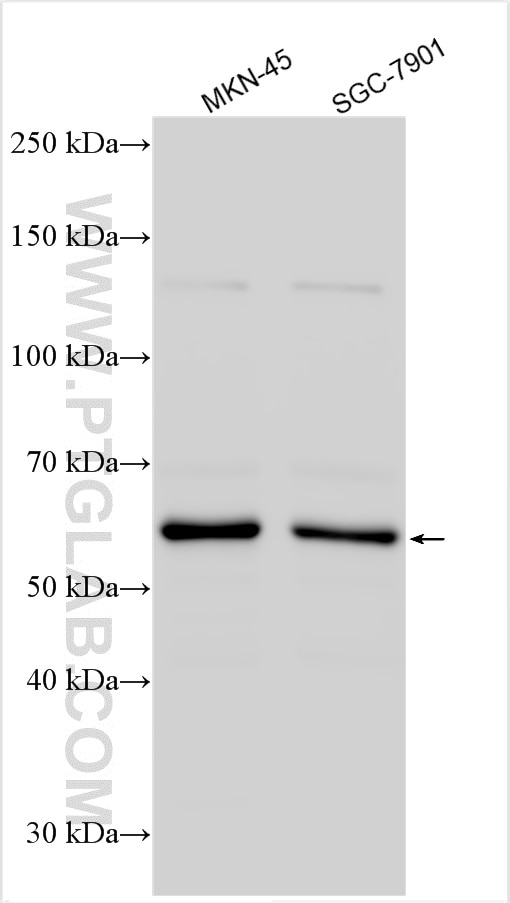
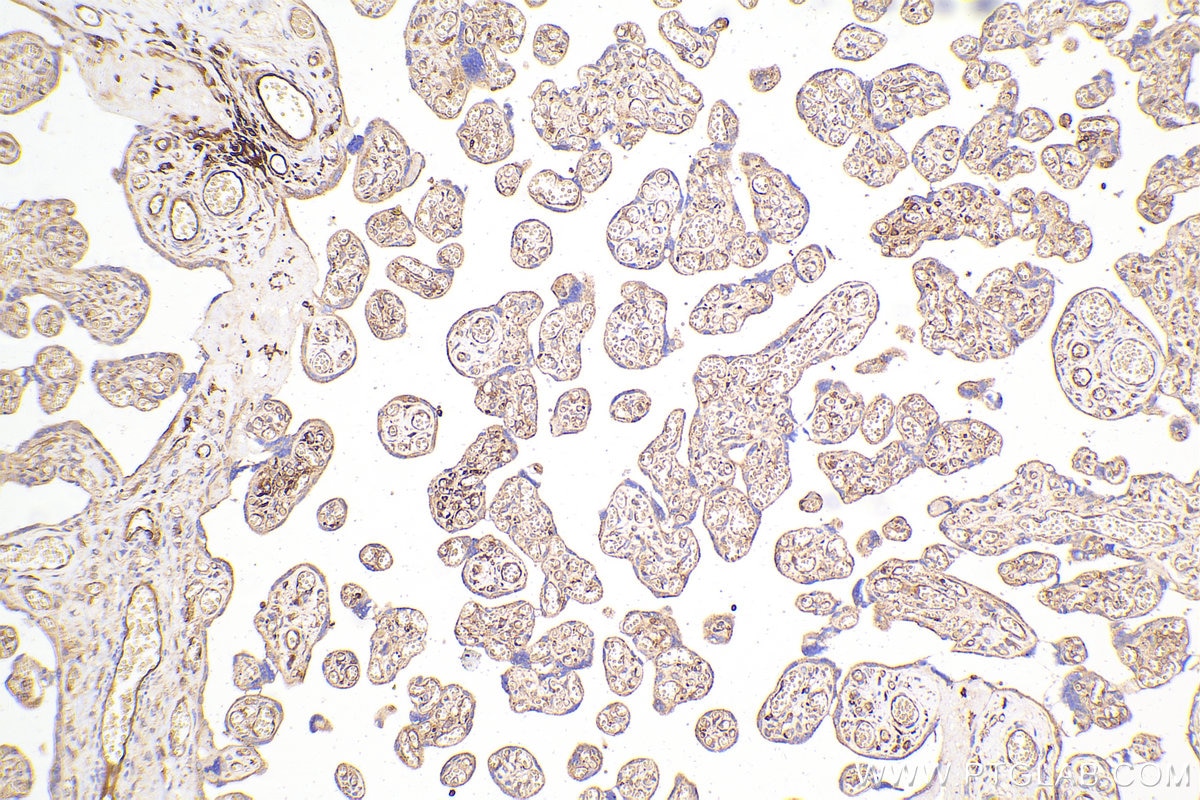

Tested Applications
| Positive WB detected in | MKN-45 cells, SGC-7901 cells |
| Positive IHC-Autostainer detected in | human placenta tissue |
Recommended dilution
| Application | Dilution |
|---|---|
| Western Blot (WB) | WB : 1:2000-1:12000 |
| Immunohistochemistry (IHC)-AUTOSTAINER | IHC-AUTOSTAINER : 1:500-1:2000 |
| It is recommended that this reagent should be titrated in each testing system to obtain optimal results. | |
| Sample-dependent, Check data in validation data gallery. | |
Product Information
15201-1-AP targets IFIT3 in WB, IHC-Autostainer, IF, IP, CoIP, ChIP, ELISA applications and shows reactivity with human samples.
| Tested Reactivity | human |
| Cited Reactivity | human, mouse, pig, monkey |
| Host / Isotype | Rabbit / IgG |
| Class | Polyclonal |
| Type | Antibody |
| Immunogen |
CatNo: Ag7349 Product name: Recombinant human IFIT3 protein Source: e coli.-derived, PGEX-4T Tag: GST Domain: 141-490 aa of BC004977 Sequence: EEGWTQLKCGRNERAKVCFEKALEEKPNNPEFSSGLAIAMYHLDNHPEKQFSTDVLKQAIELSPDNQYVKVLLGLKLQKMNKEAEGEQFVEEALEKSPCQTDVLRSAAKFYRRKGDLDKAIELFQRVLESTPNNGYLYHQIGCCYKAKVRQMQNTGESEASGNKEMIEALKQYAMDYSNKALEKGLNPLNAYSDLAEFLETECYQTPFNKEVPDAEKQQSHQRYCNLQKYNGKSEDTAVQHGLEGLSISKKSTDKEEIKDQPQNVSENLLPQNAPNYWYLQGLIHKQNGDLLQAAKCYEKELGRLLRDAPSGIGSIFLSASELEDGSEEMGQGAVSSSPRELLSNSEQLN Predict reactive species |
| Full Name | IFIT3 |
| Calculated Molecular Weight | 56 kDa |
| Observed Molecular Weight | 60 kDa |
| GenBank Accession Number | BC004977 |
| Gene Symbol | IFIT3 |
| Gene ID (NCBI) | 3437 |
| RRID | AB_2248738 |
| Conjugate | Unconjugated |
| Form | Liquid |
| Purification Method | Antigen affinity purification |
| UNIPROT ID | O14879 |
| Storage Buffer | PBS with 0.02% sodium azide and 50% glycerol, pH 7.3. |
| Storage Conditions | Store at -20°C. Stable for one year after shipment. Aliquoting is unnecessary for -20oC storage. 20ul sizes contain 0.1% BSA. |
Background Information
IFIT3 (IFN-induced protein with tetratricopeptide repeats 3), also known as IFIT-4, ISG-60 or RIG-G, is a 56 kDa IFN induced protein. IFIT3 has been identified to be associated with strong IFN antiviral activity. Upon RNA virus infection, IFIT3 is significantly induced, ectopic expression or knockdown of IFIT3 could, respectively, enhance or impair IFN regulatory factor 3 (IRF3)-mediated gene expression. IFIT3 thus may serve as an important modulator in innate immunity, revealing a new function of the IFIT family proteins.
Protocols
| Product Specific Protocols | |
|---|---|
| IHC protocol for IFIT3 antibody 15201-1-AP | Download protocol |
| WB protocol for IFIT3 antibody 15201-1-AP | Download protocol |
| Standard Protocols | |
|---|---|
| Click here to view our Standard Protocols |
Publications
What published studies show
Anti-IFIT3 antibody (Cat# 15201-1-AP) has 66 total citations published in journals including Nature Biotechnology, Nature Immunology, Nature Communications, Science Translational Medicine, Advanced Science, Cell Reports, Journal of Virology, Journal of Immunology, PLoS Pathogens, and Frontiers in Immunology. Associated research fields include innate immunity, interferon signaling, antiviral defense against influenza, SARS-CoV-2, HIV, and HSV; oncology; neuroinflammation; autoimmune diseases such as systemic sclerosis and lupus; liver disease; and inflammatory disorders.
| Species | Application | Title |
|---|---|---|
Signal Transduct Target Ther TRAF3 activates STING-mediated suppression of EV-A71 and target of viral evasion | ||
Nat Biotechnol DestVI identifies continuums of cell types in spatial transcriptomics data | ||
Nat Immunol Single-cell atlas of human liver and blood immune cells across fatty liver disease stages reveals distinct signatures linked to liver dysfunction and fibrogenesis | ||
Sci Transl Med Hepatocytes demarcated by EphB2 contribute to the progression of nonalcoholic steatohepatitis | ||
Adv Sci (Weinh) Single-Cell Transcriptomic Analysis of Primary and Metastatic Tumor Ecosystems in Esophageal Squamous Cell Carcinoma |



