

Tested Applications
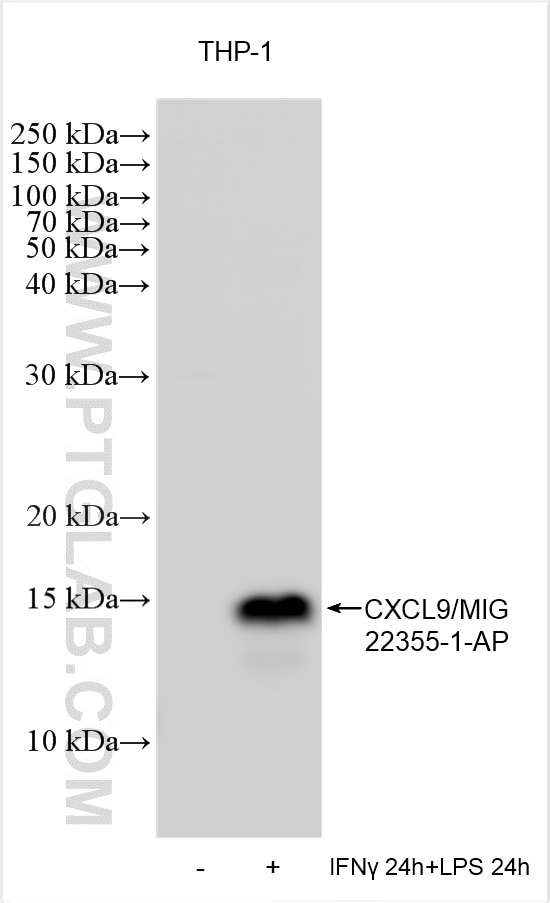
| Positive WB detected in | IFN gamma and LPS treated THP-1 cells |
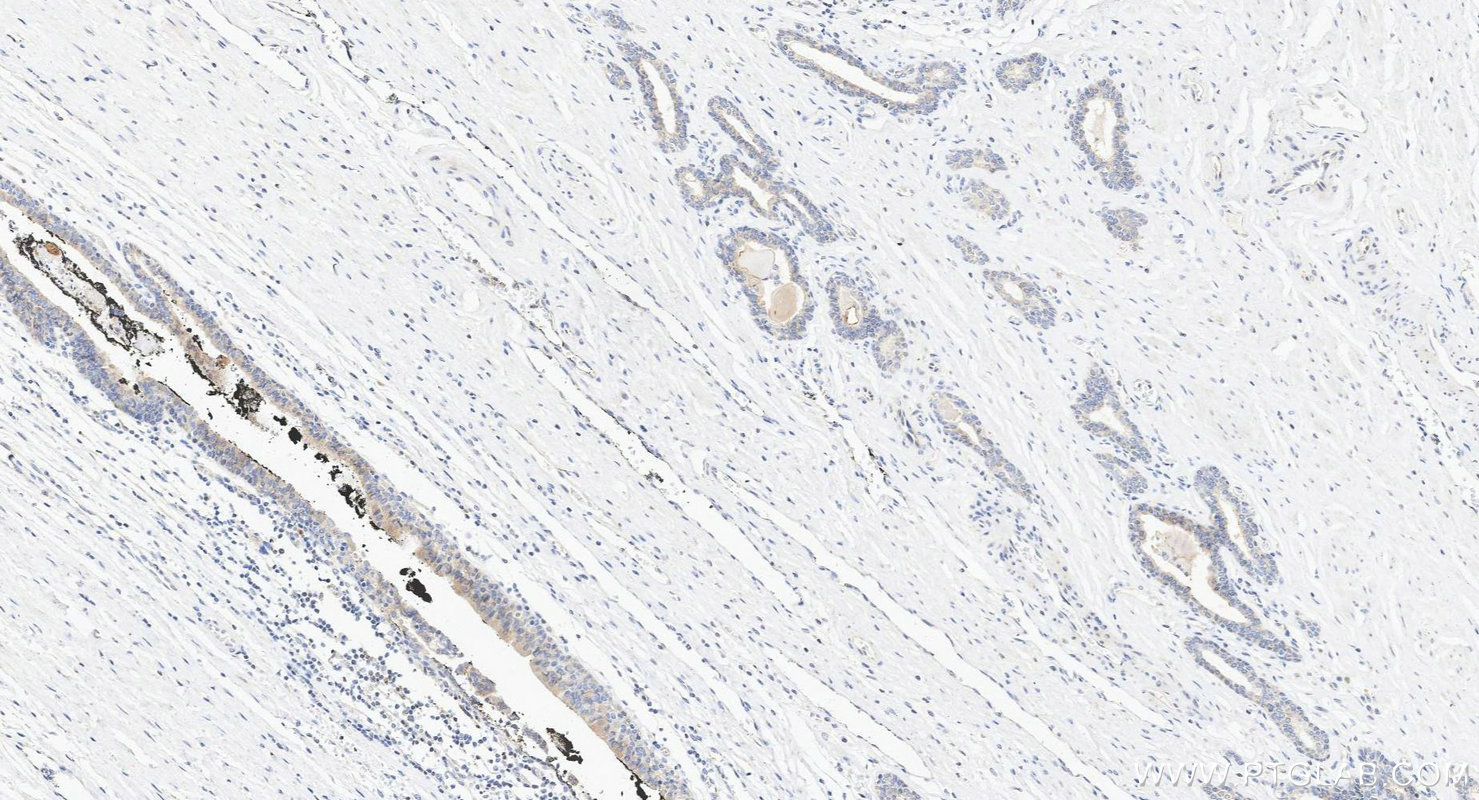
| Positive IHC detected in | human prostate cancer tissue Note: suggested antigen retrieval with TE buffer pH 9.0; (*) Alternatively, antigen retrieval may be performed with citrate buffer pH 6.0 |
Recommended dilution
| Application | Dilution |
|---|---|
| Western Blot (WB) | WB : 1:500-1:2000 |
| Immunohistochemistry (IHC) | IHC : 1:400-1:1600 |
| It is recommended that this reagent should be titrated in each testing system to obtain optimal results. | |
| Sample-dependent, Check data in validation data gallery. | |
Product Information
22355-1-AP targets CXCL9/MIG in WB, IHC, IF, ELISA applications and shows reactivity with human samples.
| Tested Reactivity | human |
| Cited Reactivity | human, mouse |
| Host / Isotype | Rabbit / IgG |
| Class | Polyclonal |
| Type | Antibody |
| Immunogen |
CatNo: Ag17932 Product name: Recombinant human CXCL9 protein Source: e coli.-derived, PGEX-4T Tag: GST Domain: 23-125 aa of BC095396 Sequence: TPVVRKGRCSCISTNQGTIHLQSLKDLKQFAPSPSCEKIEIIATLKNGVQTCLNPDSADVKELIKKWEKQVSQKKKQKNGKKHQKKKVLKVRKSQRSRQKKTT Predict reactive species |
| Full Name | chemokine (C-X-C motif) ligand 9 |
| Calculated Molecular Weight | 14 kDa |
| Observed Molecular Weight | 14 kDa |
| GenBank Accession Number | BC095396 |
| Gene Symbol | CXCL9 |
| Gene ID (NCBI) | 4283 |
| RRID | AB_2879086 |
| Conjugate | Unconjugated |
| Form | Liquid |
| Purification Method | Antigen affinity purification |
| UNIPROT ID | Q07325 |
| Storage Buffer | PBS with 0.02% sodium azide and 50% glycerol, pH 7.3. |
| Storage Conditions | Store at -20°C. Stable for one year after shipment. Aliquoting is unnecessary for -20oC storage. 20ul sizes contain 0.1% BSA. |
Background Information
CXCL9 is a small cytokine known as MIG. CXCL9 is a T-cell chemoattractant, which is induced by IFN-γ. It is closely related to two other CXC chemokines called CXCL10 and CXCL11, whose genes are located near the gene for CXCL9 on human chromosome 4. A high level of CXCL9 revealed in peripheral liquids, can be considered as a marker of host immune response, especially of that involving Th1 cells.
Protocols
| Product Specific Protocols | |
|---|---|
| IHC protocol for CXCL9/MIG antibody 22355-1-AP | Download protocol |
| WB protocol for CXCL9/MIG antibody 22355-1-AP | Download protocol |
| Standard Protocols | |
|---|---|
| Click here to view our Standard Protocols |
Publications
What published studies show
The CXCL9/MIG polyclonal antibody (Cat# 22355-1-AP) has 35 citations. These appear in journals including Nature Communications, Cancer Cell, Cell Research, Advanced Science, Molecular Therapy, Cell Death & Disease, Journal for ImmunoTherapy of Cancer, Frontiers in Immunology, and Science Reports. Research fields span cancer immunotherapy and tumor microenvironment studies (hepatocellular, breast, lung, bladder, ovarian, and colorectal cancers), immune checkpoint therapy, inflammatory diseases (vitiligo, allergic dermatitis), infectious disease (tuberculosis), and reproductive disorders.
| Species | Application | Title |
|---|---|---|
Signal Transduct Target Ther Ultra-high dose rate radiotherapy overcomes radioresistance in head and neck squamous cell carcinoma | ||
Cancer Cell Spatial transcriptomics reveals tryptophan metabolism restricting maturation of intratumoral tertiary lymphoid structures | ||
Cell Res Glucose starvation mimetic aldometanib removes immune barriers permitting mice with hepatocellular carcinoma to live to normal ages. | ||
Drug Resist Updat ITPKB suppresses ER calcium release to promote CXCL9 expression and enhance immunotherapy sensitivity in triple-negative breast cancer. | ||
Nat Commun Miniature and versatile genome regulation TnpB-ωRNA toolkits facilitate cancer immunotherapy. | ||
Nat Commun CD276-dependent efferocytosis by tumor-associated macrophages promotes immune evasion in bladder cancer |
Reviews
What customers say
One reviewer rated this antibody 4 out of 5 stars, reporting successful use in IHC on mouse meningeal tissue at a 1:200 dilution. The protocol involved blocking with 0.3% Triton-X-100 in 2% goat serum for 1 hour. Overall, the user found the antibody performed well for their application.
The reviews below have been submitted by verified Proteintech customers who received an incentive for providing their feedback.
Wojciech (Verified Customer) (05-25-2023) | This antibody works well. It was used for IHC analysis of mouse meningeal tissue at dilution of 1:200. Blocking in 0.3% Triton-X-100 containing 2% of goat serum for 1 hour.
|



