
Tertiary Lymphoid Structures: What They Are and Why They Matter in Immuno-oncology
Written by Sarah Wilkey, PhD Student at the University of Queensland, Australia
Tertiary lymphoid structures (TLSs) have become a hot topic in the immuno-oncology field. Growing evidence supports their role as both a predictive biomarker and a therapeutic target for cancer immunotherapy1,2. But what exactly are TLSs? Why do they matter in cancer? And how do we study them?
What Are TLSs?
TLSs are transient, ectopic lymphoid aggregates that arise in chronically inflamed tissues, including solid tumors. They are structurally and functionally similar to secondary lymphoid organs (SLOs) but form spontaneously and lack a surrounding capsule3. Like SLOs, mature TLSs are highly organized, comprising an inner B cell zone with germinal centers (GCs), peripheral T cell areas, and high endothelial venules (HEVs). Thus, T and B cells dominate these structures; however, other cell types also play crucial roles, such as mature dendritic cells (DCs), follicular dendritic cells (FDCs), endothelial cells, and fibroblasts1-3.
How do TLSs Form?
TLS formation is a dynamic, multistep process driven by complex cellular and molecular crosstalk. Briefly, stromal cells recruit lymphoid tissue inducer (LTi)-like cells (e.g., Th17 cells, macrophages), triggering HEV differentiation and lymphocyte recruitment. These lymphocytes subsequently organize into discrete T and B cell zones. This entire process is orchestrated by a network of cytokines and chemokines, including lymphotoxins (LTα/β), TNF-α, CXCL13, CCL19, CCL21, and IL-71-3.
Overall, TLS maturation can be defined in three stages (Figure 1):
-
Lymphoid aggregates: T and B cells, but no B cell follicles and FDCs.
-
Early TLS: Presence of CD21+ FDCs in B cell area, lack GC region.
-
Mature TLS: Presence of GC region with CD21+ FDCs in B cell area.
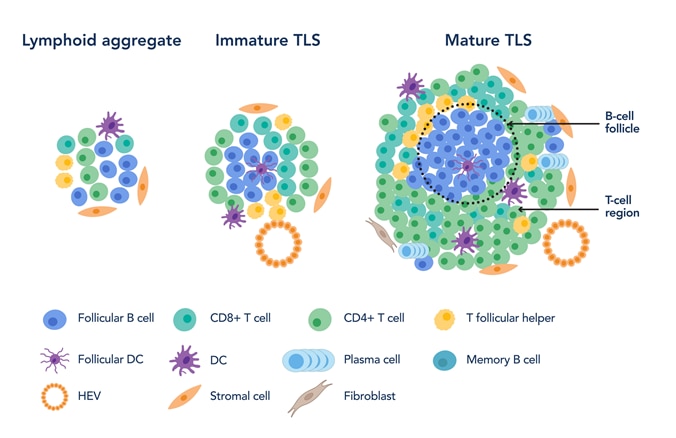
Figure 1. Stages of tertiary lymphoid structure (TLSs) development. TLSs show heterogeneous structure, ranging from lymphoid aggregates to mature, highly organized formations. Early TLSs exhibit compartmentalization into T and B cell zones, along with the presence of supporting dendritic cells (DCs), follicular dendritic cells (FDCs), and high endothelial venules (HEVs). Mature TLSs contain well-developed germinal centers within the B cell zone. Image adapted from Zhang et al. (2023)4.
TLSs and Immunotherapy: Why They Matter
Over the past decade, immunotherapies, particularly immune checkpoint inhibitors (ICIs), have revolutionized cancer treatment. Nonetheless, many patients still fail to respond, highlighting the need for predictive biomarkers and novel strategies to overcome resistance. Notably, accumulating evidence indicates that TLS density, intratumoral location, and maturation stage are independent predictors of ICI response2,5,6. This is because mature TLSs act as privileged sites for local immune activation. Their unencapsulated nature enables direct antigen exposure, leading to more efficient effector T cell priming. Within GCs, B cells undergo class switching and somatic hypermutation, ultimately differentiating into antibody-secreting plasma cells1,2. Finally, TLSs also appear to serve as reservoirs for PD-1⁺ TCF1⁺ stem-like CD8⁺ T cells, which are now recognized to underlie effective ICI response7.
Can We Induce TLSs to Improve Immunotherapy?
Despite their clinical relevance, TLSs are not universally present. For example, a retrospective pan-cancer study reported that mature TLSs were only detectable in ~25% of cases5. This has sparked interest in developing therapies to induce or promote their maturation within the tumor microenvironment. Strategies under investigation include cytokine modulation (such as LIGHT or STING agonists), oncolytic viruses, and biomaterial scaffolds. Indeed, pre-clinical studies have shown that such interventions can boost TLS formation and enhance immunotherapy1,6.
However, our understanding of how TLSs form and function remains incomplete. Some TLS-inducing factors have dual roles, while inhibitory cell types (e.g., follicular regulatory T cells and regulatory B cells) can be found within TLS and dampen immunity6. Importantly, we still do not fully understand why some patients naturally develop mature TLSs while others do not, even within the same tumor type. These research gaps underscore that TLS biology is still an emerging field, and a more nuanced understanding of their molecular and immunological mechanism is needed.
How Do We Study TLSs?
To better understand TLSs, we need robust ways to detect and characterize them. Some common methods include:
-
Hematoxylin and Eosin (H&E)
-
Immunohistochemistry and Immunofluorescence
-
Next Generation Sequencing
Hematoxylin and Eosin (H&E)
The simplest approach involves haematoxylin and eosin (H&E) staining of formalin-fixed paraffin-embedded (FFPE) tumor sections. On H&E slides, TLSs appear as discrete, tightly packed lymphocytic aggregates, which a trained pathologist can easily identify. However, manual scoring can introduce inter-observer variability8,9. To address this limitation, artificial intelligence (AI) algorithms have been developed to detect TLSs from whole-slide H&E images9. With several of these tools now publicly available10, AI-driven approaches are making TLS analysis more accessible and reproducible, potentially further expanding the role of H&E staining in clinical practice and research. For reliable and convenient staining, Proteintech offers a ready-to-use H&E Staining Kit (Catalogue #PK10031).
Immunohistochemistry (IHC) and Immunofluorescence (IF)
However, H&E offers limited resolution when it comes to distinguishing specific immune cell types or understanding their interactions within TLSs. To address this, immunohistochemistry (IHC) or multiplex immunofluorescence (mIF) are commonly employed (see Figure 2). For instance, TLS maturation can be examined via IHC using CD3 (T cell), CD20 (B cell), and CD21 or CD23 (FDC) markers, while cytokines (e.g., CXCL13) can be profiled to examine chemotactic activity associated with TLS formation1.
For more detailed characterization of TLS structure and cellular composition, multiplex immunofluorescence (mIF) is now widely used. This technique utilizes fluorescently labelled antibodies to simultaneously detect multiple markers within a single tissue section. For example, studies have co-stained for CD20 (B cells), CD4 and CD8 (T cells), CD21/CD23 (follicular dendritic cells), PNAD (high endothelial venules), and LAMP3 (mature dendritic cells) to visualize TLS architecture in situ1. Table 1 summarizes commonly used markers for TLS analysis.
Table 1. Common markers used to profile tertiary lymphoid structures
|
T cell |
|
|
Naïve B cell |
|
|
Plasma cell |
|
|
Follicular dendritic cell |
|
|
Mature dendritic cell |
|
|
High endothelial venule |
|
|
Regulatory T cells |
Proteintech is at the forefront of mIF technology, with the FlexAble 2.0 Antibody Labeling Kits streamlining the process of same-species multiplexing. To learn more about mIF, check out this workshop or read Derek Sung’s blog post, “Imaging the Rainbow: Multiplexing with Same-Species Antibodies for Immunofluorescence.”
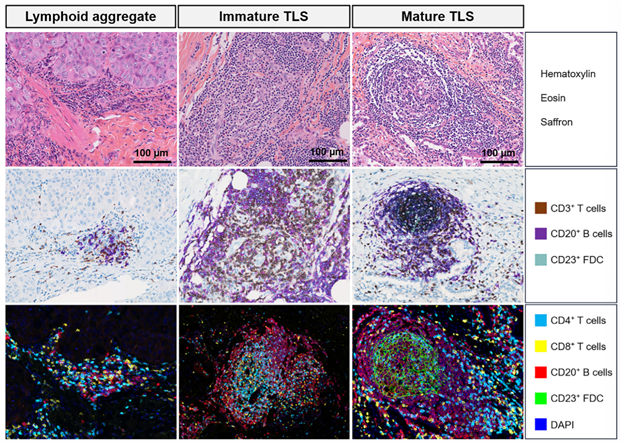
Figure 2. Representative images of different approaches used to identify and quantify TLS in tumors at different maturation stages, including H&E stain (upper row), immunohistochemistry (middle row), and multiplex immunofluorescence (bottom row). Image courtesy of Peyraud et al. (2025)2.
Next-Generation Sequencing
Finally, to fully appreciate the complex biology of TLSs, high-dimensional approaches such as multi-omics analysis will be crucial. For example, Proteintech’s MultiPro® Human Discovery Panel supports simultaneous profiling of 325 proteins alongside whole-transcriptome analysis at single-cell resolution, offering powerful insights into TLS-related cellular mechanisms.
Looking Ahead
Evidently, TLSs represent an exciting and rapidly advancing area of research, with many questions still unanswered. A deeper understanding of their molecular and immunological mechanisms will be key to harnessing these structures to improve cancer patient outcomes.
References
-
Zhao, L., Jin, S., Wang, S., Zhang, Z., Wang, X., Chen, Z., Wang, X., Huang, S., Zhang, D., & Wu, H. Tertiary lymphoid structures in diseases: immune mechanisms and therapeutic advances. Signal Transduction and Targeted Therapy 9, 225 (2024).
-
Peyraud, F., Guegan, J.-P., Vanhersecke, L., Brunet, M., Teyssonneau, D., Palmieri, L.-J., Bessede, A., & Italiano, A. Tertiary lymphoid structures and cancer immunotherapy: From bench to bedside. Med 6, 100546 (2025).
-
Sato, Y., Silina, K., van den Broek, M., Hirahara, K. & Yanagita, M. The roles of tertiary lymphoid structures in chronic diseases. Nature Reviews Nephrology 19, 525-537 (2023).
-
Zhang, K., Xie, X., Zheng, S.-L., Deng, Y.-R., Liao, D., Yan, H.-C., Kang, X., Jiang, H.-P., & Guo, S.-Q. Tertiary lymphoid structures in gynecological cancers: prognostic role, methods for evaluating, antitumor immunity, and induction for therapy. Frontiers in Oncology 13 (2023).
-
Vanhersecke, L., Brunet, M., Guégan, J.-P., Rey, C., Bougouin, A., Cousin, S., Le Moulec, S., Besse, B., Loriot, Y., Larroquette, M., Soubeyran, I., Toulmonde, M., Roubaud, G., Pernot, S., Cabart, M., Chomy, F., Lefevre, C., Bourcier, K., Kind, M., Giglioli, I., Sautès-Fridman, C., Velasco, V., Courgeon, F., Oflazoglu, E., Savina, A., Marabelle, A., Soria, J.-C., Bellera, C., Sofeu, C., Bessede, A., Fridman, W.H., Le Loarer, F., & Italiano, A. Mature tertiary lymphoid structures predict immune checkpoint inhibitor efficacy in solid tumors independently of PD-L1 expression. Nature Cancer 2, 794-802 (2021).
-
Zhang, Y., Xu, M., Ren, Y., Ba, Y., Liu, S., Zuo, A., Xu, H., Weng, S., Han, X., & Liu, Z. Tertiary lymphoid structural heterogeneity determines tumour immunity and prospects for clinical application. Molecular Cancer 23, 75 (2024).
-
Im, S.J., Obeng, R.C., Nasti, T.H., McManus, D., Kamphorst, A.O., Gunisetty, S., Prokhnevska, N., Carlisle, J.W., Yu, K., Sica, G.L., Cardozo, L.E., Gonçalves, A.N.A., Kissick, H.T., Nakaya, H.I., Ramalingam, S.S., & Ahmed, R. Characteristics and anatomic location of PD-1+TCF1+ stem-like CD8 T cells in chronic viral infection and cancer. Proceedings of the National Academy of Sciences 120, e2221985120 (2023).
-
Vanhersecke, L., Bougouin, A., Crombé, A., Brunet, M., Sofeu, C., Parrens, M., Pierron, H., Bonhomme, B., Lembege, N., Rey, C., Velasco, V., Soubeyran, I., Begueret, H., Bessede, A., Bellera, C., Scoazec, J.-Y., Italiano, A., Fridman, C.S., Fridman, W.H., & Le Loarer, F. Standardized Pathology Screening of Mature Tertiary Lymphoid Structures in Cancers. Laboratory Investigation 103, 100063 (2023).
-
Silina, K. & Ciompi, F. Cancer-Associated Lymphoid Aggregates in Histology Images: Manual and Deep Learning-Based Quantification Approaches. in Tertiary Lymphoid Structures: Methods and Protocols (ed. Dieu-Nosjean, M.-C.) 231-246 (Springer US, New York, NY, 2025).
-
van Rijthoven, M., Obahor, S., Pagliarulo, F., van den Broek, M., Schraml, P., Moch, H., van der Laak, J., Ciompi, F., & Silina, K. Multi-resolution deep learning characterizes tertiary lymphoid structures and their prognostic relevance in solid tumors. Communications Medicine (Lond) 4, 5 (2024).

Related Content
Immune Checkpoint Inhibitor Therapy: Revolutionizing Cancer Treatment
Immunotherapy: boosting the immune system to fight rare cancers
Cancer stem cells as a key to cure cancer
A beginners guide to Immunohistochemistry
How to choose your recombinant proteins, cytokines & growth-factors
Support
Newsletter Signup
Stay up-to-date with our latest news and events. New to Proteintech? Get 10% off your first order when you sign up.