
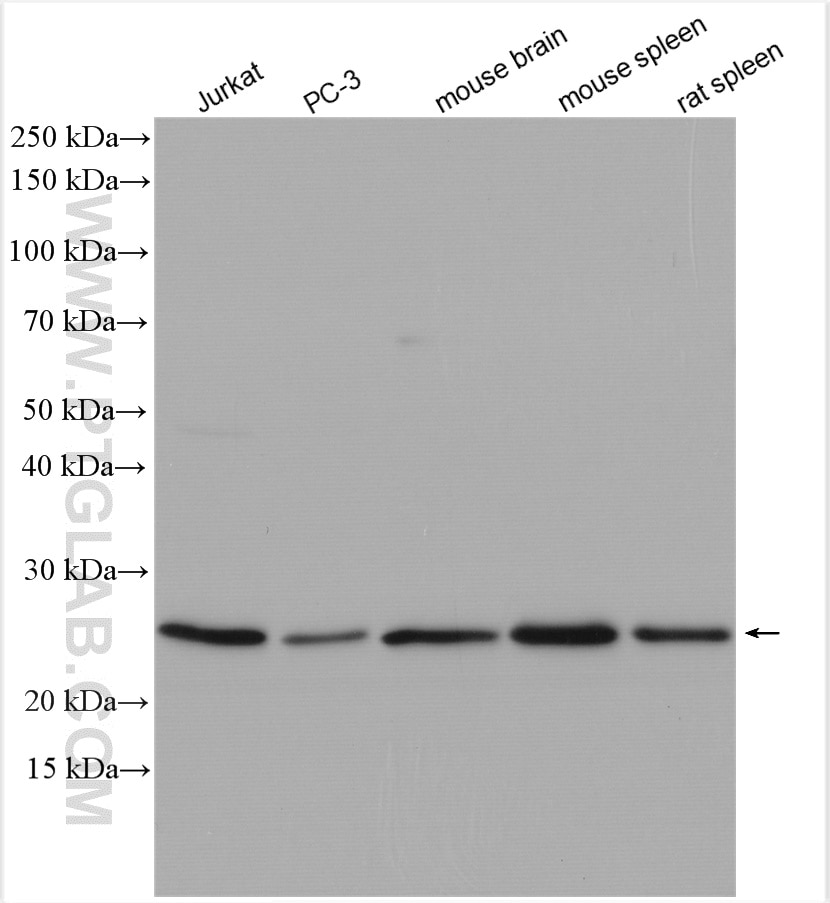
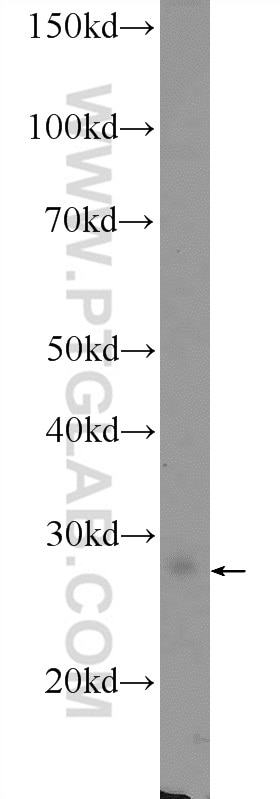
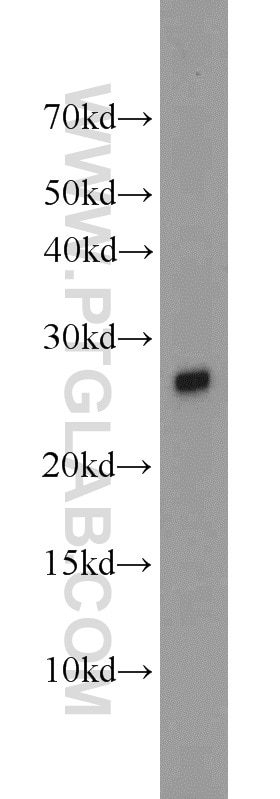
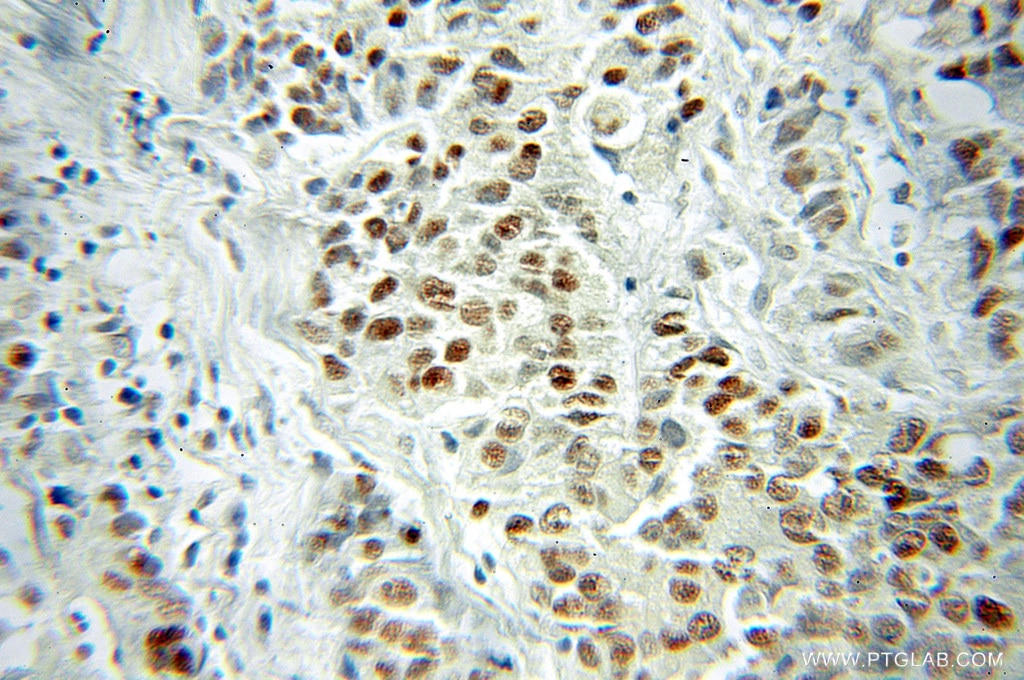

Tested Applications
| Positive WB detected in | Jurkat cells, human brain tissue, rat brain tissue, PC-3 cells, mouse brain tissue, mouse spleen tissue, rat spleen tissue |
| Positive IHC detected in | human prostate cancer tissue Note: suggested antigen retrieval with TE buffer pH 9.0; (*) Alternatively, antigen retrieval may be performed with citrate buffer pH 6.0 |
Recommended dilution
| Application | Dilution |
|---|---|
| Western Blot (WB) | WB : 1:1000-1:6000 |
| Immunohistochemistry (IHC) | IHC : 1:20-1:200 |
| It is recommended that this reagent should be titrated in each testing system to obtain optimal results. | |
| Sample-dependent, Check data in validation data gallery. | |
Product Information
10124-2-AP targets VGLL1 in WB, IHC, IF, IP, RIP, ELISA applications and shows reactivity with human, mouse, rat samples.
| Tested Reactivity | human, mouse, rat |
| Cited Reactivity | human, mouse |
| Host / Isotype | Rabbit / IgG |
| Class | Polyclonal |
| Type | Antibody |
| Immunogen |
CatNo: Ag0169 Product name: Recombinant human VGLL1 protein Source: e coli.-derived, PGEX-4T Tag: GST Domain: 38-255 aa of BC000045 Sequence: SSVVDEHFSRALSNIKSPQELTPSSQSEGVMLKNDDSMSPNQWRYSSPWTKPQPEVPVTNRAANCNLHVPGPMAVNQFSPSLARRASVRPGELWHFSSLAGTSSLEPGYSHPFPARHLVPEPQPDGKREPLLSLLQQDRCLARPQESAARENGNPGQIAGSTGLLFNLPPGSVHYKKLYVSRGSASTSLPNETLSELETPGKYSLTPPNHWGHPHRYL Predict reactive species |
| Full Name | vestigial like 1 (Drosophila) |
| Calculated Molecular Weight | 29 kDa |
| Observed Molecular Weight | 26-29 kDa |
| GenBank Accession Number | BC000045 |
| Gene Symbol | VGLL1 |
| Gene ID (NCBI) | 51442 |
| RRID | AB_2218174 |
| Conjugate | Unconjugated |
| Form | Liquid |
| Purification Method | Antigen affinity purification |
| UNIPROT ID | Q99990 |
| Storage Buffer | PBS with 0.02% sodium azide and 50% glycerol, pH 7.3. |
| Storage Conditions | Store at -20°C. Stable for one year after shipment. Aliquoting is unnecessary for -20oC storage. 20ul sizes contain 0.1% BSA. |
Background Information
VGLL1 is a specific coactivator for the mammalian TEFs. It can bind proteins of the TEA domain family of transcription factors. Vgll1-TEFs complex upregulates the expression of IGFBP-5, a proliferation-promoting gene, and facilitates anchorage-independent cell proliferation. The calculated molecular weight of VGLL1 is 29 kDa, and the observed molecular weight is 26-29 kDa(PMID:31816819,33087697).
Protocols
| Product Specific Protocols | |
|---|---|
| IHC protocol for VGLL1 antibody 10124-2-AP | Download protocol |
| WB protocol for VGLL1 antibody 10124-2-AP | Download protocol |
| Standard Protocols | |
|---|---|
| Click here to view our Standard Protocols |
Publications
What published studies show
The VGLL1 Polyclonal antibody (Cat# 10124-2-AP) has 7 citations across journals including Cancer Research, International Journal of Molecular Sciences, Scientific Reports, Cancers, iScience, Endocrine-Related Cancer, and Frontiers in Oncology. Research fields span breast cancer, gastric cancer, bladder cancer, and ovarian cancer, with studies focusing on Wnt/β-catenin signaling, metastasis, tumorigenesis, and estrogen receptor-targeted therapy resistance.
| Species | Application | Title |
|---|---|---|
Cancer Res Induction of the TEAD Co-activator VGLL1 by Estrogen Receptor-Targeted Therapy Drives Resistance in Breast Cancer
| ||
Int J Mol Sci TNF−α Secreted from Macrophages Increases the Expression of Prometastatic Integrin αV in Gastric Cancer
| ||
Sci Rep A novel signature constructed by mitochondrial function and cell death-related gene for the prediction of prognosis in bladder cancer | ||
Cancers (Basel) PI3K/AKT/β-Catenin Signaling Regulates Vestigial-Like 1 Which Predicts Poor Prognosis and Enhances Malignant Phenotype in Gastric Cancer.
| ||
iScience N6-methyladenosine-modified VGLL1 promotes ovarian cancer metastasis through high-mobility group AT-hook 1/Wnt/β-catenin signaling | ||
Endocr Relat Cancer Vgll1 expression is associated with a triple-negative basal-like phenotype in breast cancer. |
Reviews
What customers say
The product received a 4-star rating from a user who tested it by Western Blot at a 1:1000 dilution on human urothelial cells. No additional written comments were provided beyond the experimental conditions. Overall, the reviewer indicated a positive experience with the antibody's performance in this application.
The reviews below have been submitted by verified Proteintech customers who received an incentive for providing their feedback.
Jennifer (Verified Customer) (06-10-2022) |
|





