
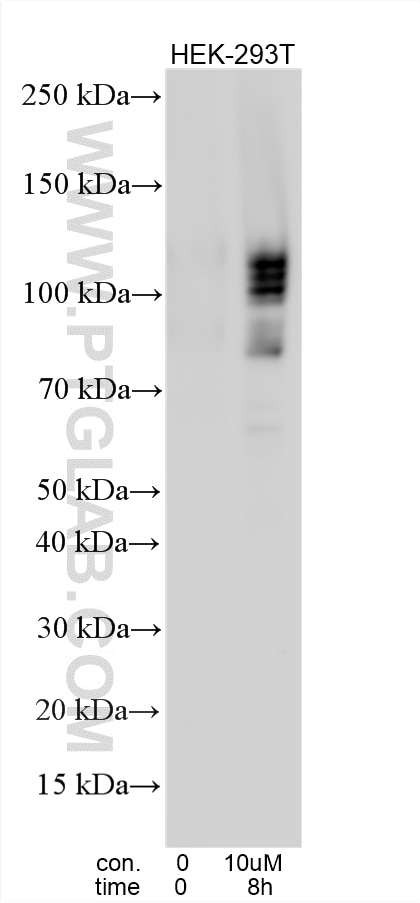



Tested Applications
| Positive WB detected in | HEK-293T cells |
| Positive IP detected in | mouse skeletal muscle tissue |
| Positive IHC detected in | human breast cancer tissue, mouse brain tissue Note: suggested antigen retrieval with TE buffer pH 9.0; (*) Alternatively, antigen retrieval may be performed with citrate buffer pH 6.0 |
Recommended dilution
| Application | Dilution |
|---|---|
| Western Blot (WB) | WB : 1:2000-1:10000 |
| Immunoprecipitation (IP) | IP : 0.5-4.0 ug for 1.0-3.0 mg of total protein lysate |
| Immunohistochemistry (IHC) | IHC : 1:50-1:500 |
| It is recommended that this reagent should be titrated in each testing system to obtain optimal results. | |
| Sample-dependent, Check data in validation data gallery. | |
Product Information
12936-1-AP targets NFE2L1 in WB, IHC, IF, IP, chIP, ELISA applications and shows reactivity with human, mouse, rat samples.
| Tested Reactivity | human, mouse, rat |
| Cited Reactivity | human, mouse, rat |
| Host / Isotype | Rabbit / IgG |
| Class | Polyclonal |
| Type | Antibody |
| Immunogen |
CatNo: Ag3916 Product name: Recombinant human NFE2L1 protein Source: e coli.-derived, PGEX-4T Tag: GST Domain: 293-742 aa of BC010623 Sequence: MQAMEVNTSASEILYSAPPGDPLSTNYSLAPNTPINQNVSLHQASLGGCSQDFLLFSPEVESLPVASSSTLLPLAPSNSTSLNSTFGSTNLTGLFFPPQLNGTANDTAGPELPDPLGGLLDEAMLDEISLMDLAIEEGFNPVQASQLEEEFDSDSGLSLDSSHSPSSLSSSEGSSSSSSSSSSSSSSASSSASSSFSEEGAVGYSSDSETLDLEEAEGAVGYQPEYSKFCRMSYQDPAQLSCLPYLEHVGHNHTYNMAPSALDSADLPPPSALKKGSKEKQADFLDKQMSRDEHRARAMKIPFTNDKIINLPVEEFNELLSKYQLSEAQLSLIRDIRRRGKNKMAAQNCRKRKLDTILNLERDVEDLQRDKARLLREKVEFLRSLRQMKQKVQSLYQEVFGRLRDENGRPYSPSQYALQYAGDGSVLLIPRTMADQQARRQERKPKDRRK Predict reactive species |
| Full Name | nuclear factor (erythroid-derived 2)-like 1 |
| Calculated Molecular Weight | 772 aa, 85 kDa |
| Observed Molecular Weight | 65-120 kDa |
| GenBank Accession Number | BC010623 |
| Gene Symbol | NFE2L1 |
| Gene ID (NCBI) | 4779 |
| RRID | AB_2267298 |
| Conjugate | Unconjugated |
| Form | Liquid |
| Purification Method | Antigen affinity purification |
| UNIPROT ID | Q14494 |
| Storage Buffer | PBS with 0.02% sodium azide and 50% glycerol, pH 7.3. |
| Storage Conditions | Store at -20°C. Stable for one year after shipment. Aliquoting is unnecessary for -20oC storage. 20ul sizes contain 0.1% BSA. |
Background Information
NFE2L1, also named as HBZ17, NRF1, TCF11 and LCR-F1, belongs to the bZIP family and CNC subfamily. It activates erythroid-specific, globin gene expression. NFE2L1 is involved in mediating ascorbic acid-induced osterix expression and osteoblast differentiation via binding to the antioxidant response element of the osterix promoter. NFE2L1, produced by osteoblasts, is involved in regulating osterix expression, osteoblast differentiation, and bone formation. (PMID:19887580).
Protocols
| Product Specific Protocols | |
|---|---|
| IHC protocol for NFE2L1 antibody 12936-1-AP | Download protocol |
| IP protocol for NFE2L1 antibody 12936-1-AP | Download protocol |
| WB protocol for NFE2L1 antibody 12936-1-AP | Download protocol |
| Standard Protocols | |
|---|---|
| Click here to view our Standard Protocols |
Publications
What published studies show
Anti-NFE2L1 (12936-1-AP) has 16 citations across 15 journals including Redox Biology, Science Translational Medicine, Science Advances, Cell Death & Disease, Free Radical Biology and Medicine, and others. Research fields span adipogenesis, lipid metabolism, diabetic nephropathy, atherosclerosis, cancer (cholangiocarcinoma, glioblastoma, prostate), neuroprotection, autophagy, macrophage signaling, bone biology, and placental biology. Applications include WB, IF, IP, and ChIP in human, mouse, and rat samples.
| Species | Application | Title |
|---|---|---|
Redox Biol Long isoforms of NRF1 negatively regulate adipogenesis via suppression of PPARγ expression. | ||
Sci Transl Med PTEN status determines chemosensitivity to proteasome inhibition in cholangiocarcinoma. | ||
Cell Death Dis A dual Keap1 and p47phox inhibitor Ginsenoside Rb1 ameliorates high glucose/ox-LDL-induced endothelial cell injury and atherosclerosis | ||
Free Radic Biol Med Nrf1 regulates lipid metabolism through the PPAR⍺ signaling pathway and influences the fibrotic process in diabetic nephropathy. | ||
Free Radic Biol Med Novel mechanistic insight on the neuroprotective effect of berberine: The role of PPARδ for antioxidant action. |



