

Tested Applications
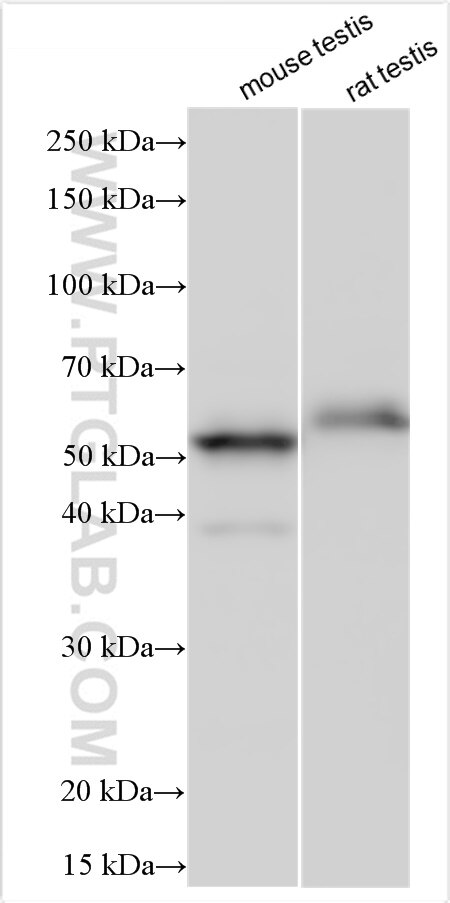
| Positive WB detected in | mouse testis tissue, rat testis tissue |
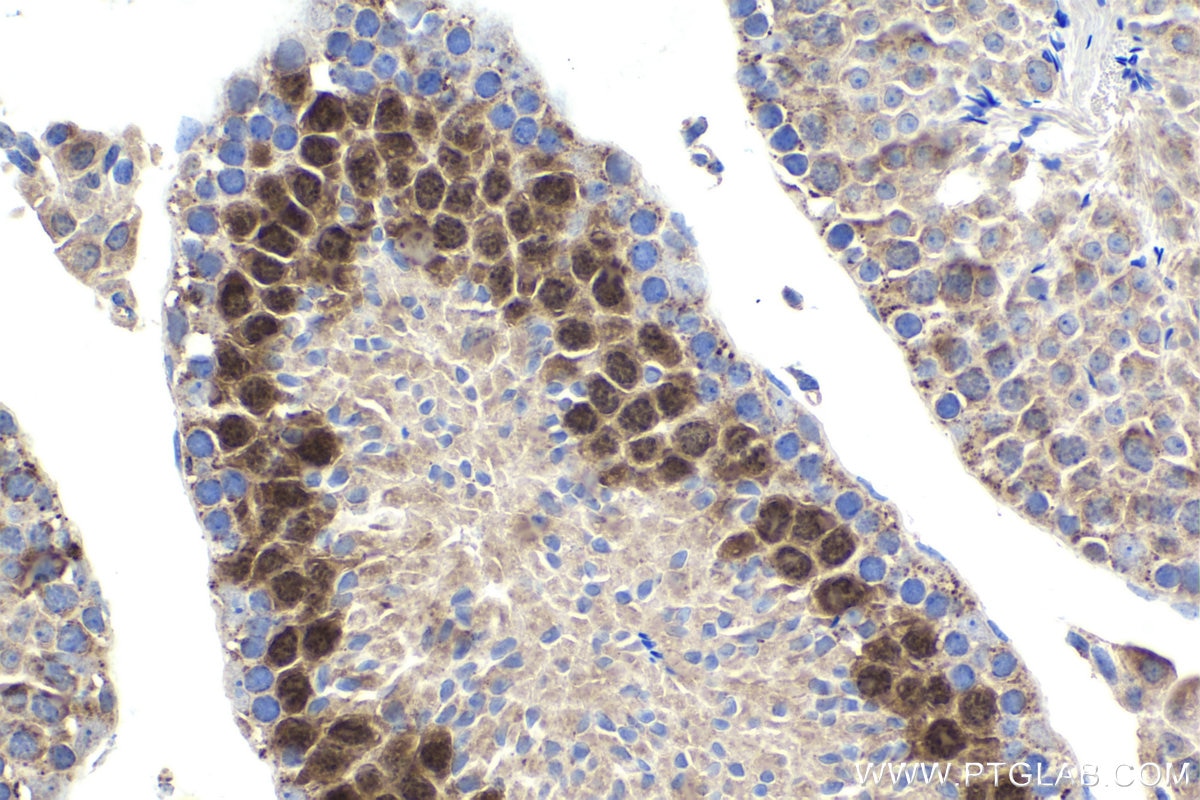
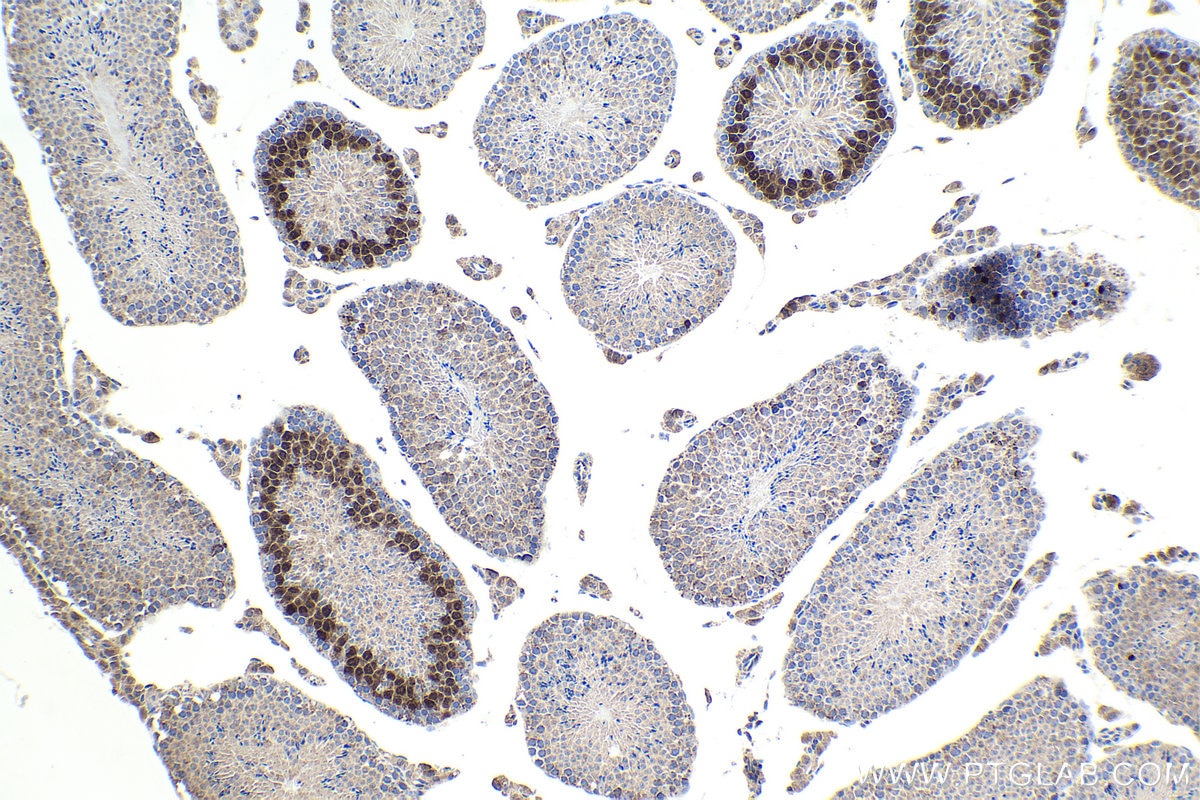
| Positive IHC detected in | mouse testis tissue Note: suggested antigen retrieval with TE buffer pH 9.0; (*) Alternatively, antigen retrieval may be performed with citrate buffer pH 6.0 |
Recommended dilution
| Application | Dilution |
|---|---|
| Western Blot (WB) | WB : 1:500-1:1000 |
| Immunohistochemistry (IHC) | IHC : 1:500-1:2000 |
| It is recommended that this reagent should be titrated in each testing system to obtain optimal results. | |
| Sample-dependent, Check data in validation data gallery. | |
Product Information
13295-1-AP targets Cyclin A1 in WB, IHC, IF, ELISA applications and shows reactivity with human, mouse, rat samples.
| Tested Reactivity | human, mouse, rat |
| Cited Reactivity | human, mouse, rat, bovine |
| Host / Isotype | Rabbit / IgG |
| Class | Polyclonal |
| Type | Antibody |
| Immunogen |
CatNo: Ag4005 Product name: Recombinant human CCNA1 protein Source: e coli.-derived, PGEX-4T Tag: GST Domain: 166-465 aa of BC036346 Sequence: GTLKSDLHFLLDFNTVSPMLVDSSLLSQSEDISSLGTDVINVTEYAEEIYQYLREAEIRHRPKAHYMKKQPDITEGMRTILVDWLVEVGEEYKLRAETLYLAVNFLDRFLSCMSVLRGKLQLVGTAAMLLASKYEEIYPPEVDEFVYITDDTYTKRQLLKMEHLLLKVLAFDLTVPTTNQFLLQYLRRQGVCVRTENLAKYVAELSLLEADPFLKYLPSLIAAAAFCLANYTVNKHFWPETLAAFTGYSLSEIVPCLSELHKAYLDIPHRPQQAIREKYKASKYLCVSLMEPPAVLLLQ Predict reactive species |
| Full Name | cyclin A1 |
| Calculated Molecular Weight | 464 aa, 52 kDa |
| Observed Molecular Weight | 52 kDa |
| GenBank Accession Number | BC036346 |
| Gene Symbol | Cyclin A1 |
| Gene ID (NCBI) | 8900 |
| RRID | AB_2071993 |
| Conjugate | Unconjugated |
| Form | Liquid |
| Purification Method | Antigen affinity purification |
| UNIPROT ID | P78396 |
| Storage Buffer | PBS with 0.02% sodium azide and 50% glycerol, pH 7.3. |
| Storage Conditions | Store at -20°C. Stable for one year after shipment. Aliquoting is unnecessary for -20oC storage. 20ul sizes contain 0.1% BSA. |
Background Information
CCNA1 belongs to the highly conserved cyclin family, whose members are characterized by a dramatic periodicity in protein abundance through the cell cycle. CCNA1 binds both CDK2 and CDC2 kinases, which give two distinct kinase activities, one appearing in S phase, the other in G2, and thus regulate separate functions in cell cycle. CCNA1 was found to bind to important cell cycle regulators, such as Rb family proteins, transcription factor E2F-1, and the p21 family proteins. In general, the expression of CCNA1 is tissue-specific and high CCNA1 expression is limited to testis; besides, lower levels of CCNA1 expression are also observed in other human cell lines and in healthy brain. Currently, CCNA1 expression has been illustrated to be downregulated in various tumors, including head and neck squamous-cell cancer (HNSCC) and nasopharyngeal carcinoma; and the promoter of the CCNA1 gene is found to be frequently methylated in colon cancer and HNSCC.
Protocols
| Product Specific Protocols | |
|---|---|
| IHC protocol for Cyclin A1 antibody 13295-1-AP | Download protocol |
| WB protocol for Cyclin A1 antibody 13295-1-AP | Download protocol |
| Standard Protocols | |
|---|---|
| Click here to view our Standard Protocols |
Publications
What published studies show
13295-1-AP (anti-PCNA monoclonal antibody) has accumulated 40 citations across journals such as Molecular Cancer, Nature Cardiovascular Research, Current Biology, Biomaterials, International Journal of Biological Sciences, Cell Molecular Life Sciences, European Journal of Pharmacology, and Bioorganic Chemistry. Associated research fields include cell cycle regulation, oncology (colorectal, breast, hepatic, endometrial, and pancreatic cancers), pulmonary hypertension, angiogenesis, cardiomyocyte proliferation, meiosis, apoptosis, and nanomedicine-based drug delivery.
| Species | Application | Title |
|---|---|---|
Mol Cancer MicroRNA-505 functions as a tumor suppressor in endometrial cancer by targeting TGF-α. | ||
Adv Sci (Weinh) m6A Reader hnRNPA2B1 Modulates Late Pachytene Progression in Male Meiosis Through Post-Transcriptional Control | ||
Biomaterials Biocompatible PEGylated Gold nanorods function As cytokinesis inhibitors to suppress angiogenesis. | ||
Nat Cardiovasc Res α-Ketoglutarate promotes cardiomyocyte proliferation and heart regeneration after myocardial infarction | ||
Int J Biol Sci IKBKE regulates renal cell carcinoma progression and sunitinib resistance through the RRM2-AKT pathway | ||
Sci China Life Sci Alpha-ketoglutarate restores oral epithelial homeostasis via FOXM1-mediated cell cycle regulation. |




