

Tested Applications
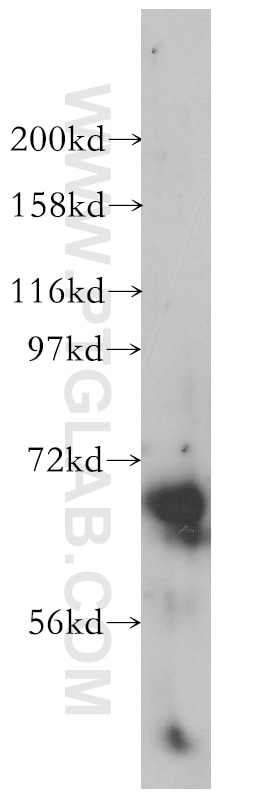
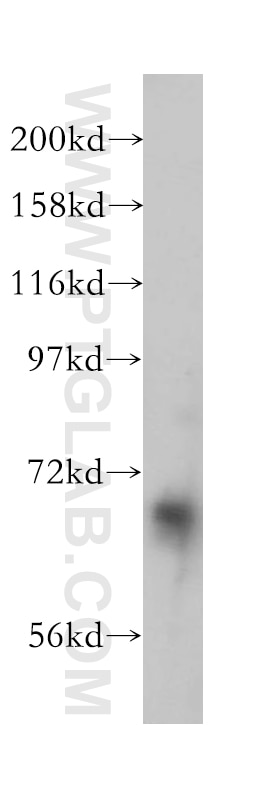
| Positive WB detected in | mouse spleen tissue, mouse heart tissue |
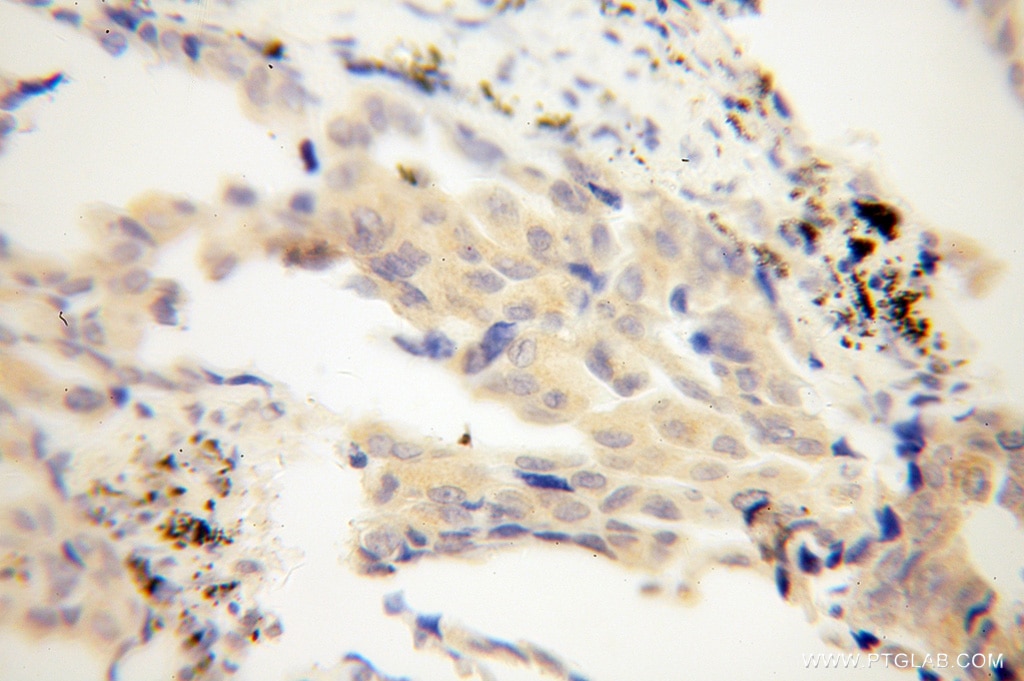
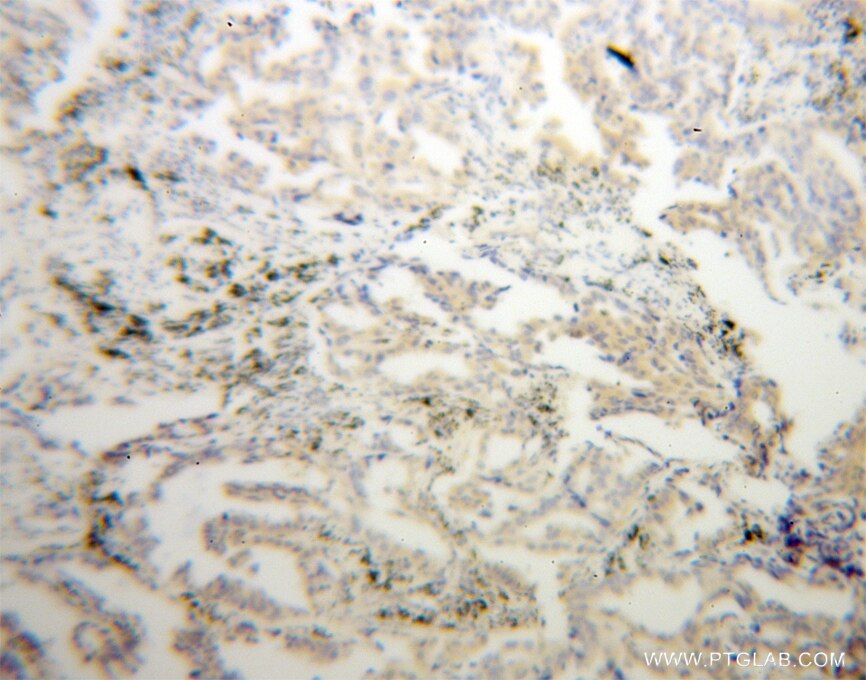
| Positive IHC detected in | human lung cancer tissue Note: suggested antigen retrieval with TE buffer pH 9.0; (*) Alternatively, antigen retrieval may be performed with citrate buffer pH 6.0 |
Recommended dilution
| Application | Dilution |
|---|---|
| Western Blot (WB) | WB : 1:500-1:1000 |
| Immunohistochemistry (IHC) | IHC : 1:20-1:200 |
| It is recommended that this reagent should be titrated in each testing system to obtain optimal results. | |
| Sample-dependent, Check data in validation data gallery. | |
Product Information
14420-1-AP targets CHSY1 in WB, IHC, IF, ELISA applications and shows reactivity with human, mouse samples.
| Tested Reactivity | human, mouse |
| Cited Reactivity | human, mouse, rat |
| Host / Isotype | Rabbit / IgG |
| Class | Polyclonal |
| Type | Antibody |
| Immunogen |
CatNo: Ag5766 Product name: Recombinant human CHSY1 protein Source: e coli.-derived, PGEX-4T Tag: GST Domain: 449-802 aa of BC046247 Sequence: LDLLLLYKKHKGKKMTVPVRRHAYLQQTFSKIQFVEHEELDAQELAKRINQESGSLSFLSNSLKKLVPFQLPGSKSEHKEPKDKKINILIPLSGRFDMFVRFMGNFEKTCLIPNQNVKLVVLLFNSDSNPDKAKQVELMRDYRIKYPKADMQILPVSGEFSRALALEVGSSQFNNESLLFFCDVDLVFTTEFLQRCRANTVLGQQIYFPIIFSQYDPKIVYSGKVPSDNHFAFTQKTGFWRNYGFGITCIYKGDLVRVGGFDVSIQGWGLEDVDLFNKVVQAGLKTFRSQEVGVVHVHHPVFCDPNLDPKQYKMCLGSKASTYGSTQQLAEMWLEKNDPSYSKSSNNNGSVRTA Predict reactive species |
| Full Name | chondroitin sulfate synthase 1 |
| Calculated Molecular Weight | 92 kDa |
| Observed Molecular Weight | 60-92 kDa |
| GenBank Accession Number | BC046247 |
| Gene Symbol | CHSY1 |
| Gene ID (NCBI) | 22856 |
| RRID | AB_2079227 |
| Conjugate | Unconjugated |
| Form | Liquid |
| Purification Method | Antigen affinity purification |
| UNIPROT ID | Q86X52 |
| Storage Buffer | PBS with 0.02% sodium azide and 50% glycerol, pH 7.3. |
| Storage Conditions | Store at -20°C. Stable for one year after shipment. Aliquoting is unnecessary for -20oC storage. 20ul sizes contain 0.1% BSA. |
Protocols
| Product Specific Protocols | |
|---|---|
| IHC protocol for CHSY1 antibody 14420-1-AP | Download protocol |
| WB protocol for CHSY1 antibody 14420-1-AP | Download protocol |
| Standard Protocols | |
|---|---|
| Click here to view our Standard Protocols |
Publications
What published studies show
The CHSY1 Polyclonal antibody (Cat# 14420-1-AP) has 7 citations published in Advanced Science, Materials Today Bio, American Journal of Human Genetics, International Journal of Molecular Sciences, Frontiers in Neuroscience, Human Cell, and Oncotarget. Research fields span intervertebral disc degeneration and extracellular matrix homeostasis, spinal cord injury repair, NOTCH signaling and brachydactyly genetics, osteosarcoma progression, sleep/memory dysfunction in psychiatric disorders, glioma progression, and chondroitin sulfate biosynthesis.
| Species | Application | Title |
|---|---|---|
Adv Sci (Weinh) Sensory Nerve Maintains Intervertebral Disc Extracellular Matrix Homeostasis Via CGRP/CHSY1 Axis
| ||
Mater Today Bio Hyaluronidase-responsive hydrogel loaded with magnetic nanoparticles combined with external magnetic stimulation for spinal cord injury repair | ||
Am J Hum Genet Loss of CHSY1, a secreted FRINGE enzyme, causes syndromic brachydactyly in humans via increased NOTCH signaling. | ||
Int J Mol Sci KIF18B Modulates SKP2 Ubiquitination to Promote Aerobic Glycolysis and Osteosarcoma Progression. | ||
Front Neurosci Sleep and Memory Consolidation Dysfunction in Psychiatric Disorders: Evidence for the Involvement of Extracellular Matrix Molecules. | ||
Hum Cell LncRNA LINC01094 contributes to glioma progression by modulating miR-224-5p/CHSY1 axis. |





