
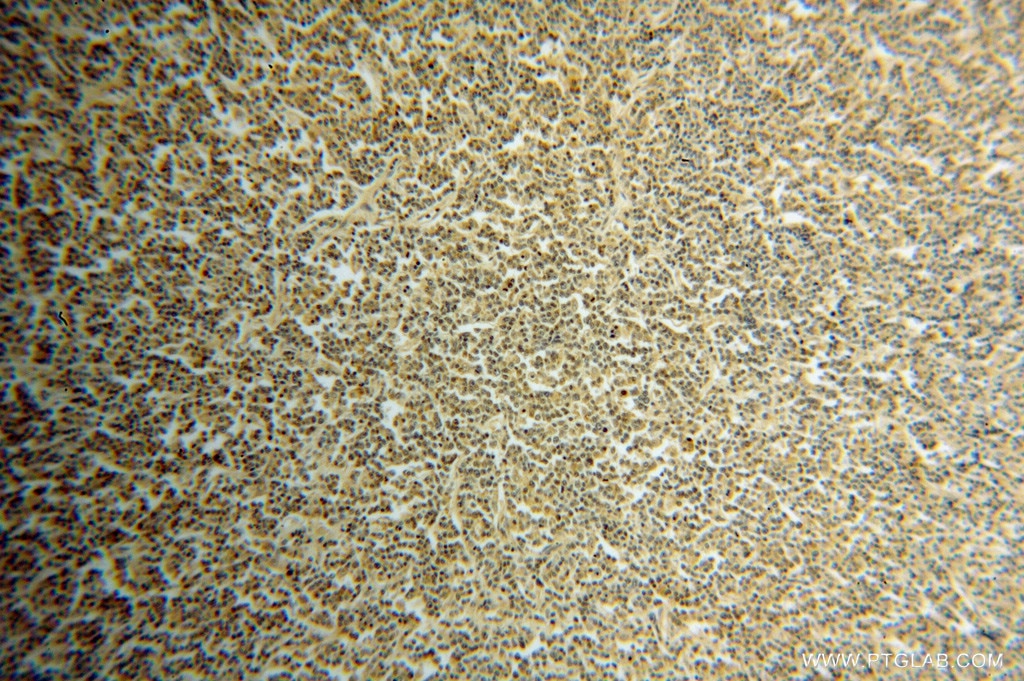
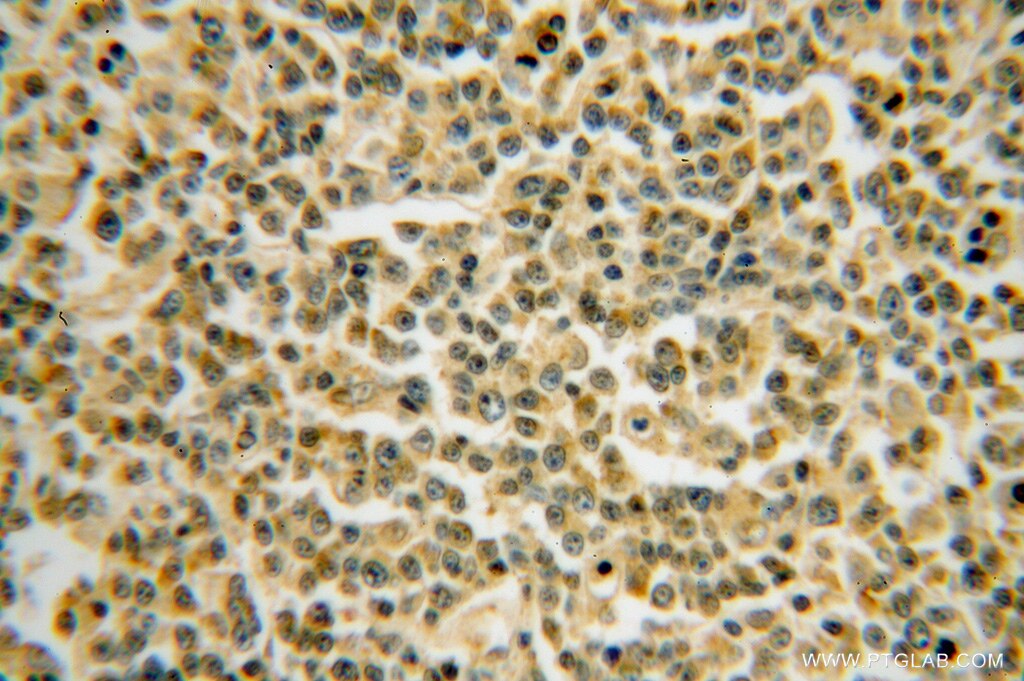

Tested Applications
| Positive IHC detected in | human thyroid cancer tissue, human lymphoma tissue Note: suggested antigen retrieval with TE buffer pH 9.0; (*) Alternatively, antigen retrieval may be performed with citrate buffer pH 6.0 |
Recommended dilution
| Application | Dilution |
|---|---|
| Immunohistochemistry (IHC) | IHC : 1:50-1:500 |
| It is recommended that this reagent should be titrated in each testing system to obtain optimal results. | |
| Sample-dependent, Check data in validation data gallery. | |
Product Information
14879-1-AP targets BTG1 in WB, IHC, IF, ELISA applications and shows reactivity with human, mouse, rat samples.
| Tested Reactivity | human, mouse, rat |
| Cited Reactivity | human, mouse |
| Host / Isotype | Rabbit / IgG |
| Class | Polyclonal |
| Type | Antibody |
| Immunogen |
CatNo: Ag6651 Product name: Recombinant human BTG1 protein Source: e coli.-derived, PGEX-4T Tag: GST Domain: 1-171 aa of BC064953 Sequence: MHPFYTRAATMIGEIAAAVSFISKFLRTKGLTSERQLQTFSQSLQELLAEHYKHHWFPEKPCKGSGYRCIRINHKMDPLIGQAAQRIGLSSQELFRLLPSELTLWVDPYEVSYRIGEDGSICVLYEASPAGGSTQNSTNVQMVDSRISCKEELLLGRTSPSKNYNMMTVSG Predict reactive species |
| Full Name | B-cell translocation gene 1, anti-proliferative |
| Calculated Molecular Weight | 19 kDa |
| GenBank Accession Number | BC064953 |
| Gene Symbol | BTG1 |
| Gene ID (NCBI) | 694 |
| RRID | AB_2067644 |
| Conjugate | Unconjugated |
| Form | Liquid |
| Purification Method | Antigen affinity purification |
| UNIPROT ID | P62324 |
| Storage Buffer | PBS with 0.02% sodium azide and 50% glycerol, pH 7.3. |
| Storage Conditions | Store at -20°C. Stable for one year after shipment. Aliquoting is unnecessary for -20oC storage. 20ul sizes contain 0.1% BSA. |
Background Information
BTG1 is a member of the TOB/BTG family of proteins known to inhibit cell proliferation and negatively regulate the cell cycle (PMID: 25017022). It is strongly expressed in quiescent cells (maximal in the G0/G1 phase) and down-regulated as the cells enter the growth cycle (PMID: 1373383). BTG1 protein is localized in cytoplasm and nucleus, and can interact with CAF1 and PRMT1 (PMID: 1113675, 9712883, 26622543). The aberration of BTG1 expression is associated with B-cell lymphocytic leukemia, and may serve as a diagnostic indicator and prognostic marker of thyroid carcinoma (PMID: 2069907, 25017022).
Protocols
| Product Specific Protocols | |
|---|---|
| IHC protocol for BTG1 antibody 14879-1-AP | Download protocol |
| Standard Protocols | |
|---|---|
| Click here to view our Standard Protocols |
Publications
What published studies show
The antibody BTG1 (Cat# 14879-1-AP) has 12 citations published in journals including Advanced Science, Oncotarget, International Journal of Molecular Sciences, iScience, Frontiers in Oncology, Molecular Medicine Reports, Journal of Cellular Physiology, International Journal of Molecular Medicine, Oncology Letters, Frontiers in Bioscience, and International Journal of Women's Health. Research fields span gastric cancer, ovarian carcinoma, breast cancer, colorectal cancer, nasopharyngeal carcinoma, acute myeloid leukemia, liver fibrosis, and ovarian hypofunction.
| Species | Application | Title |
|---|---|---|
Adv Sci (Weinh) HIGD1A Alleviates Oxidative Stress Related Ovarian Hypofunction by Enhancing Granulosa Cell Functions via NF-κB/SOD2 Signaling Pathway | ||
Int J Mol Med B cell translocation gene 1 reduces the biological outcome of kidney cancer through induction of cell proliferation, cell cycle arrest, cell apoptosis and cell metastasis. | ||
Oncotarget BTG1 expression correlates with pathogenesis, aggressive behaviors and prognosis of gastric cancer: a potential target for gene therapy. | ||
Int J Mol Sci BTG1 expression correlates with the pathogenesis and progression of ovarian carcinomas. | ||
Mol Med Rep Exosomal microRNA-301a-3p promotes the proliferation and invasion of nasopharyngeal carcinoma cells by targeting BTG1 mRNA | ||
iScience Prognostic value of BTG1 for predicting decitabine sensitivity in de novo acute myeloid leukemia.
|



