




Tested Applications
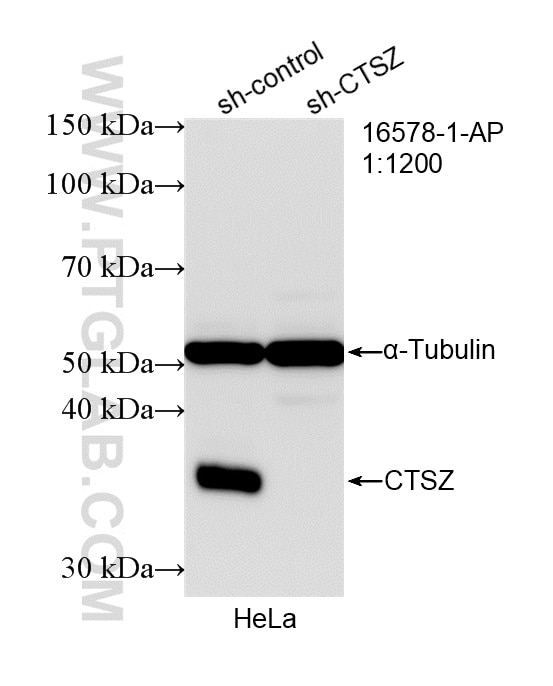
| Positive WB detected in | HeLa cells |
| Positive IP detected in | HeLa cells |
| Positive IHC detected in | human pancreas tissue Note: suggested antigen retrieval with TE buffer pH 9.0; (*) Alternatively, antigen retrieval may be performed with citrate buffer pH 6.0 |
Recommended dilution
| Application | Dilution |
|---|---|
| Western Blot (WB) | WB : 1:500-1:3000 |
| Immunoprecipitation (IP) | IP : 0.5-4.0 ug for 1.0-3.0 mg of total protein lysate |
| Immunohistochemistry (IHC) | IHC : 1:50-1:500 |
| It is recommended that this reagent should be titrated in each testing system to obtain optimal results. | |
| Sample-dependent, Check data in validation data gallery. | |
Product Information
16578-1-AP targets CTSZ in WB, IHC, IF, IP, ELISA applications and shows reactivity with human, mouse, rat samples.
| Tested Reactivity | human, mouse, rat |
| Cited Reactivity | human, mouse |
| Host / Isotype | Rabbit / IgG |
| Class | Polyclonal |
| Type | Antibody |
| Immunogen |
CatNo: Ag9865 Product name: Recombinant human CTSZ protein Source: e coli.-derived, PGEX-4T Tag: GST Domain: 1-303 aa of BC042168 Sequence: MARRGPGWRPLLLLVLLAGAAQGGLYFRRGQTCYRPLRGDGLAPLGRSTYPRPHEYLSPADLPKSWDWRNVDGVNYASITRNQHIPQYCGSCWAHASTSAMADRINIKRKGAWPSTLLSVQNVIDCGNAGSCEGGNDLSVWDYAHQHGIPDETCNNYQAKDQECDKFNQCGTCNEFKECHAIRNYTLWRVGDYGSLSGREKMMAEIYANGPISCGIMATERLANYTGGIYAEYQDTTYINHVVSVAGWGISDGTEYWIVRNSWGEPWGERGWLRIVTSTYKDGKGARYNLAIEEHCTFGDPIV Predict reactive species |
| Full Name | cathepsin Z |
| Calculated Molecular Weight | 303 aa, 34 kDa |
| Observed Molecular Weight | 34-37 kDa |
| GenBank Accession Number | BC042168 |
| Gene Symbol | CTSZ |
| Gene ID (NCBI) | 1522 |
| RRID | AB_2878282 |
| Conjugate | Unconjugated |
| Form | Liquid |
| Purification Method | Antigen affinity purification |
| UNIPROT ID | Q9UBR2 |
| Storage Buffer | PBS with 0.02% sodium azide and 50% glycerol, pH 7.3. |
| Storage Conditions | Store at -20°C. Stable for one year after shipment. Aliquoting is unnecessary for -20oC storage. 20ul sizes contain 0.1% BSA. |
Protocols
| Product Specific Protocols | |
|---|---|
| IHC protocol for CTSZ antibody 16578-1-AP | Download protocol |
| IP protocol for CTSZ antibody 16578-1-AP | Download protocol |
| WB protocol for CTSZ antibody 16578-1-AP | Download protocol |
| Standard Protocols | |
|---|---|
| Click here to view our Standard Protocols |
Publications
What published studies show
The anti-Cathepsin Z (CTSZ) antibody (Cat# 16578-1-AP) has 7 total citations published in journals including Alzheimer's & Dementia, Analytical Chemistry, Frontiers in Immunology, Cancer Cell International, Respiratory Research, Glia, and Proteoglycan Research. Research fields span neurodegeneration (Alzheimer's disease), prostate cancer progression, pulmonary surfactant homeostasis, vestibular schwannoma immunology, lymphatic endothelial cell biology, and membrane protein complex analysis. Applications include WB and IF in human and mouse samples.
| Species | Application | Title |
|---|---|---|
Alzheimers Dement Urolithin A improves Alzheimer's disease cognition and restores mitophagy and lysosomal functions | ||
Anal Chem Ionic Liquid-Based Extraction System for In-Depth Analysis of Membrane Protein Complexes. | ||
Front Immunol Prognostic and immunological implications of cathepsin Z overexpression in prostate cancer | ||
Cancer Cell Int Macrophage-derived CTSZ promotes prostate cancer progression via αVβ3 integrin-mediated activation of the AKT/FOXO1/JUNB signaling axis. | ||
Respir Res Isoleucyl-tRNA synthetase 1 mutation impairs pulmonary surfactant homeostasis by disrupting alveolar macrophage function. | ||
Glia Molecular Characterization and Immune Modulation of Schwann Cells in Vestibular Schwannoma. |




