

Tested Applications
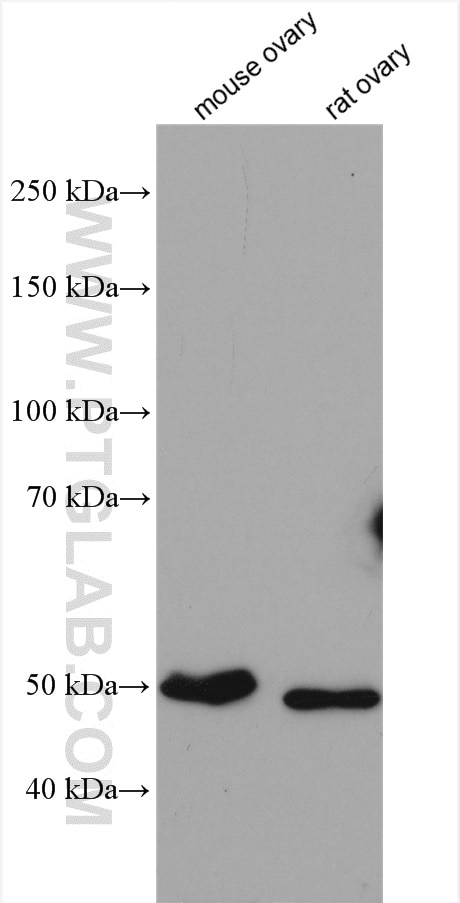
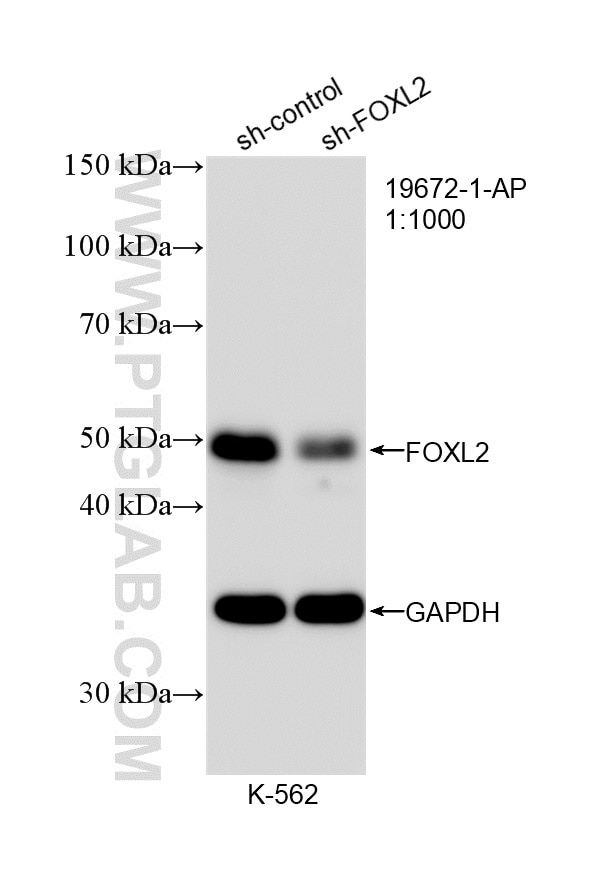
| Positive WB detected in | mouse ovary tissue, K-562 cells, rat ovary tissue |
Recommended dilution
| Application | Dilution |
|---|---|
| Western Blot (WB) | WB : 1:500-1:2000 |
| It is recommended that this reagent should be titrated in each testing system to obtain optimal results. | |
| Sample-dependent, Check data in validation data gallery. | |
Product Information
19672-1-AP targets FOXL2-Specific in WB, IHC, IF, ELISA applications and shows reactivity with human, mouse, rat samples.
| Tested Reactivity | human, mouse, rat |
| Cited Reactivity | human, mouse, rat, pig, chicken |
| Host / Isotype | Rabbit / IgG |
| Class | Polyclonal |
| Type | Antibody |
| Immunogen |
Peptide Predict reactive species |
| Full Name | forkhead box L2 |
| Calculated Molecular Weight | 39 kDa |
| Observed Molecular Weight | 49 kDa |
| GenBank Accession Number | NM_023067 |
| Gene Symbol | FOXL2 |
| Gene ID (NCBI) | 668 |
| RRID | AB_2878594 |
| Conjugate | Unconjugated |
| Form | Liquid |
| Purification Method | Antigen affinity purification |
| UNIPROT ID | P58012 |
| Storage Buffer | PBS with 0.02% sodium azide and 50% glycerol, pH 7.3. |
| Storage Conditions | Store at -20°C. Stable for one year after shipment. Aliquoting is unnecessary for -20oC storage. 20ul sizes contain 0.1% BSA. |
Background Information
FOXL2 is probable a transcriptional regulator. It is required to maintain the female phenotype throughout adulthood, and may provide clues to female infertility. Defects in FOXL2 are a cause of blepharophimosis, ptosis, and epicanthus inversus syndrome (BPES) Defects in FOXL2 are a cause of premature ovarian failure type 3 (POF3). This antibody is specific to the C-term of FOXL2.
Protocols
| Product Specific Protocols | |
|---|---|
| WB protocol for FOXL2-Specific antibody 19672-1-AP | Download protocol |
| Standard Protocols | |
|---|---|
| Click here to view our Standard Protocols |
Publications
What published studies show
The FOXL2-Specific Polyclonal antibody (Cat# 19672-1-AP) has 17 citations across journals including J Adv Res, Cell Death Dis, Clin Cancer Res, FASEB J, Stem Cell Res Ther, BMC Biol, Environ Int, and Am J Reprod Immunol. Research fields span ovarian follicular development, premature ovarian insufficiency, endometriosis, gastric cancer metastasis, sex development disorders, and epigenetic regulation of reproductive function.
| Species | Application | Title |
|---|---|---|
J Adv Res Lactational high weight loss impairs follicular development by causing mitochondrial dysfunction of ovarian cells in sows and mitigated by butyrate supplement | ||
J Adv Res Core fucosylation regulates the ovarian response via FSH receptor during follicular development | ||
Cell Death Dis PARP1-catalyzed PARylation of YY1 mediates endoplasmic reticulum stress in granulosa cells to determine primordial follicle activation | ||
Clin Cancer Res HMGA2-FOXL2 Axis Regulates Metastases and Epithelial-to-mesenchymal Transition of Chemo-resistant Gastric Cancer.
| ||
J Hazard Mater SO2 derivatives impair ovarian function by inhibiting Serpine1/NF-κB pathway-mediated ovarian granulosa cell survival | ||
Environ Int Tracing the epigenetic trajectory of EDC toxicity: Maternal BPAF drives uterine injuries via DNA methylation reprogramming. |
Reviews
What customers say
Users report positive experiences with this antibody. One reviewer used it at 1:100 dilution for immunofluorescence on mouse ovary tissue, describing it as an excellent granulosa cell marker that clearly labeled FOXL2 in red alongside TRA98-stained germ cells. Another reviewer used the free trial size for Western Blot on 293T cells and was pleased with the result. Overall, the antibody is well-received for its specificity and performance in both IF and WB applications.
The reviews below have been submitted by verified Proteintech customers who received an incentive for providing their feedback.
Y C (Verified Customer) (01-23-2020) | I use the free trial size antibody code from the 12 days of free X'mas gifts to order this.Free product and one figure!! Yay!
|
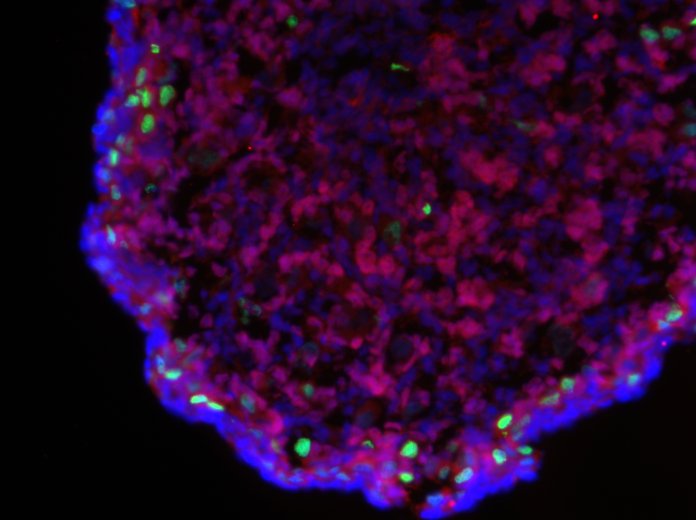
Kathryn (Verified Customer) (11-04-2019) | Image shows post-natal day 2 mouse ovary with germ cells marked by TRA98 (Abcam) in green and granulosa cells marked by FOXL2 (Proteintech) in red. This is an excellent granulosa cell marker.
 |



