
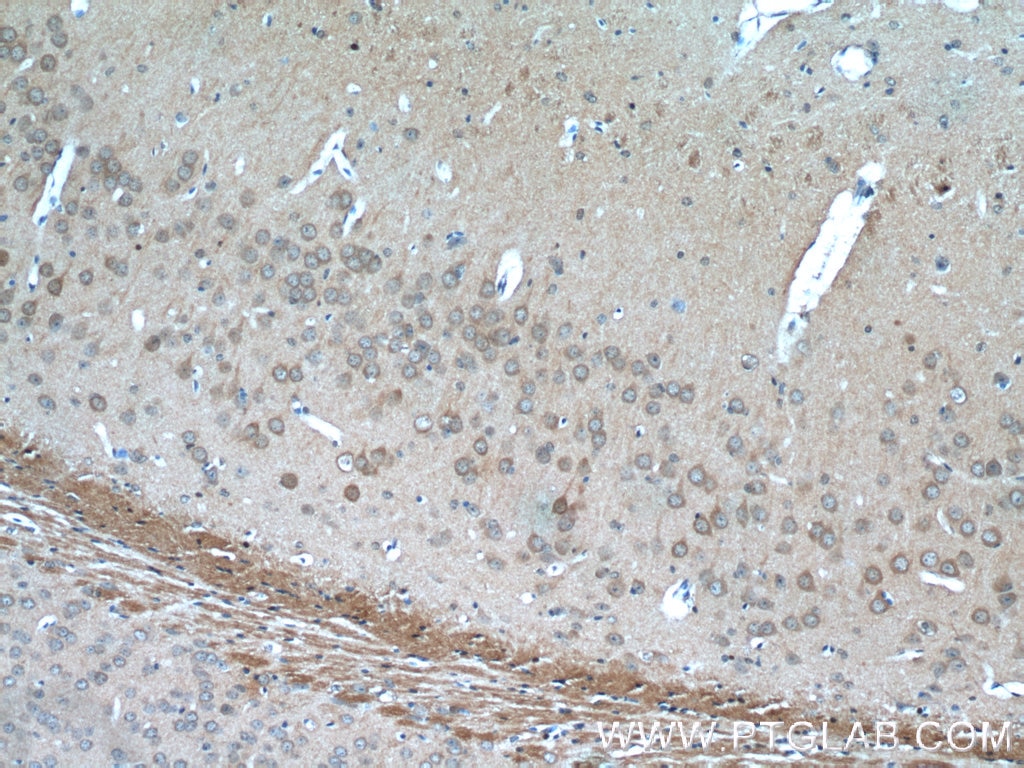
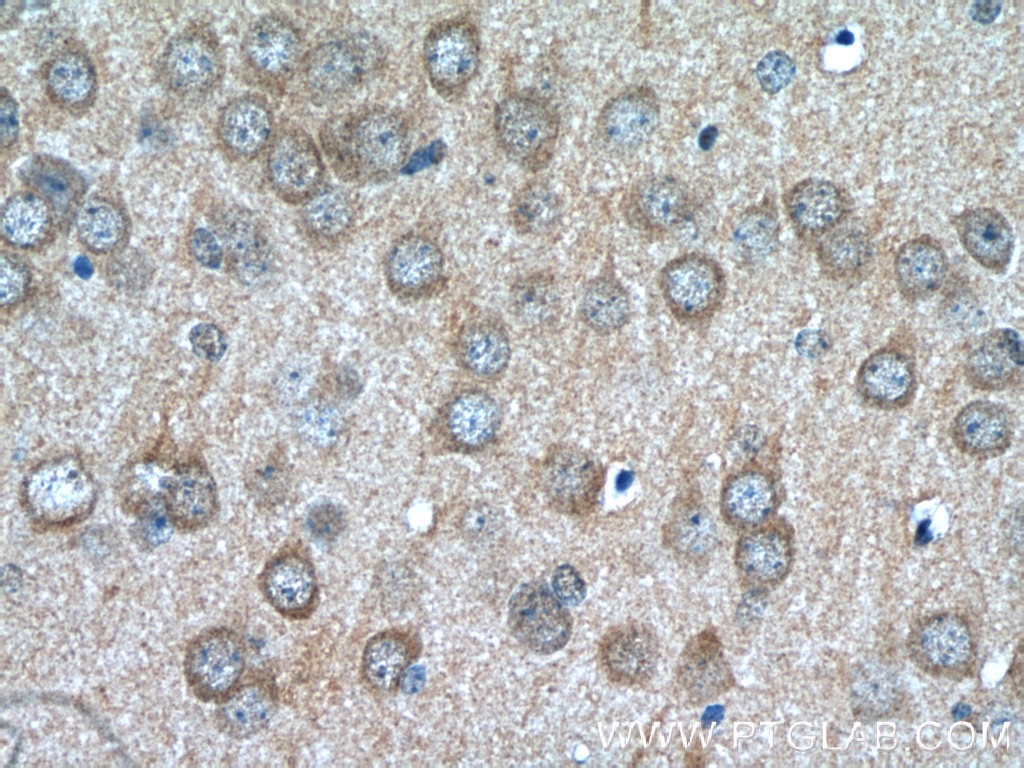

Tested Applications
| Positive IHC detected in | mouse brain tissue Note: suggested antigen retrieval with TE buffer pH 9.0; (*) Alternatively, antigen retrieval may be performed with citrate buffer pH 6.0 |
Recommended dilution
| Application | Dilution |
|---|---|
| Immunohistochemistry (IHC) | IHC : 1:20-1:200 |
| It is recommended that this reagent should be titrated in each testing system to obtain optimal results. | |
| Sample-dependent, Check data in validation data gallery. | |
Product Information
20083-1-AP targets GPR139-Specific in IHC, ELISA applications and shows reactivity with human, mouse, rat samples.
| Tested Reactivity | human, mouse, rat |
| Host / Isotype | Rabbit / IgG |
| Class | Polyclonal |
| Type | Antibody |
| Immunogen |
Peptide Predict reactive species |
| Full Name | G protein-coupled receptor 139 |
| Calculated Molecular Weight | 41 kDa |
| GenBank Accession Number | NM_001002911 |
| Gene Symbol | GPR139 |
| Gene ID (NCBI) | 124274 |
| RRID | AB_2878640 |
| Conjugate | Unconjugated |
| Form | Liquid |
| Purification Method | Antigen affinity purification |
| UNIPROT ID | Q6DWJ6 |
| Storage Buffer | PBS with 0.02% sodium azide and 50% glycerol, pH 7.3. |
| Storage Conditions | Store at -20°C. Stable for one year after shipment. Aliquoting is unnecessary for -20oC storage. 20ul sizes contain 0.1% BSA. |
Background Information
GPR139, also named as GPRG1 and PGR3, belongs to the G-protein coupled receptor 1 family. It is an orphan receptor. GPR139 seems to act through a G(q/11)-mediated pathway. The antibody is specific to GPR139.
Protocols
| Product Specific Protocols | |
|---|---|
| IHC protocol for GPR139-Specific antibody 20083-1-AP | Download protocol |
| Standard Protocols | |
|---|---|
| Click here to view our Standard Protocols |
Publications
What published studies show
The GPR139-Specific Polyclonal antibody (Cat# 20083-1-AP) has 1 total citation. It appears in the journal Proteomics, in a study titled "Microglia Ablation and Downstream Effects in the Cerebrospinal Fluid Proteome" (2026). The research field is neuroscience and proteomics, specifically investigating microglial ablation and its downstream effects on cerebrospinal fluid protein profiles.
| Species | Application | Title |
|---|---|---|
Proteomics Microglia Ablation and Downstream Effects in the Cerebrospinal Fluid Proteome. |



