

Tested Applications
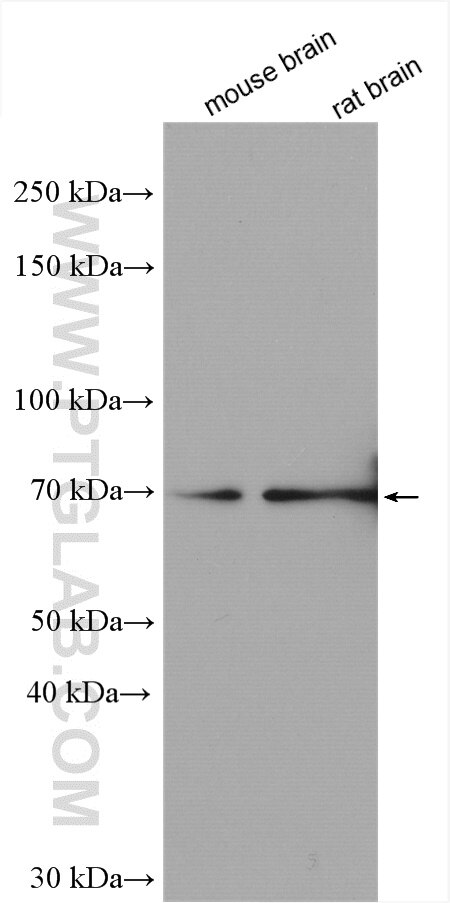
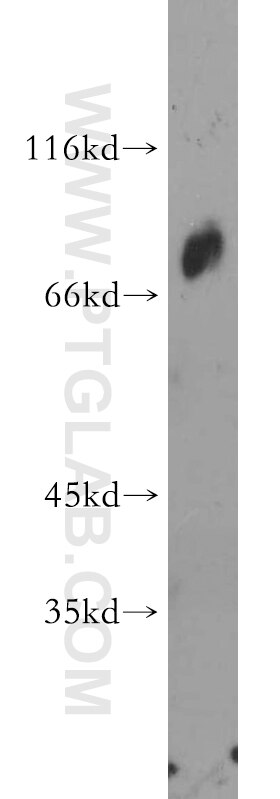
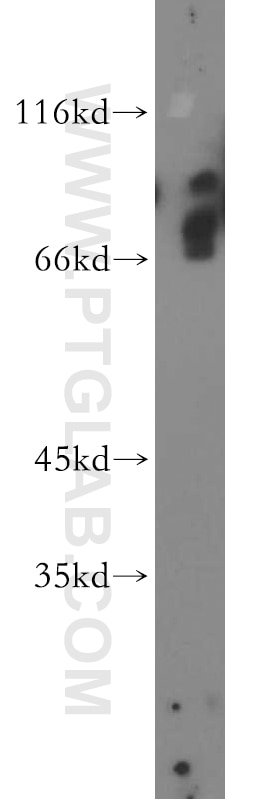
| Positive WB detected in | mouse brain tissue, mouse ovary tissue, HEK-293 cells, rat brain tissue |
Recommended dilution
| Application | Dilution |
|---|---|
| Western Blot (WB) | WB : 1:500-1:2000 |
| It is recommended that this reagent should be titrated in each testing system to obtain optimal results. | |
| Sample-dependent, Check data in validation data gallery. | |
Product Information
21043-1-AP targets MED26 in WB, ELISA applications and shows reactivity with human, mouse, rat samples.
| Tested Reactivity | human, mouse, rat |
| Cited Reactivity | human |
| Host / Isotype | Rabbit / IgG |
| Class | Polyclonal |
| Type | Antibody |
| Immunogen |
CatNo: Ag15381 Product name: Recombinant human MED26 protein Source: e coli.-derived, PGEX-4T Tag: GST Domain: 251-600 aa of BC110430 Sequence: QQLDRVDETPGPPHPKGPPRCSFSPRNSRHEGSFARQQSLYAPKGSVPSPSPRPQALDATQVPSPLPLAQPSTPPVRRLELLPSAESPVCWLEQPESHQRLAGPGCKAGLSPAEPLLSLAGFSPDSSKADSDAASSGGSDSKKKKRYRPRDYTVNLDGQVAEAGVKPVRLKERKLTFDPMTRQIKPLTQKEPVRADSPVHMEQQSRTELDKQEAKASLQSPFEQTNWKELSRNEIIQSYLSRQSSLLSSSGAQTPGAHHFMSEYLKQEESTRQGARQLHVLVPQSPPTDLPGLTREVTQDDLDRIQASQWPGVNGCQDTQGNWYDWTQCISLDPHGDDGRLNILPYVCLD Predict reactive species |
| Full Name | mediator complex subunit 26 |
| Calculated Molecular Weight | 600 aa, 65 kDa |
| Observed Molecular Weight | 66-70 kDa |
| GenBank Accession Number | BC110430 |
| Gene Symbol | MED26 |
| Gene ID (NCBI) | 9441 |
| RRID | AB_10733342 |
| Conjugate | Unconjugated |
| Form | Liquid |
| Purification Method | Antigen affinity purification |
| UNIPROT ID | O95402 |
| Storage Buffer | PBS with 0.02% sodium azide and 50% glycerol, pH 7.3. |
| Storage Conditions | Store at -20°C. Stable for one year after shipment. Aliquoting is unnecessary for -20oC storage. 20ul sizes contain 0.1% BSA. |
Background Information
MED26 (Mediator complex subunit 26), also known as ARC70 or CRSP7, is a metazoan-specific Mediator subunit essential for transcription regulation. MED26 plays a critical role in the transition from transcription initiation to elongation. It acts as a molecular switch, with its conserved N-terminal domain facilitating the exchange of the initiation factor TFIID for the super elongation complex (SEC), which contains factors such as ELL/EAF and P-TEFb, thereby promoting RNA polymerase II elongation (PMID: 21729782, PMID: 33836240).
Protocols
| Product Specific Protocols | |
|---|---|
| WB protocol for MED26 antibody 21043-1-AP | Download protocol |
| Standard Protocols | |
|---|---|
| Click here to view our Standard Protocols |
Publications
What published studies show
The MED26 Polyclonal antibody (Cat# 21043-1-AP) has 3 citations published in Nucleic Acids Research, Retrovirology, and bioRxiv. The cited research spans transcription regulation—specifically RNA polymerase II elongation and P-TEFb function—and retroviral biology, focusing on Gag–host cell nuclear interactome interactions. All citations used the antibody for Western blot (WB) applications in human samples.
| Species | Application | Title |
|---|---|---|
Nucleic Acids Res Multiple P-TEFbs cooperatively regulate the release of promoter-proximally paused RNA polymerase II.
| ||
Retrovirology Comparative analysis of retroviral Gag-host cell interactions: focus on the nuclear interactome | ||
bioRxiv Comparative analysis of retroviral Gag-host cell interactions: focus on the nuclear interactome |
Reviews
What customers say
Both reviews rate the antibody 4 stars for Western Blot. One user, using a 1:500 dilution on mouse heart tissue, reported a clear band. The other, also at 1:500 on embryonic heart, found performance "not very good in our system." Overall, results are mixed: the antibody can produce clear bands in some applications, but performance may vary depending on the specific experimental system and tissue type.
The reviews below have been submitted by verified Proteintech customers who received an incentive for providing their feedback.
siting (Verified Customer) (06-24-2021) | clear band
 |
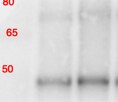
SITING (Verified Customer) (05-25-2021) | not very good in our system
 |




