
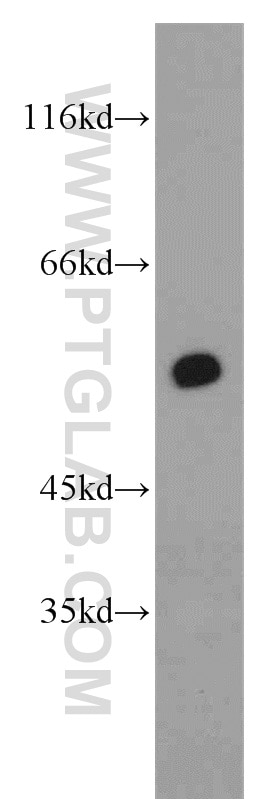



Tested Applications
| Positive WB detected in | NIH/3T3 cells, MCF-7 cells |
| Positive IP detected in | MCF-7 cells, HCT 116 cells |
| Positive IHC detected in | human kidney tissue, mouse heart tissue, human stomach cancer tissue, human thyroid cancer tissue Note: suggested antigen retrieval with TE buffer pH 9.0; (*) Alternatively, antigen retrieval may be performed with citrate buffer pH 6.0 |
| Positive IF/ICC detected in | Hela cells |
Recommended dilution
| Application | Dilution |
|---|---|
| Western Blot (WB) | WB : 1:2000-1:12000 |
| Immunoprecipitation (IP) | IP : 0.5-4.0 ug for 1.0-3.0 mg of total protein lysate |
| Immunohistochemistry (IHC) | IHC : 1:20-1:200 |
| Immunofluorescence (IF)/ICC | IF/ICC : 1:10-1:100 |
| It is recommended that this reagent should be titrated in each testing system to obtain optimal results. | |
| Sample-dependent, Check data in validation data gallery. | |
Product Information
21218-1-AP targets RXRA in WB, IHC, IF/ICC, IP, CoIP, ChIP, RIP, ELISA applications and shows reactivity with human, mouse, rat samples.
| Tested Reactivity | human, mouse, rat |
| Cited Reactivity | human, mouse, rat, pig, bovine, duck |
| Host / Isotype | Rabbit / IgG |
| Class | Polyclonal |
| Type | Antibody |
| Immunogen |
CatNo: Ag15651 Product name: Recombinant human RXRA protein Source: e coli.-derived, PGEX-4T Tag: GST Domain: 113-462 aa of BC110998 Sequence: LNGVLKVPAHPSGNMASFTKHICAICGDRSSGKHYGVYSCEGCKGFFKRTVRKDLTYTCRDNKDCLIDKRQRNRCQYCRYQKCLAMGMKREAVQEERQRGKDRNENEVESTSSANEDMPVERILEAELAVEPKTETYVEANMGLNPSSPNDPVTNICQAADKQLFTLVEWAKRIPHFSELPLDDQVILLRAGWNELLIASFSHRSIAVKDGILLATGLHVHRNSAHSAGVGAIFDRVLTELVSKMRDMQMDKTELGCLRAIVLFNPDSKGLSNPAEVEALREKVYASLEAYCKHKYPEQPGRFAKLLLRLPALRSIGLKCLEHLFFFKLIGDTPIDTFLMEMLEAPHQMT Predict reactive species |
| Full Name | retinoid X receptor, alpha |
| Calculated Molecular Weight | 462 aa, 51 kDa |
| Observed Molecular Weight | 50-54 kDa |
| GenBank Accession Number | BC110998 |
| Gene Symbol | RXRA |
| Gene ID (NCBI) | 6256 |
| RRID | AB_10693633 |
| Conjugate | Unconjugated |
| Form | Liquid |
| Purification Method | Antigen affinity purification |
| UNIPROT ID | P19793 |
| Storage Buffer | PBS with 0.02% sodium azide and 50% glycerol, pH 7.3. |
| Storage Conditions | Store at -20°C. Stable for one year after shipment. Aliquoting is unnecessary for -20oC storage. 20ul sizes contain 0.1% BSA. |
Background Information
Retinoid X receptor alpha (RXRA). Retinoic acid receptors bind as heterodimers to their target response elements in response to their ligands, all-trans or 9-cis retinoic acid, and regulate gene expression in various biological processes. The RAR/RXR heterodimers bind to the retinoic acid response elements (RARE) composed of tandem 5'-AGGTCA-3' sites known as DR1-DR5. The high-affinity ligand for RXRs is 9-cis retinoic acid. RXRA serves as a common heterodimeric partner for a number of nuclear receptors. The RXR/RAR heterodimers bind to the retinoic acid response elements (RARE) composed of tandem 5'-AGGTCA-3' sites known as DR1-DR5. In the absence of a ligand, the RXR-RAR heterodimers associate with a multiprotein complex containing transcription corepressors that induce histone acetylation, chromatin condensation, and transcriptional suppression. On ligand binding, the corepressors dissociate from the receptors and associate with the coactivators leading to transcriptional activation. The RXRA/PPARA heterodimer is required for PPARA transcriptional activity on fatty acid oxidation genes such as ACOX1 and the P450 system genes. This antibody is a rabbit polyclonal antibody raised against the 350 AA of human RXRA C-terminal. RXRA is highly expressed in the liver and also expressed in the lungs, kidneys, and heart. It can recognize the mature 54 kDa RXRA and the truncated 44 kDa RXRA (PMID: 20541701).
Protocols
| Product Specific Protocols | |
|---|---|
| IF protocol for RXRA antibody 21218-1-AP | Download protocol |
| IHC protocol for RXRA antibody 21218-1-AP | Download protocol |
| IP protocol for RXRA antibody 21218-1-AP | Download protocol |
| WB protocol for RXRA antibody 21218-1-AP | Download protocol |
| Standard Protocols | |
|---|---|
| Click here to view our Standard Protocols |
Publications
What published studies show
The RXRA Polyclonal Antibody (Cat# 21218-1-AP) has 65 citations published in journals including Nature, Nature Genetics, Cancer Research, Science Advances, Cell Death & Disease, Journal of Experimental Medicine, Phytomedicine, and Journal of Ethnopharmacology. Research fields span lipid metabolism, liver disease (NASH/MAFLD), cancer, cardiovascular biology, neurology, drug metabolism, and reproductive biology. Cited applications include WB, ChIP, IF, and IP across human, mouse, rat, pig, bovine, and duck species.
| Species | Application | Title |
|---|---|---|
Nat Genet Comprehensive characterization of protein-protein interactions perturbed by disease mutations. | ||
Cancer Res Long noncoding RNA HULC modulates abnormal lipid metabolism in hepatoma cells through an miR-9-mediated RXRA signaling pathway. | ||
Redox Biol Dysfunction of astrocytic glycophagy exacerbates reperfusion injury in ischemic stroke | ||
Theranostics Oscillating lncRNA Platr4 regulates NLRP3 inflammasome to ameliorate nonalcoholic steatohepatitis in mice.
|
Reviews
What customers say
The single review for this antibody (used in Western Blot on mouse samples) reports a 3-star experience. The user tested it on 4T1 and D2A1 cell lines (both 2D and 3D cultures) at a 1:4000 dilution in 5% milk/TBST, overnight at 4°C, with 10 µg protein per lane. While the antibody did produce signal, the main concern was the appearance of multiple non-specific bands, making it difficult to identify the correct target band expected at 50–54 kDa. Overall, the reviewer found the specificity suboptimal for their application.
The reviews below have been submitted by verified Proteintech customers who received an incentive for providing their feedback.
Bruna (Verified Customer) (06-10-2026) | I did this WB with 4T1 WT cells (2D and 3D) and D2A1 WT cells (2D and 3D) in this order in the image. I used 10ug of protein per sample, and the protocol that I used include to incubate the membrane with the Ab in MILK 5% (in TBST) in a 1:4000 dilution overnight at 4ºC and block 1h also in MILK. My only problem is that right now i am nor sure of wich one is the correct band, because a lot of bands are showing. Should be one between 50 and 54 kDa.
 |



