
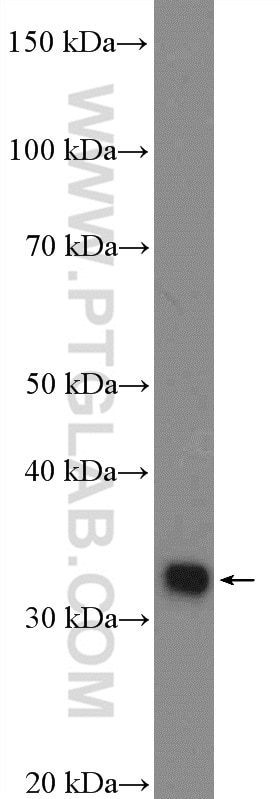
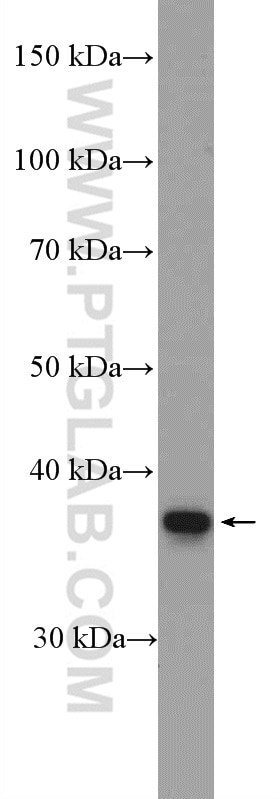
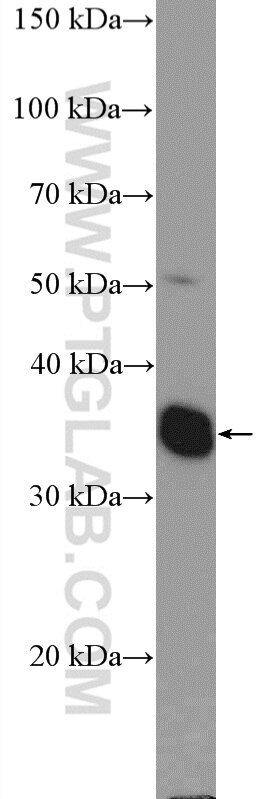

Tested Applications
| Positive WB detected in | Neuro-2a cells, HL-60 cells |
Recommended dilution
| Application | Dilution |
|---|---|
| Western Blot (WB) | WB : 1:500-1:2000 |
| It is recommended that this reagent should be titrated in each testing system to obtain optimal results. | |
| Sample-dependent, Check data in validation data gallery. | |
Product Information
21509-1-AP targets POU4F3 in WB, IHC, IF, ELISA applications and shows reactivity with human, mouse samples.
| Tested Reactivity | human, mouse |
| Cited Reactivity | human, mouse, pig |
| Host / Isotype | Rabbit / IgG |
| Class | Polyclonal |
| Type | Antibody |
| Immunogen |
CatNo: Ag16004 Product name: Recombinant human POU4F3 protein Source: e coli.-derived, PGEX-4T Tag: GST Domain: 99-184 aa of BC104923 Sequence: HPAALTSHPHHAVHQGLEGDLLEHISPTLSVSGLGAPEHSVMPAQIHPHHLGAMGHLHQAMGMSHPHTVAPHSAMPACLSDVESDP Predict reactive species |
| Full Name | POU class 4 homeobox 3 |
| Calculated Molecular Weight | 338 aa, 37 kDa |
| Observed Molecular Weight | 35-40 kDa |
| GenBank Accession Number | BC104923 |
| Gene Symbol | POU4F3 |
| Gene ID (NCBI) | 5459 |
| RRID | AB_2878872 |
| Conjugate | Unconjugated |
| Form | Liquid |
| Purification Method | Antigen affinity purification |
| UNIPROT ID | Q15319 |
| Storage Buffer | PBS with 0.02% sodium azide and 50% glycerol, pH 7.3. |
| Storage Conditions | Store at -20°C. Stable for one year after shipment. Aliquoting is unnecessary for -20oC storage. 20ul sizes contain 0.1% BSA. |
Protocols
| Product Specific Protocols | |
|---|---|
| WB protocol for POU4F3 antibody 21509-1-AP | Download protocol |
| Standard Protocols | |
|---|---|
| Click here to view our Standard Protocols |
Publications
What published studies show
The POU4F3 Polyclonal antibody (Cat# 21509-1-AP) has 10 citations spanning journals including Cell, Advanced Science, Stem Cell Research & Therapy, Neurochemistry International, Frontiers in Cell and Developmental Biology, Scientific Reports, European Journal of Medical Research, Frontiers in Neurology, Hearing Research, and eLife. Research fields cover retinal ganglion cell regeneration, glaucoma, inner retinal injury, vestibular hair cell regeneration, hearing loss, and neurological disease.
| Species | Application | Title |
|---|---|---|
Cell Glia-to-Neuron Conversion by CRISPR-CasRx Alleviates Symptoms of Neurological Disease in Mice. | ||
Adv Sci (Weinh) Injectable, Antioxidative, and Tissue-Adhesive Nanocomposite Hydrogel as a Potential Treatment for Inner Retina Injuries | ||
Stem Cell Res Ther Genetic correction of induced pluripotent stem cells from a DFNA36 patient results in morphologic and functional recovery of derived hair cell-like cells | ||
Neurochem Int Human primary retinal cells as an in-vitro model for investigating defective signalling caused by OPTN mutants associated with glaucoma. | ||
Front Cell Dev Biol In vivo Regeneration of Ganglion Cells for Vision Restoration in Mammalian Retinas. | ||
Sci Rep 661W is a retinal ganglion precursor-like cell line in which glaucoma-associated optineurin mutants induce cell death selectively. |
Reviews
What customers say
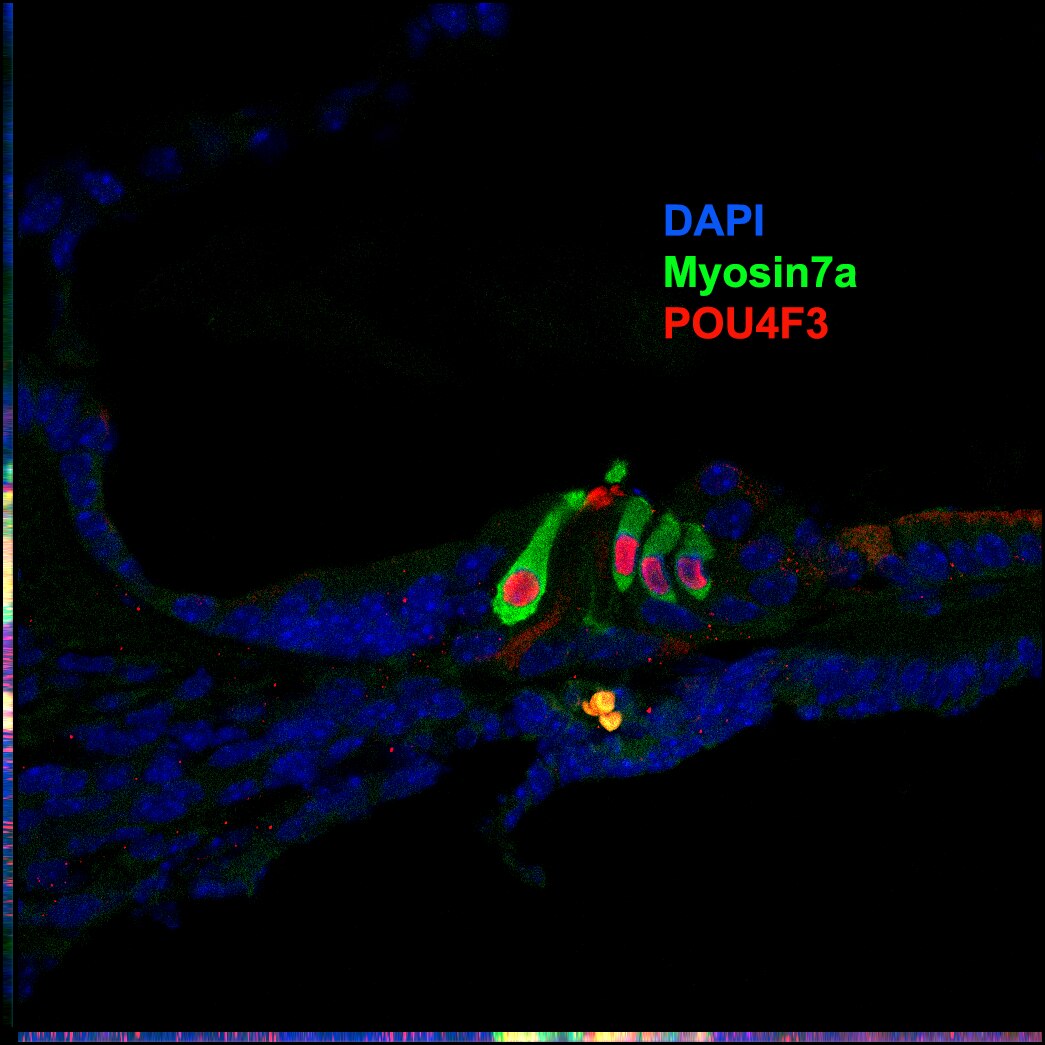
The single review for this antibody is a 5-star rating from an IHC application on inner ear tissue (organ of Corti hair cells) at a 1:200 dilution. The reviewer noted that the antibody performs well but requires a prior antigen retrieval step of 15 minutes at 80°C to achieve optimal staining. Overall, the feedback is positive, highlighting reliable performance in immunohistochemistry with a practical tip on protocol optimization.
The reviews below have been submitted by verified Proteintech customers who received an incentive for providing their feedback.
AMRITA (Verified Customer) (02-15-2021) | The antibody requires a prior antigen retrieval step for 15min in 80 deg centigrade
 |




