
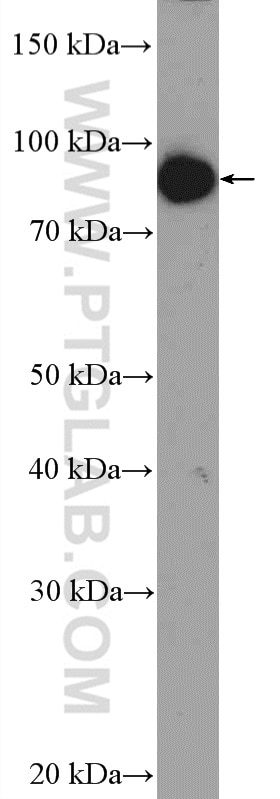
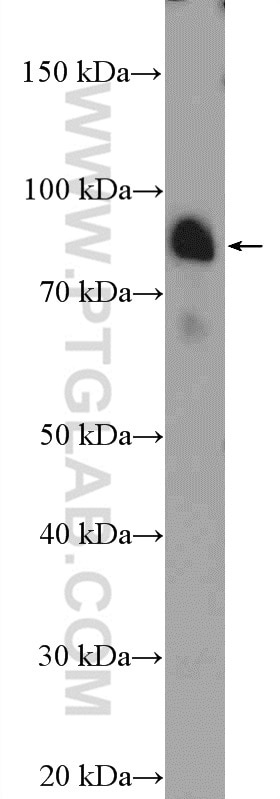
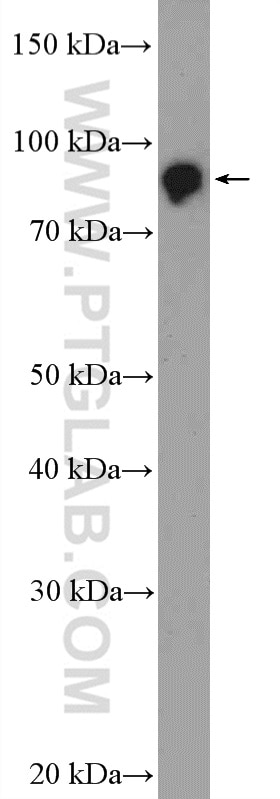

Tested Applications
| Positive WB detected in | mouse skeletal muscle tissue |
Recommended dilution
| Application | Dilution |
|---|---|
| Western Blot (WB) | WB : 1:500-1:1000 |
| It is recommended that this reagent should be titrated in each testing system to obtain optimal results. | |
| Sample-dependent, Check data in validation data gallery. | |
Product Information
21772-1-AP targets ZNF509 in WB, ELISA applications and shows reactivity with human, mouse samples.
| Tested Reactivity | human, mouse |
| Host / Isotype | Rabbit / IgG |
| Class | Polyclonal |
| Type | Antibody |
| Immunogen |
CatNo: Ag16445 Product name: Recombinant human ZNF509 protein Source: e coli.-derived, PGEX-4T Tag: GST Domain: 1-350 aa of BC109087 Sequence: MDPVATHSCHLLQQLHEQRIQGLLCDCMLVVKGVCFKAHKNVLAAFSQYFRSLFQNSSSQKNDVFHLDVKNVSGIGQILDFMYTSHLDLNQDNIQVMLDTAQCLQVQNVLSLCHTFLKSATVVQPPGMPCNSTLSLQSTLTPDATCVISENYPPHLLQECSADAQQNKTLDESHPHASPSVNRHHSAGEISKQAPDTSDGSCTELPFKQPNYYYKLRNFYSKQYHKHAAGPSQERVVEQPFAFSTSTDLTTVESQPCAVSHSECILESPEHLPSNFLAQPVNDSAPHPESDATCQQPVKQMRLKKAIHLKKLNFLKSQKYAEQVSEPKSDDGLTKRLESASKNTLEKASS Predict reactive species |
| Full Name | zinc finger protein 509 |
| Calculated Molecular Weight | 765 aa, 85 kDa |
| Observed Molecular Weight | 85 kDa |
| GenBank Accession Number | BC109087 |
| Gene Symbol | ZNF509 |
| Gene ID (NCBI) | 166793 |
| RRID | AB_2878917 |
| Conjugate | Unconjugated |
| Form | Liquid |
| Purification Method | Antigen affinity purification |
| UNIPROT ID | Q6ZSB9 |
| Storage Buffer | PBS with 0.02% sodium azide and 50% glycerol, pH 7.3. |
| Storage Conditions | Store at -20°C. Stable for one year after shipment. Aliquoting is unnecessary for -20oC storage. 20ul sizes contain 0.1% BSA. |
Protocols
| Product Specific Protocols | |
|---|---|
| WB protocol for ZNF509 antibody 21772-1-AP | Download protocol |
| Standard Protocols | |
|---|---|
| Click here to view our Standard Protocols |
Publications
What published studies show
The ZNF509 Polyclonal antibody (Cat# 21772-1-AP) has 1 citation. It appears in Food Science and Animal Resources (IF: 4.9, 2022), in a study investigating how metabolites of Latilactobacillus curvatus BYB3 and indole activate the aryl hydrocarbon receptor to attenuate LPS-induced intestinal barrier dysfunction. The research field encompasses food science, gut microbiome metabolism, and intestinal barrier biology.
| Species | Application | Title |
|---|---|---|
Food Sci Anim Resour Metabolites of Latilactobacillus curvatus BYB3 and Indole Activate Aryl Hydrocarbon Receptor to Attenuate Lipopolysaccharide-Induced Intestinal Barrier Dysfunction |




