
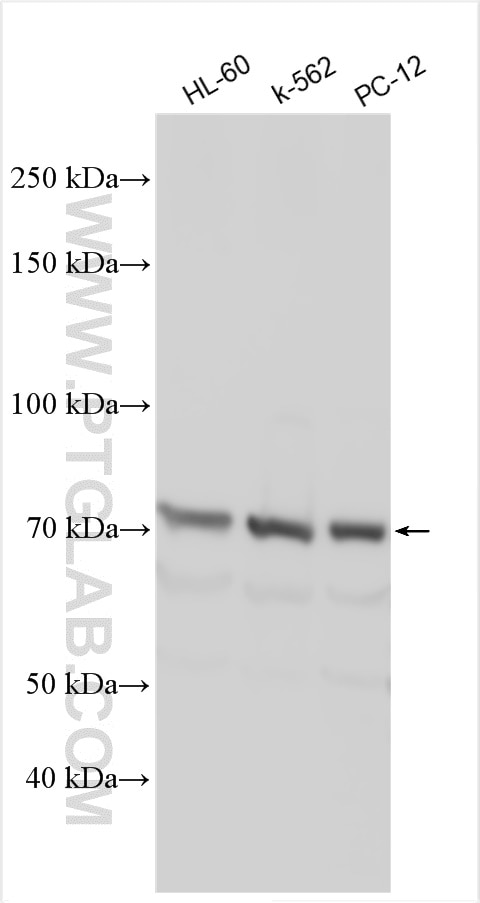

Tested Applications
| Positive WB detected in | HL-60 cells, PC-12 cells, k-562 cells |
Recommended dilution
| Application | Dilution |
|---|---|
| Western Blot (WB) | WB : 1:500-1:2000 |
| It is recommended that this reagent should be titrated in each testing system to obtain optimal results. | |
| Sample-dependent, Check data in validation data gallery. | |
Product Information
24453-1-AP targets ABCG8 in WB, ELISA applications and shows reactivity with human, rat samples.
| Tested Reactivity | human, rat |
| Cited Reactivity | human, mouse, rat |
| Host / Isotype | Rabbit / IgG |
| Class | Polyclonal |
| Type | Antibody |
| Immunogen |
CatNo: Ag19879 Product name: Recombinant human ABCG8 protein Source: e coli.-derived, PET28a Tag: 6*His Domain: 21-386 aa of BC113657 Sequence: SGLQDRLFSSESDNSLYFTYSGQPNTLEVRDLNYQVDLASQVPWFEQLAQFKMPWTSPSCQNSCELGIQNLSFKVRSGQMLAIIGSSGCGRASLLDVITGRGHGGKIKSGQIWINGQPSSPQLVRKCVAHVRQHNQLLPNLTVRETLAFIAQMRLPRTFSQAQRDKRVEDVIAELRLRQCADTRVGNMYVRGLSGGERRRVSIGVQLLWNPGILILDEPTSGLDSFTAHNLVKTLSRLAKGNRLVLISLHQPRSDIFRLFDLVLLMTSGTPIYLGAAQHMVQYFTAIGYPCPRYSNPADFYVDLTSIDRRSREQELATREKAQSLAALFLEKVRDLDDFLWKAETKDLDEDTCVESSVTPLDTNCL Predict reactive species |
| Full Name | ATP-binding cassette, sub-family G (WHITE), member 8 |
| Calculated Molecular Weight | 673 aa, 76 kDa |
| Observed Molecular Weight | 70 kDa |
| GenBank Accession Number | BC113657 |
| Gene Symbol | ABCG8 |
| Gene ID (NCBI) | 64241 |
| RRID | AB_3085735 |
| Conjugate | Unconjugated |
| Form | Liquid |
| Purification Method | Antigen affinity purification |
| UNIPROT ID | Q9H221 |
| Storage Buffer | PBS with 0.02% sodium azide and 50% glycerol, pH 7.3. |
| Storage Conditions | Store at -20°C. Stable for one year after shipment. Aliquoting is unnecessary for -20oC storage. 20ul sizes contain 0.1% BSA. |
Background Information
ABCG8(ATP-binding cassette sub-family G member 8) and ABCG5(ATP-binding cassette protein G5) are members of the ABC transporter family and are half-type ABC transporters, which consist of six transmembrane helices and one nucleotide-binding domain. ABCG5 and ABCG8 form a heterodimer (ABCG5/ABCG8). Mutations in either ABCG5 or ABCG8 cause a genetic disorder, sitosterolemia. Patients with sitosterolemia show high plant sterol levels and develop hypercholesterolemia and atherosclerosis at a young age.(PMID: 36839356)
Protocols
| Product Specific Protocols | |
|---|---|
| WB protocol for ABCG8 antibody 24453-1-AP | Download protocol |
| Standard Protocols | |
|---|---|
| Click here to view our Standard Protocols |
Publications
What published studies show
Anti-ASGR1 antibody (Cat# 24453-1-AP) has 6 citations published in Stem Cell Research & Therapy, Chinese Medicine, Drug Design, Development and Therapy, Pharmaceuticals, Naunyn-Schmiedeberg's Archives of Pharmacology, and Journal of Pharmaceutical and Biomedical Analysis. The research fields span lipid metabolism, atherosclerosis, cholesterol homeostasis, gallstone management, intrahepatic cholestasis, and hyperlipidemia, primarily using Western blot in human, mouse, and rat models.
| Species | Application | Title |
|---|---|---|
Stem Cell Res Ther Allogeneic mesenchymal stromal cells ameliorate lupus nephritis by regulating lipid metabolism via ASGR1. | ||
Chin Med ZeXieYin formula alleviates atherosclerosis by regulating SBAs levels through the FXR/FGF15 pathway and restoring intestinal barrier integrity | ||
Drug Des Devel Ther Baolier Capsule's Secret Weapon: Piperine Boosts Cholesterol Excretion to Combat Atherosclerosis | ||
Pharmaceuticals (Basel) Sinapic Acid Regulates the LXRα-ABCG5/8 Axis in the Hepatocytes: A Potential Strategy for Cholesterol Gallstone Management. | ||
Naunyn Schmiedebergs Arch Pharmacol Molecular mechanism of geniposide against ANIT-induced intrahepatic cholestasis by integrative analysis of transcriptomics and metabolomics | ||
J Pharm Biomed Anal Multi-omics reveals the role of PPARα signaling in the treatment of hyperlipidemia with Qinlian Hongqu Decoction. |


