

Tested Applications
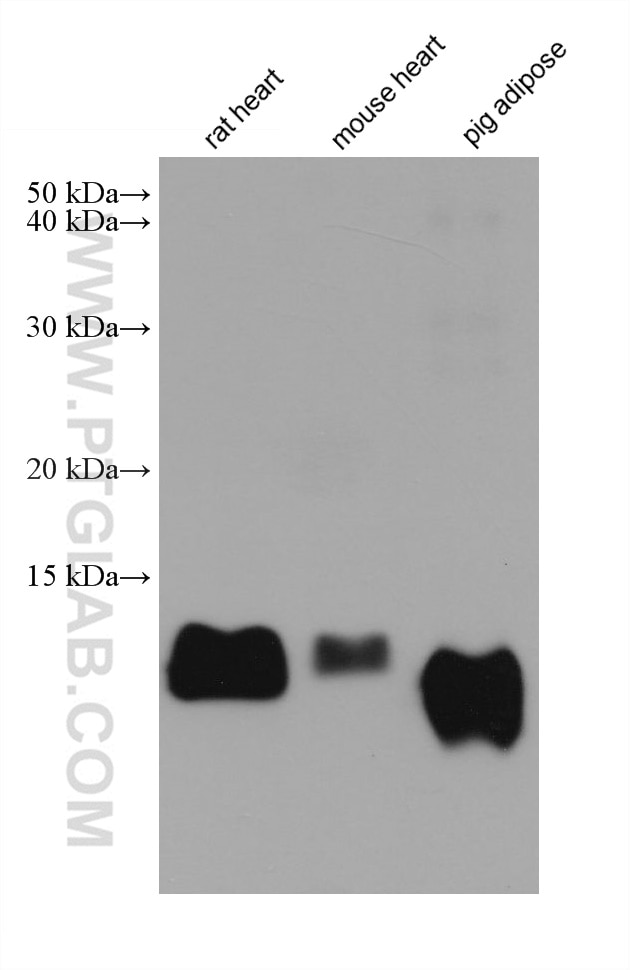
| Positive WB detected in | rat heart tissue, mouse heart tissue, pig adipose tissue |
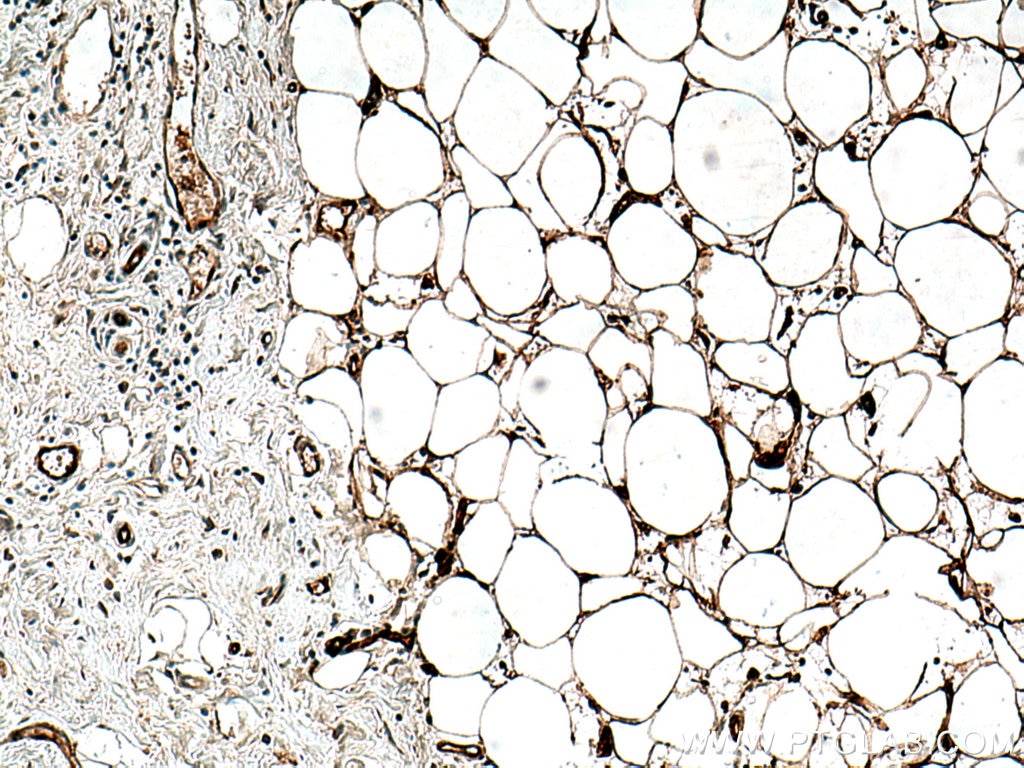
| Positive IHC detected in | human breast cancer tissue Note: suggested antigen retrieval with TE buffer pH 9.0; (*) Alternatively, antigen retrieval may be performed with citrate buffer pH 6.0 |
Recommended dilution
| Application | Dilution |
|---|---|
| Western Blot (WB) | WB : 1:5000-1:50000 |
| Immunohistochemistry (IHC) | IHC : 1:800-1:4000 |
| It is recommended that this reagent should be titrated in each testing system to obtain optimal results. | |
| Sample-dependent, Check data in validation data gallery. | |
Product Information
67167-1-Ig targets FABP4 in WB, IHC, ELISA applications and shows reactivity with human, mouse, rat, pig samples.
| Tested Reactivity | human, mouse, rat, pig |
| Cited Reactivity | human, mouse, bovine |
| Host / Isotype | Mouse / IgG2b |
| Class | Monoclonal |
| Type | Antibody |
| Immunogen |
CatNo: Ag8565 Product name: Recombinant human FABP4 protein Source: e coli.-derived, PET28a Tag: 6*His Domain: 6-132 aa of BC003672 Sequence: VGTWKLVSSENFDDYMKEVGVGFATRKVAGMAKPNMIISVNGDVITIKSESTFKNTEISFILGQEFDEVTADDRKVKSTITLDGGVLVHVQKWDGKSTTIKRKREDDKLVVECVMKGVTSTRVYERA Predict reactive species |
| Full Name | fatty acid binding protein 4, adipocyte |
| Calculated Molecular Weight | 132 aa, 15 kDa |
| Observed Molecular Weight | 14 kDa |
| GenBank Accession Number | BC003672 |
| Gene Symbol | FABP4 |
| Gene ID (NCBI) | 2167 |
| RRID | AB_2882463 |
| Conjugate | Unconjugated |
| Form | Liquid |
| Purification Method | Protein A purification |
| UNIPROT ID | P15090 |
| Storage Buffer | PBS with 0.02% sodium azide and 50% glycerol, pH 7.3. |
| Storage Conditions | Store at -20°C. Stable for one year after shipment. Aliquoting is unnecessary for -20oC storage. 20ul sizes contain 0.1% BSA. |
Background Information
Fatty acid binding protein (FABP) 4 is a member of the FABP family which abundantly expressed, fatty acid carrier proteins. FABPs are capable of binding a variety of hydrophobic molecules such as long-chain fatty acids and are important for their uptake and intracellular trafficking. It was first identified as an adipocyte-specific protein, important for the maintenance of lipid and glucose metabolism. It is also detected in macrophages, where it participates in regulating inflammation and cholesterol trafficking via NFκB and PPAR. In more recent studies, FABP4 has been found in a variety of endothelial cells, where it has been identified as a target of VEGF and a regulator of cell proliferation and possibly angiogenesis. Pathologically, FABP4 has been associated with the development of metabolic syndrome, diabetes and cancer and vulnerability of atherosclerotic plaques. FABP4 has been identified as a novel prognostic factor for both adverse cardiovascular events and breast cancer.
Protocols
| Product Specific Protocols | |
|---|---|
| IHC protocol for FABP4 antibody 67167-1-Ig | Download protocol |
| WB protocol for FABP4 antibody 67167-1-Ig | Download protocol |
| Standard Protocols | |
|---|---|
| Click here to view our Standard Protocols |
Publications
What published studies show
FABP4 Monoclonal antibody (3E7E1), catalog number 67167-1-Ig, has 10 total citations. Citations appear in Genes Dis, International Journal of Biological Sciences, Journal of Orthopaedic Translation, Stem Cell Research & Therapy, Biomedical Pharmacotherapy, iScience, Frontiers in Oncology, In Vitro Cell & Developmental Biology – Animal, and Biological & Pharmaceutical Bulletin. Research fields span bone metabolism and osteoblast differentiation, adipogenesis and lipid metabolism, cancer metastasis (gastric and thyroid), myocardial repair, and skeletal aging.
| Species | Application | Title |
|---|---|---|
Genes Dis Naked cuticle homolog 2 controls the differentiation of osteoblasts and osteoclasts and ameliorates bone loss in ovariectomized mice | ||
Int J Biol Sci LAMC1-mediated preadipocytes differentiation promoted peritoneum pre-metastatic niche formation and gastric cancer metastasis. | ||
J Orthop Translat Accumulation of advanced oxidation protein products aggravates bone-fat imbalance during skeletal aging | ||
Stem Cell Res Ther Oncostatin M receptor regulates osteoblast differentiation via extracellular signal-regulated kinase/autophagy signaling. | ||
Stem Cell Res Ther Single-cell sequencing of facial adipose tissue unveils FKBP5 as a therapeutic target for facial infiltrating lipomatosis | ||
Biomed Pharmacother Extracellular vesicle mediated targeting delivery of growth differentiation factor-15 improves myocardial repair by reprogramming macrophages post myocardial injury |



