
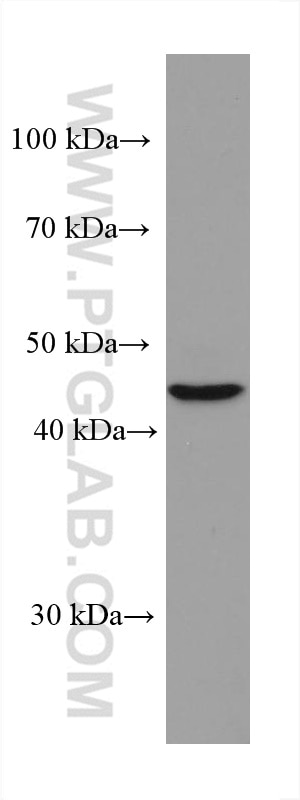
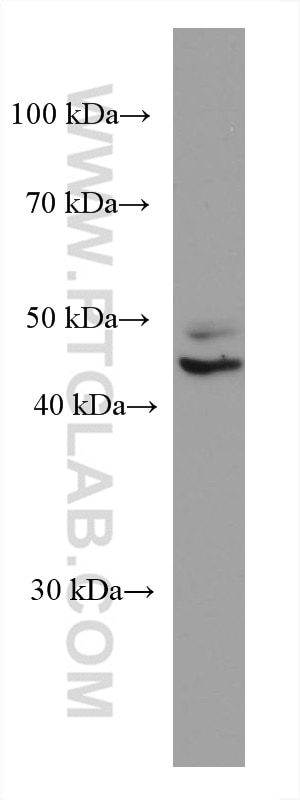
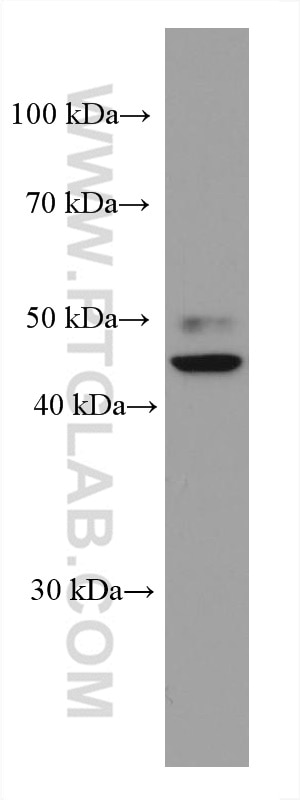

Tested Applications
| Positive WB detected in | K-562 cells, HEK-293 cells, Jurkat cells |
Recommended dilution
| Application | Dilution |
|---|---|
| Western Blot (WB) | WB : 1:1000-1:6000 |
| It is recommended that this reagent should be titrated in each testing system to obtain optimal results. | |
| Sample-dependent, Check data in validation data gallery. | |
Product Information
67592-1-Ig targets TERF1 in WB, IF, IP, ChIP, ELISA applications and shows reactivity with human samples.
| Tested Reactivity | human |
| Cited Reactivity | human |
| Host / Isotype | Mouse / IgG1 |
| Class | Monoclonal |
| Type | Antibody |
| Immunogen |
CatNo: Ag12540 Product name: Recombinant human TERF1 protein Source: e coli.-derived, PET28a Tag: 6*His Domain: 118-419 aa of BC029378 Sequence: CQLRTIYICQFLTRIAAGKTLDAQFENDERITPLESALMIWGSIEKEHDKLHEEIQNLIKIQAIAVCMENGNFKEAEEVFERIFGDPNSHMPFKSKLLMIISQKDTFHSFFQHFSYNHMMEKIKSYVNYVLSEKSSTFLMKAAAKVVESKRTRTITSQDKPSGNDVEMETEANLDTRKRSHKNLFLSKLQHGTQQQDLNKKERRVGTPQSTKKKKESRRATESRIPVSKSQPVTPEKHRARKRQAWLWEEDKNLRSGVRKYGEGNWSKILLHYKFNNRTSVMLKDRWRTMKKLKLISSDSED Predict reactive species |
| Full Name | telomeric repeat binding factor (NIMA-interacting) 1 |
| Calculated Molecular Weight | 439 aa, 50 kDa |
| Observed Molecular Weight | 48-50 kDa |
| GenBank Accession Number | BC029378 |
| Gene Symbol | TERF1 |
| Gene ID (NCBI) | 7013 |
| RRID | AB_2918494 |
| Conjugate | Unconjugated |
| Form | Liquid |
| Purification Method | Protein G purification |
| UNIPROT ID | P54274 |
| Storage Buffer | PBS with 0.02% sodium azide and 50% glycerol, pH 7.3. |
| Storage Conditions | Store at -20°C. Stable for one year after shipment. Aliquoting is unnecessary for -20oC storage. 20ul sizes contain 0.1% BSA. |
Background Information
Telomeres are nucleoprotein complexes located at chromosome ends that consist of tandem arrays of TTAGGG repeats bound to specific proteins. Telomeres protect chromosome ends from degradation and end-to-end fusions, prevent activation of DNA damage checkpoints, and modulate the maintenance of telomeric DNA by telomerase. TERF1 (telomeric repeat-binding factor 1) binds the telomeric double-stranded TTAGGG repeat and negatively regulates telomere length. It's one component of the shelterin complex, which involved in the regulation of telomere length and protection.
Protocols
| Product Specific Protocols | |
|---|---|
| WB protocol for TERF1 antibody 67592-1-Ig | Download protocol |
| Standard Protocols | |
|---|---|
| Click here to view our Standard Protocols |
Publications
What published studies show
The TERF1 Monoclonal antibody (1D10G4), catalog number 67592-1-Ig, has 3 citations. These appear in Nature Communications, Cell Reports, and bioRxiv. The cited research focuses on telomere biology, including transcription stress at telomeres, cytosolic DNA release, paracrine senescence, and alternative lengthening of telomeres (ALT) regulation by topoisomerase IIIα and SLFN11. All citations involve human samples using WB, IF, IP, and ChIP applications.
| Species | Application | Title |
|---|---|---|
Nat Commun Transcription stress at telomeres leads to cytosolic DNA release and paracrine senescence | ||
Reviews
What customers say
The antibody performed excellently for both immunofluorescence and Western blot on human and mouse cardiac myocytes. For ICC imaging of 2D and 3D cardiac cells, a 1:250–500 dilution with a 1:400–500 secondary antibody and DAPI staining produced strong results. For Western blot, a 1:1000 dilution with overnight incubation followed by a 1:300 secondary antibody for 1 hour yielded clear signals in both human and mouse tissues. The reviewer rated it 5 stars, highlighting its reliable performance across species and applications.
The reviews below have been submitted by verified Proteintech customers who received an incentive for providing their feedback.
Refik (Verified Customer) (08-22-2025) | Antibody works really well at a 1:250 - 500 dilution for ICC imaging of 2D and 3D cardiac cells with secondary Alexa Flour antibody at 1:400 - 500 and DAPI for both human and mouse specific cells. Works really well at 1:1000 concentration in western blot for overnight incubation followed by 1:300 secondary antibody incubation for 1 hour for human and mouse tissue.
|




