


Tested Applications
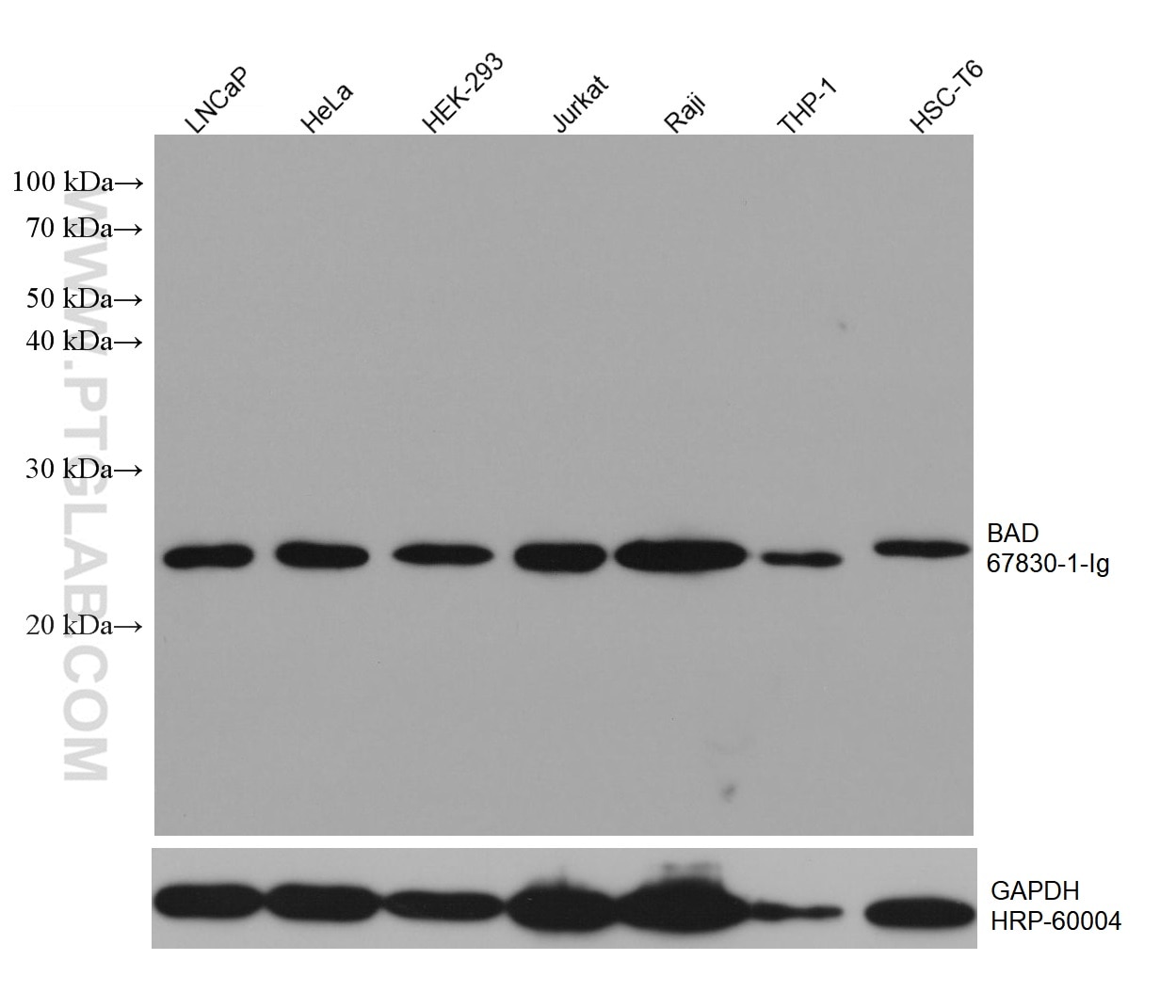
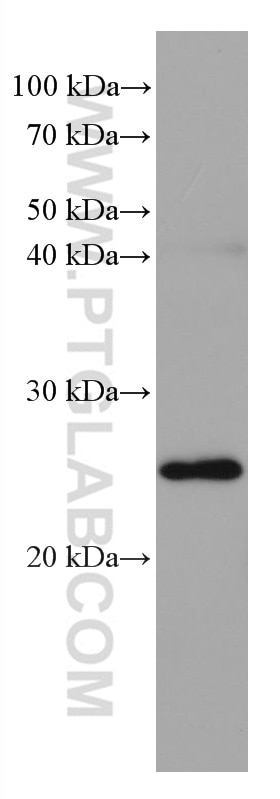
| Positive WB detected in | LNCaP cells, RAW 264.7 cells, HeLa cells, HEK-293 cells, Jurkat cells, Raji cells, THP-1 cells, HSC-T6 cells |
| Positive IF/ICC detected in | HeLa cells |
Recommended dilution
| Application | Dilution |
|---|---|
| Western Blot (WB) | WB : 1:1000-1:6000 |
| Immunofluorescence (IF)/ICC | IF/ICC : 1:400-1:1600 |
| It is recommended that this reagent should be titrated in each testing system to obtain optimal results. | |
| Sample-dependent, Check data in validation data gallery. | |
Product Information
67830-1-Ig targets BAD in WB, IHC, IF/ICC, ELISA applications and shows reactivity with human, mouse, rat samples.
| Tested Reactivity | human, mouse, rat |
| Cited Reactivity | human, mouse, rat |
| Host / Isotype | Mouse / IgG1 |
| Class | Monoclonal |
| Type | Antibody |
| Immunogen |
Peptide Predict reactive species |
| Full Name | BCL2-associated agonist of cell death |
| Calculated Molecular Weight | 18 kDa |
| Observed Molecular Weight | 18-25 kDa |
| GenBank Accession Number | BC001901 |
| Gene Symbol | BAD |
| Gene ID (NCBI) | 572 |
| RRID | AB_2918592 |
| Conjugate | Unconjugated |
| Form | Liquid |
| Purification Method | Protein G purification |
| UNIPROT ID | Q92934 |
| Storage Buffer | PBS with 0.02% sodium azide and 50% glycerol, pH 7.3. |
| Storage Conditions | Store at -20°C. Stable for one year after shipment. Aliquoting is unnecessary for -20oC storage. 20ul sizes contain 0.1% BSA. |
Background Information
BAD, also named as BBC6 and BCL2L8, promotes cell death. It is successfully competes for the binding to Bcl-X(L), Bcl-2 and Bcl-W, thereby affecting the level of heterodimerization of these proteins with BAX. BAD can reverse the death repressor activity of Bcl-X(L), but not that of Bcl-2. It appears to act as a link between growth factor receptor signaling and the apoptotic pathways.
Protocols
| Product Specific Protocols | |
|---|---|
| IF protocol for BAD antibody 67830-1-Ig | Download protocol |
| WB protocol for BAD antibody 67830-1-Ig | Download protocol |
| Standard Protocols | |
|---|---|
| Click here to view our Standard Protocols |
Publications
What published studies show
BAD Monoclonal antibody (4B12G2), catalog number 67830-1-Ig, has 14 citations across journals including J Nanobiotechnology, Advanced Science, Phytomedicine, J Transl Med, Oxid Med Cell Longev, Eur J Med Chem, Ecotoxicol Environ Saf, Int Immunopharmacol, Oncol Rep, FASEB J, Curr Issues Mol Biol, Hepatobiliary Pancreat Dis Int, and Toxicol Appl Pharmacol. Research fields span oncology, neurology, toxicology, reproductive biology, and metabolic signaling pathways.
| Species | Application | Title |
|---|---|---|
J Nanobiotechnology Early assessment and treatment of ventricular remodeling in vivo via a targeted ultrasonic molecular probe loaded with oxygen and cholecystokinin | ||
Adv Sci (Weinh) Mitochondrial tRNAGlu 14693A>G Mutation, an "Enhancer" to the Phenotypic Expression of Leber's Hereditary Optic Neuropathy | ||
Phytomedicine Differences in p38-STAT3-S100A11 signaling after the administration of aristolochic acid I and IVa may account for the disparity in their nephrotoxicity | ||
J Transl Med circSORBS1 inhibits lung cancer progression by sponging miR-6779-5p and directly binding RUFY3 mRNA | ||
Oxid Med Cell Longev Curcumin Inhibits Hyperandrogen-Induced IRE1α-XBP1 Pathway Activation by Activating the PI3K/AKT Signaling in Ovarian Granulosa Cells of PCOS Model Rats | ||
Eur J Med Chem Mitochondrion-targeted magnolol derivatives exert synergistic anticancer activity by modulating energy metabolism and tumor microenvironment. |




