
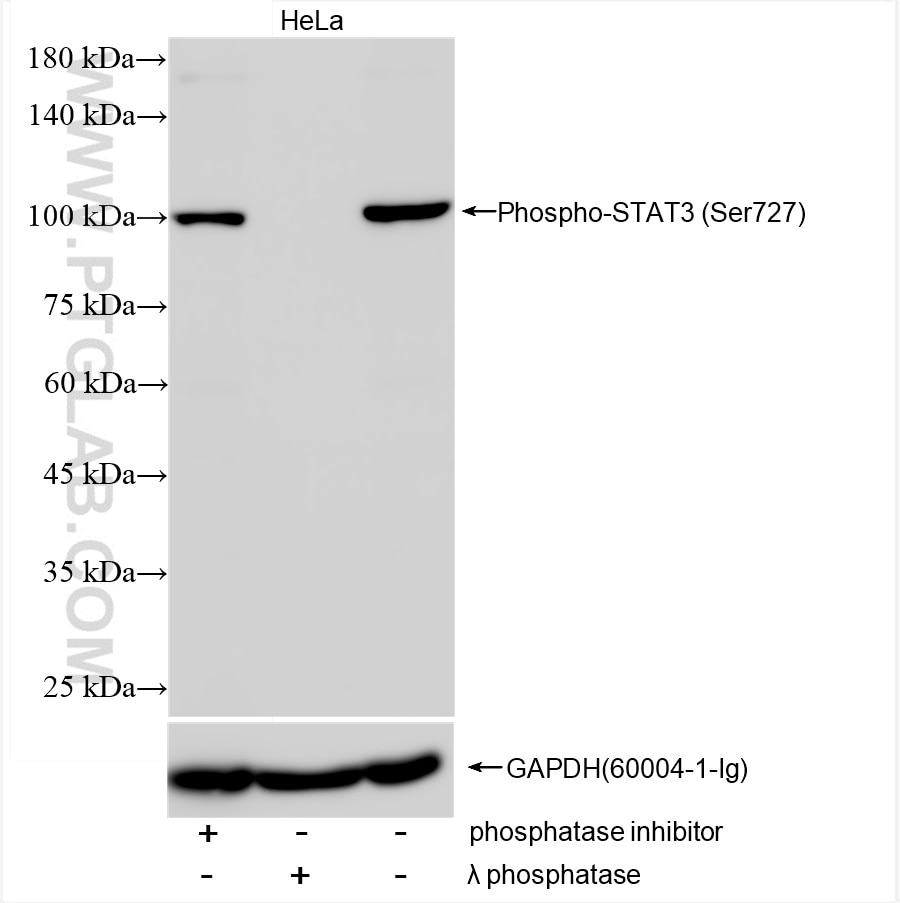
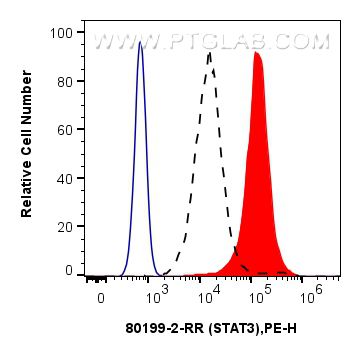
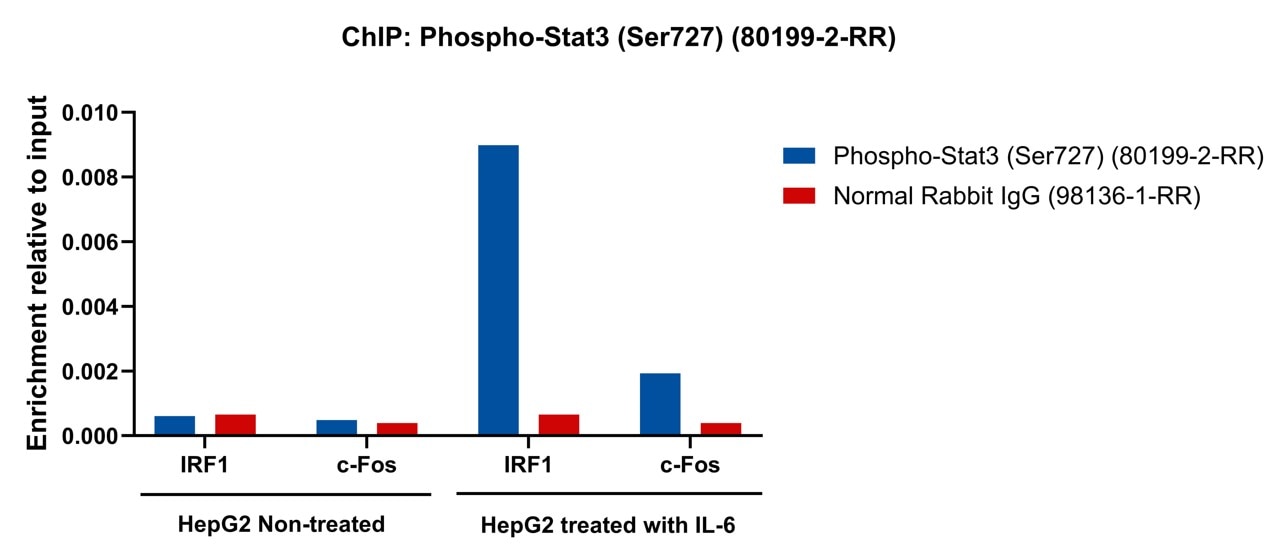

Tested Applications
| Positive WB detected in | HeLa cells |
| Positive FC (Intra) detected in | Calyculin A treated HEK-293T cells |
| Positive ChIP-qPCR detected in | IL-6 (100ng/mL,30min) HepG2 cells |
Recommended dilution
| Application | Dilution |
|---|---|
| Western Blot (WB) | WB : 1:1000-1:4000 |
| Flow Cytometry (FC) (INTRA) | FC (INTRA) : 0.25 ug per 10^6 cells in a 100 µl suspension |
| CHIP-QPCR | CHIP-QPCR : 1:10-1:100 |
| It is recommended that this reagent should be titrated in each testing system to obtain optimal results. | |
| Sample-dependent, Check data in validation data gallery. | |
Product Information
80199-2-RR targets Phospho-STAT3 (Ser727) in WB, IHC, FC (Intra), ELISA, ChIP-qPCR applications and shows reactivity with human samples.
| Tested Reactivity | human |
| Cited Reactivity | human, mouse |
| Host / Isotype | Rabbit / IgG |
| Class | Recombinant |
| Type | Antibody |
| Immunogen |
Peptide Predict reactive species |
| Full Name | signal transducer and activator of transcription 3 (acute-phase response factor) |
| Calculated Molecular Weight | 770 aa, 88 kDa |
| Observed Molecular Weight | 100 kDa |
| GenBank Accession Number | BC000627 |
| Gene Symbol | STAT3 |
| Gene ID (NCBI) | 6774 |
| RRID | AB_3670470 |
| Conjugate | Unconjugated |
| Form | Liquid |
| Purification Method | Protein A purfication |
| UNIPROT ID | P40763 |
| Storage Buffer | PBS with 0.02% sodium azide and 50% glycerol, pH 7.3. |
| Storage Conditions | Store at -20°C. Stable for one year after shipment. Aliquoting is unnecessary for -20oC storage. 20ul sizes contain 0.1% BSA. |
Background Information
Signal transducer and activator of transcription 3 (acute-phase response factor) (STAT3, synonyms: APRF, FLJ20882, MGC16063) is a member of the STAT protein family. In response to cytokines and growth factors, STAT family members are phosphorylated by the receptor associated kinases, and then form homo- or heterodimers that translocate to the cell nucleus where they act as transcription activators. STAT3 is activated through phosphorylation in response to various cytokines and growth factors including IFNs, EGF, IL5, IL6, HGF, LIF and BMP2. STAT3 mediates the expression of a variety of genes in response to cell stimuli, and thus plays a key role in many cellular processes such as cell growth and apoptosis.
Protocols
| Product Specific Protocols | |
|---|---|
| WB protocol for Phospho-STAT3 (Ser727) antibody 80199-2-RR | Download protocol |
| Standard Protocols | |
|---|---|
| Click here to view our Standard Protocols |
Publications
What published studies show
Phospho-STAT3 (Ser727) Recombinant monoclonal antibody (240778A12), catalog number 80199-2-RR, has 14 citations published in journals including Cell Death Discovery, International Journal of Biological Macromolecules, Scientific Reports, Neuropharmacology, Food & Function, and others. Research fields span oncology (gastric, colorectal, liver, brain, and blood cancers), metabolic dysfunction-associated fatty liver disease, ulcerative colitis, sepsis, spinal cord injury, PCOS, stem cell differentiation, and macrophage-mediated inflammation.
| Species | Application | Title |
|---|---|---|
Cell Mol Biol Lett The promoting roles of GLP1R and GIPR in stemness maintenance and multiple lineage-specific differentiation of PDLSCs. | ||
Cell Death Discov MFAP2 secreted by TGF-β1-induced cancer-associated fibroblast cells promotes gastric cancer peritoneal metastasis through Src-STAT3-PTK7 axis. | ||
Int J Biol Macromol Matrix metallopeptidase 2-responsive curcumin-loaded nanoparticles-induced signal transducer and activator of transcription 3 inhibition suppresses glioblastoma multiforme growth via enhancing nuclear factor erythroid 2-related factor 2 activity | ||
Bioresour Bioprocess Mechanism of arbutin in metabolic dysfunction-associated fatty liver disease based on multi-omics research.
| ||
Food Funct Sulforaphane attenuates DSS-induced ulcerative colitis via the Nrf2/STAT3 signaling pathway and gut microbiota modulation. | ||
Front Endocrinol (Lausanne) Cangfu Daotan decoction treats PCOS-IR through the IL6/JAK2/STAT3/FOXO4 signaling pathway. |




