
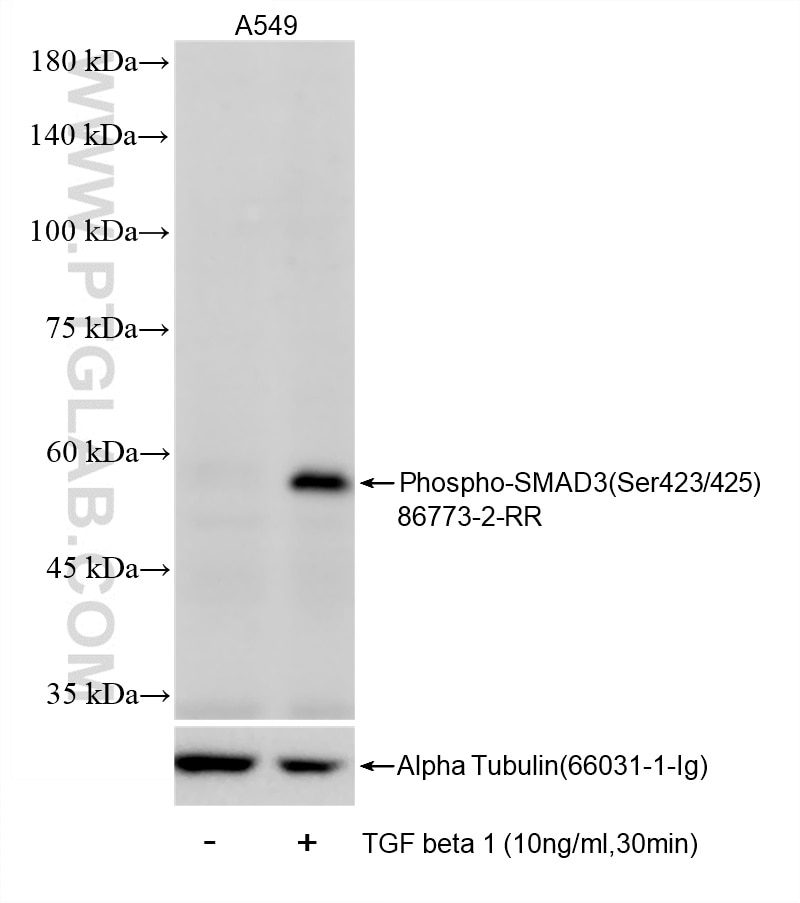

Tested Applications
| Positive WB detected in | TGF beta 1 treated A549 cells |
Recommended dilution
| Application | Dilution |
|---|---|
| Western Blot (WB) | WB : 1:500-1:2000 |
| It is recommended that this reagent should be titrated in each testing system to obtain optimal results. | |
| Sample-dependent, Check data in validation data gallery. | |
Product Information
86773-2-RR targets Phospho-SMAD2 (Ser465/467)/SMAD3 (Ser423/425) in WB, ELISA applications and shows reactivity with human samples.
| Tested Reactivity | human |
| Host / Isotype | Rabbit / IgG |
| Class | Recombinant |
| Type | Antibody |
| Immunogen |
Peptide Predict reactive species |
| Full Name | SMAD family member 3 |
| Calculated Molecular Weight | 48 kDa |
| Observed Molecular Weight | 52 kDa |
| GenBank Accession Number | BC050743 |
| Gene Symbol | SMAD3 |
| Gene ID (NCBI) | 4088 |
| Conjugate | Unconjugated |
| Form | Liquid |
| Purification Method | Protein A purification |
| UNIPROT ID | P84022 |
| Storage Buffer | PBS with 0.02% sodium azide and 50% glycerol, pH 7.3. |
| Storage Conditions | Store at -20°C. Stable for one year after shipment. Aliquoting is unnecessary for -20oC storage. 20ul sizes contain 0.1% BSA. |
Background Information
SMAD3, also named as hMAD 3 or Mad3, is a 425 amino acid protein, which contains one MH1 domain and one MH2 domain. Phospho-SMAD3 (Ser423/425) is the dual-phosphorylated, active form of SMAD3 that results from TGF-β, activin or BMP receptor kinase signaling. Upon ligand binding, the type II receptor phosphorylates the type I receptor, which in turn phosphorylates SMAD3 at Ser423 and Ser425 within the SSXS motif. This creates a binding surface for SMAD4, forming the heterotrimeric transcription complex that translocates to the nucleus to regulate genes involved in cell cycle control, fibrosis, immune modulation and epithelial-mesenchymal transition (EMT).


