
Filter:
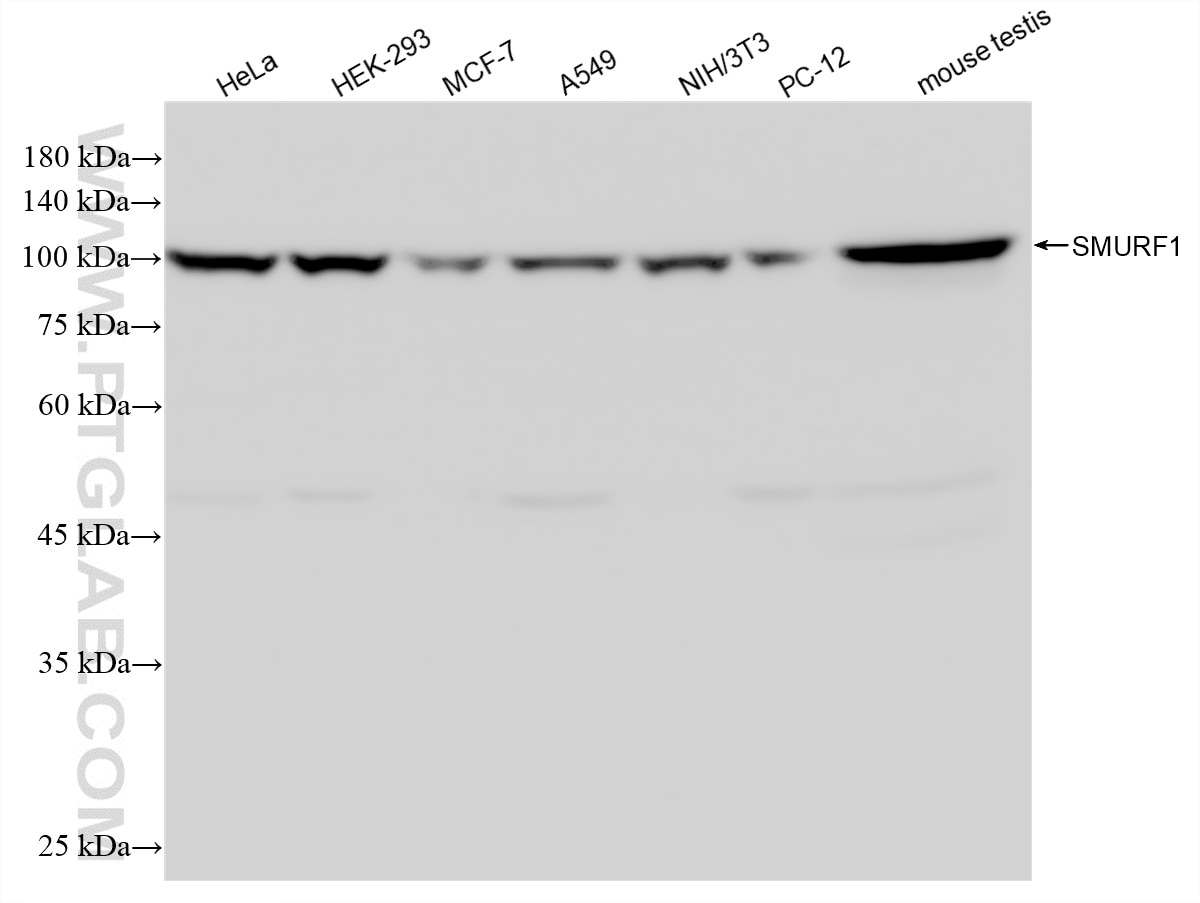
Tested Applications
| Positive WB detected in | HeLa cells, HEK-293 cells, MCF-7 cells, A549 cells, NIH/3T3 cells, PC-12 cells, mouse testis tissue |
Recommended dilution
| Application | Dilution |
|---|---|
| Western Blot (WB) | WB : 1:5000-1:50000 |
| It is recommended that this reagent should be titrated in each testing system to obtain optimal results. | |
| Sample-dependent, Check data in validation data gallery. | |
Product Information
87769-1-RR targets SMURF1 in WB, IHC, ELISA applications and shows reactivity with human, mouse samples.
| Tested Reactivity | human, mouse |
| Cited Reactivity | human |
| Host / Isotype | Rabbit / IgG |
| Class | Recombinant |
| Type | Antibody |
| Immunogen |
Peptide Predict reactive species |
| Full Name | SMAD specific E3 ubiquitin protein ligase 1 |
| Calculated Molecular Weight | 86 kDa |
| Observed Molecular Weight | 90-100 kDa |
| GenBank Accession Number | NM_020429 |
| Gene Symbol | SMURF1 |
| Gene ID (NCBI) | 57154 |
| RRID | AB_3745744 |
| Conjugate | Unconjugated |
| Form | Liquid |
| Purification Method | Protein A purification |
| UNIPROT ID | Q9HCE7 |
| Storage Buffer | PBS with 0.02% sodium azide and 50% glycerol, pH 7.3. |
| Storage Conditions | Store at -20°C. Stable for one year after shipment. Aliquoting is unnecessary for -20oC storage. 20ul sizes contain 0.1% BSA. |
Background Information
SMURF1, also named as KIAA1625, is E3 ubiquitin-protein ligase which accepts ubiquitin from an E2 ubiquitin-conjugating enzyme in the form of a thioester and then directly transfers the ubiquitin to targeted substrates. SMURF1 interacts with receptor-regulated SMADs specific for the BMP pathway, SMAD1 and SMAD5, in order to trigger their ubiquitination and degradation and hence their inactivation. The antibody is specific to SMURF1. SMURF1 can be detected as 90-100 kDa when ubiquitinated (PMID:17576816, PMID:20484049).
Protocols
| Product Specific Protocols | |
|---|---|
| WB protocol for SMURF1 antibody 87769-1-RR | Download protocol |
| Standard Protocols | |
|---|---|
| Click here to view our Standard Protocols |


