
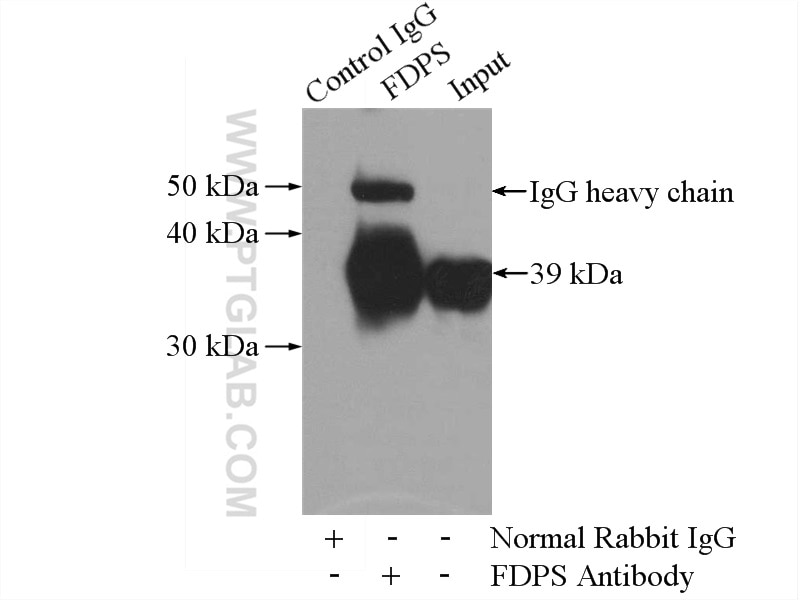

Tested Applications
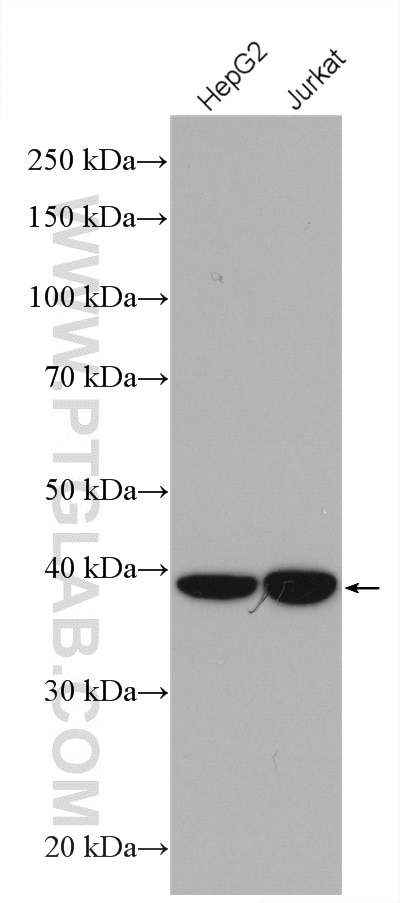
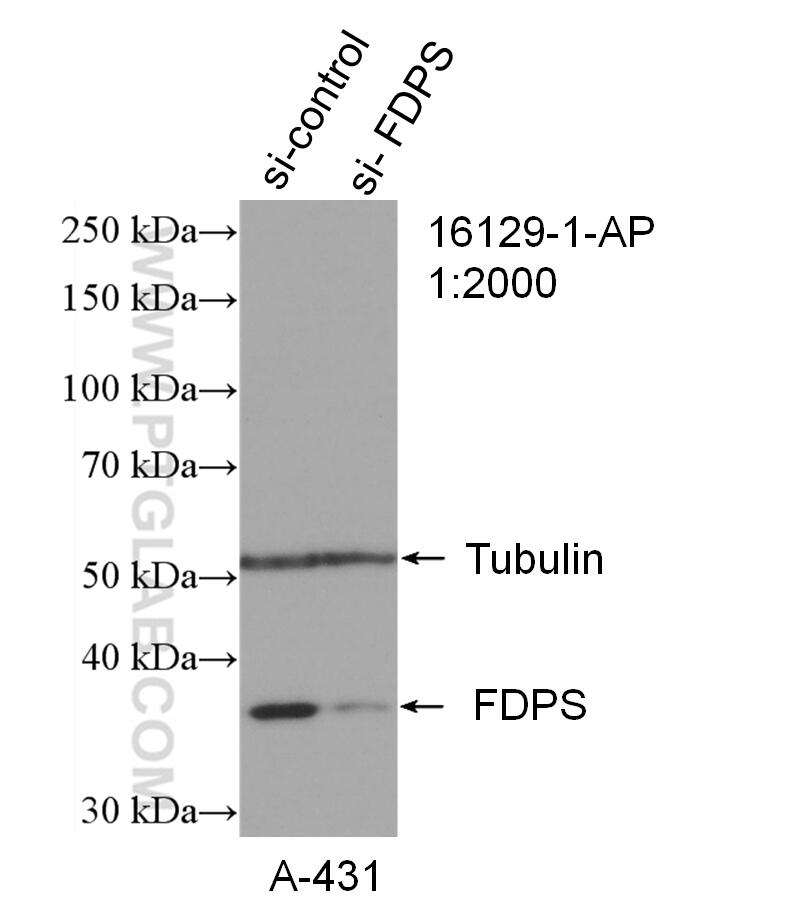
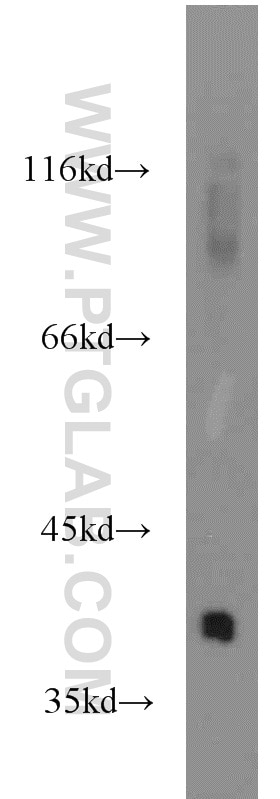
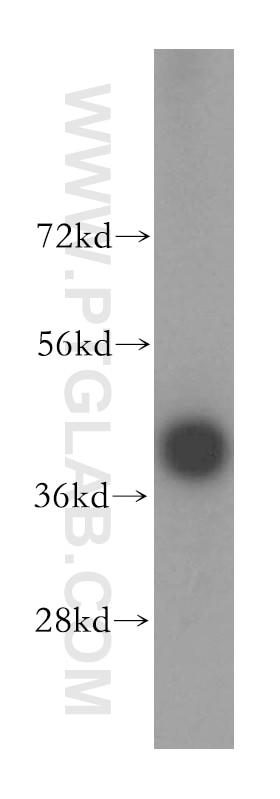
| Positive WB detected in | HepG2 cells, A431 cells, human cerebellum tissue, rat liver tissue |
| Positive IP detected in | mouse liver tissue |
Recommended dilution
| Application | Dilution |
|---|---|
| Western Blot (WB) | WB : 1:1000-1:5000 |
| Immunoprecipitation (IP) | IP : 0.5-4.0 ug for 1.0-3.0 mg of total protein lysate |
| It is recommended that this reagent should be titrated in each testing system to obtain optimal results. | |
| Sample-dependent, Check data in validation data gallery. | |
Product Information
16129-1-AP targets FDPS in WB, IHC, IP, ELISA applications and shows reactivity with human, mouse, rat samples.
| Tested Reactivity | human, mouse, rat |
| Cited Reactivity | human, mouse |
| Host / Isotype | Rabbit / IgG |
| Class | Polyclonal |
| Type | Antibody |
| Immunogen |
CatNo: Ag9115 Product name: Recombinant human FDPS protein Source: e coli.-derived, PGEX-4T Tag: GST Domain: 68-419 aa of BC010004 Sequence: NGDQNSDVYAQEKQDFVQHFSQIVRVLTEDEMGHPEIGDAIARLKEVLEYNAIGGKYNRGLTVVVAFRELVEPRKQDADSLQRAWTVGWCVELLQAFFLVADDIMDSSLTRRGQICWYQKPGVGLDAINDANLLEACIYRLLKLYCREQPYYLNLIELFLQSSYQTEIGQTLDLLTAPQGNVDLVRFTEKRYKSIVKYKTAFYSFYLPIAAAMYMAGIDGEKEHANAKKILLEMGEFFQIQDDYLDLFGDPSVTGKIGTDIQDNKCSWLVVQCLQRATPEQYQILKENYGQKEAEKVARVKALYEELDLPAVFLQYEEDSYSHIMALIEQYAAPLPPAVFLGLARKIYKRRK Predict reactive species |
| Full Name | farnesyl diphosphate synthase (farnesyl pyrophosphate synthetase, dimethylallyltranstransferase, geranyltranstransferase) |
| Calculated Molecular Weight | 419 aa, 48 kDa |
| Observed Molecular Weight | 39-41 kDa |
| GenBank Accession Number | BC010004 |
| Gene Symbol | FDPS |
| Gene ID (NCBI) | 2224 |
| RRID | AB_2104749 |
| Conjugate | Unconjugated |
| Form | Liquid |
| Purification Method | Antigen affinity purification |
| UNIPROT ID | P14324 |
| Storage Buffer | PBS with 0.02% sodium azide and 50% glycerol, pH 7.3. |
| Storage Conditions | Store at -20°C. Stable for one year after shipment. Aliquoting is unnecessary for -20oC storage. 20ul sizes contain 0.1% BSA. |
Background Information
FPPS (also known as FDPS) is a key enzyme in isoprenoid biosynthesis which catalyzes the formation of farnesyl diphosphate (FPP), a precursor for several classes of essential metabolites including sterols, dolichols, carotenoids, and ubiquinones. The expression of FPPS was elevated in prostate tumor cell lines, indicating its potential role in prostate cancer progression.
Protocols
| Product Specific Protocols | |
|---|---|
| IP protocol for FDPS antibody 16129-1-AP | Download protocol |
| WB protocol for FDPS antibody 16129-1-AP | Download protocol |
| Standard Protocols | |
|---|---|
| Click here to view our Standard Protocols |
Publications
What published studies show
FDPS Polyclonal antibody (Cat# 16129-1-AP) has 21 citations published in journals including Cancer Cell, Cell Metabolism, Nature Cancer, Cardiovascular Research, Cell Death & Disease, EBioMedicine, Cell Reports, JBC, and eLife. Research fields span oncology (lung, pancreatic, breast, melanoma, myeloma, hepatocellular carcinoma), cardiac hypertrophy and fibrosis, cholesterol and lipid metabolism, neurodegeneration, rheumatoid arthritis, polycystic ovary syndrome, NAFLD, ferroptosis, pyroptosis, and autophagy. Cited applications are primarily WB and IHC in human and mouse samples.
| Species | Application | Title |
|---|---|---|
Cancer Cell Targeting the mevalonate pathway suppresses ARID1A-inactivated cancers by promoting pyroptosis | ||
Cell Metab Regulation of VKORC1L1 is critical for p53-mediated tumor suppression through vitamin K metabolism
| ||
Nat Cancer Therapeutic targeting of the mevalonate-geranylgeranyl diphosphate pathway with statins overcomes chemotherapy resistance in small cell lung cancer. | ||
Cardiovasc Res Cardiac-specific overexpression of farnesyl pyrophosphate synthase induces cardiac hypertrophy and dysfunction in mice. | ||
Cell Death Dis Simvastatin accelerated motoneurons death in SOD1G93A mice through inhibiting Rab7-mediated maturation of late autophagic vacuoles. | ||
Int J Biol Sci The SOX10-ACAT2-Cholesterol Synthesis Axis Is Required for Melanoma Proliferation. |






