

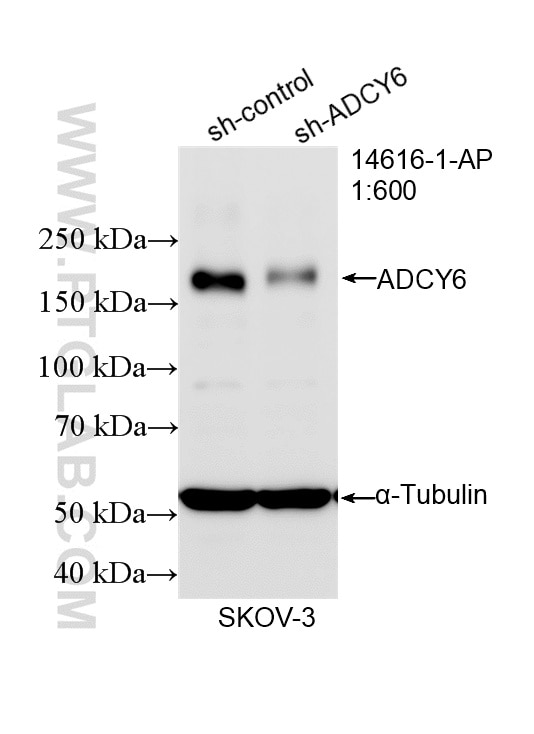



Tested Applications
| Positive WB detected in | human brain tissue, mouse brain tissue, SKOV-3 cells |
| Positive IP detected in | mouse brain tissue |
Recommended dilution
| Application | Dilution |
|---|---|
| Western Blot (WB) | WB : 1:500-1:1000 |
| Immunoprecipitation (IP) | IP : 0.5-4.0 ug for 1.0-3.0 mg of total protein lysate |
| It is recommended that this reagent should be titrated in each testing system to obtain optimal results. | |
| Sample-dependent, Check data in validation data gallery. | |
Product Information
14616-1-AP targets ADCY6 in WB, IP, CoIP, ELISA applications and shows reactivity with human, mouse, rat samples.
| Tested Reactivity | human, mouse, rat |
| Cited Reactivity | human, mouse |
| Host / Isotype | Rabbit / IgG |
| Class | Polyclonal |
| Type | Antibody |
| Immunogen |
CatNo: Ag6218 Product name: Recombinant human ADCY6 protein Source: e coli.-derived, PGEX-4T Tag: GST Domain: 310-655 aa of BC064923 Sequence: AEVSQRQAFQETRGYIQARLHLQHENRQQERLLLSVLPQHVAMEMKEDINTKKEDMMFHKIYIQKHDNVSILFADIEGFTSLASQCTAQELVMTLNELFARFDKLAAENHCLRIKILGDCYYCVSGLPEARADHAHCCVEMGVDMIEAISLVREVTGVNVNMRVGIHSGRVHCGVLGLRKWQFDVWSNDVTLANHMEAGGRAGRIHITRATLQYLNGDYEVEPGRGGERNAYLKEQHIETFLILGASQKRKEEKAMLAKLQRTRANSMEGLMPRWVPDRAFSRTKDSKAFRQMGIDDSSKDNRGTQDALNPEDEVDEFLSRAIDARSIDQLRKDHVRRFLLTFQRE Predict reactive species |
| Full Name | adenylate cyclase 6 |
| Calculated Molecular Weight | 131 kDa |
| Observed Molecular Weight | 130-150 kDa |
| GenBank Accession Number | BC064923 |
| Gene Symbol | ADCY6 |
| Gene ID (NCBI) | 112 |
| RRID | AB_2242343 |
| Conjugate | Unconjugated |
| Form | Liquid |
| Purification Method | Antigen affinity purification |
| UNIPROT ID | O43306 |
| Storage Buffer | PBS with 0.02% sodium azide and 50% glycerol, pH 7.3. |
| Storage Conditions | Store at -20°C. Stable for one year after shipment. Aliquoting is unnecessary for -20oC storage. 20ul sizes contain 0.1% BSA. |
Background Information
Adenylate cyclase 6 (ADCY6) belongs to the membrane-bound adenylate cyclase family. Increasing evidence has proven that ADCY6 is involved in pathophysiological processes of the body, such as the stability of cardiovascular system function, glucose and lipid metabolism, and even carcinogenesis.
Protocols
| Product Specific Protocols | |
|---|---|
| IP protocol for ADCY6 antibody 14616-1-AP | Download protocol |
| WB protocol for ADCY6 antibody 14616-1-AP | Download protocol |
| Standard Protocols | |
|---|---|
| Click here to view our Standard Protocols |
Publications
What published studies show
The ADCY6 polyclonal antibody (catalog number 14616-1-AP) has 8 total citations. These appear in journals including Nature Communications, Oncogene, Molecular Metabolism, Journal of Cell Biology, European Journal of Pharmacology, Molecular Pharmacology, and Pathology-Oncology Research. The associated research fields span non-alcoholic steatohepatitis and lipid metabolism, calcium signaling, osteosarcoma, hepatic glucose production, primary cilium biology, hypertrophic cardiomyopathy, and B-cell acute lymphoblastic leukemia.
| Species | Application | Title |
|---|---|---|
Nat Commun Deficiency of WTAP in hepatocytes induces lipoatrophy and non-alcoholic steatohepatitis (NASH) | ||
Nat Commun Multiple cAMP/PKA complexes at the STIM1 ER/PM junction specified by E-Syt1 and E-Syt2 reciprocally gates ANO1 (TMEM16A) via Ca2 | ||
Oncogene CPSF2-mediated 3' UTR truncation of MTERF3 drives mitochondrial dysfunction and osteosarcoma progression. | ||
J Cell Biol Sonic Hedgehog activates prostaglandin signaling to stabilize primary cilium length | ||
Eur J Pharmacol Forskolin is an effective therapeutic small molecule for the treatment of hypertrophic cardiomyopathy through ADCY6/cAMP/PKA pathway
|
Reviews
What customers say
The single review rates the product 4 out of 5 stars for Western Blot at a 1/500 dilution on NIH-3T3 cells. The reviewer used it to compare wild-type starved versus ShhN-stimulated samples, as well as ADC6 knockout cells generated with two different gRNAs, showing that the antibody clearly distinguished between starved and stimulated conditions across both knockout lines. Overall, the feedback indicates reliable performance for detecting target expression changes in these experimental setups.
The reviews below have been submitted by verified Proteintech customers who received an incentive for providing their feedback.
Charlotte (Verified Customer) (07-27-2022) | 1 and 2 : WT starved and ShhN stimulated. 3 to 6 are ADC6 KO cells with 2 different gRNAs. 3/4 is one gRNA and 5/6 is another one. 3 and 5 are starved while 4 and 6 are ShhN stimulated
 |




