

Tested Applications
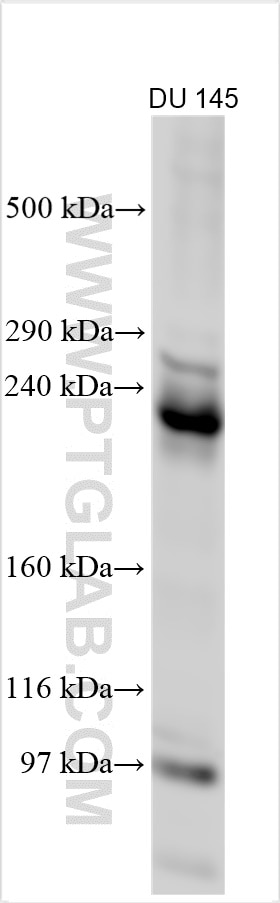
| Positive WB detected in | DU 145 cells |
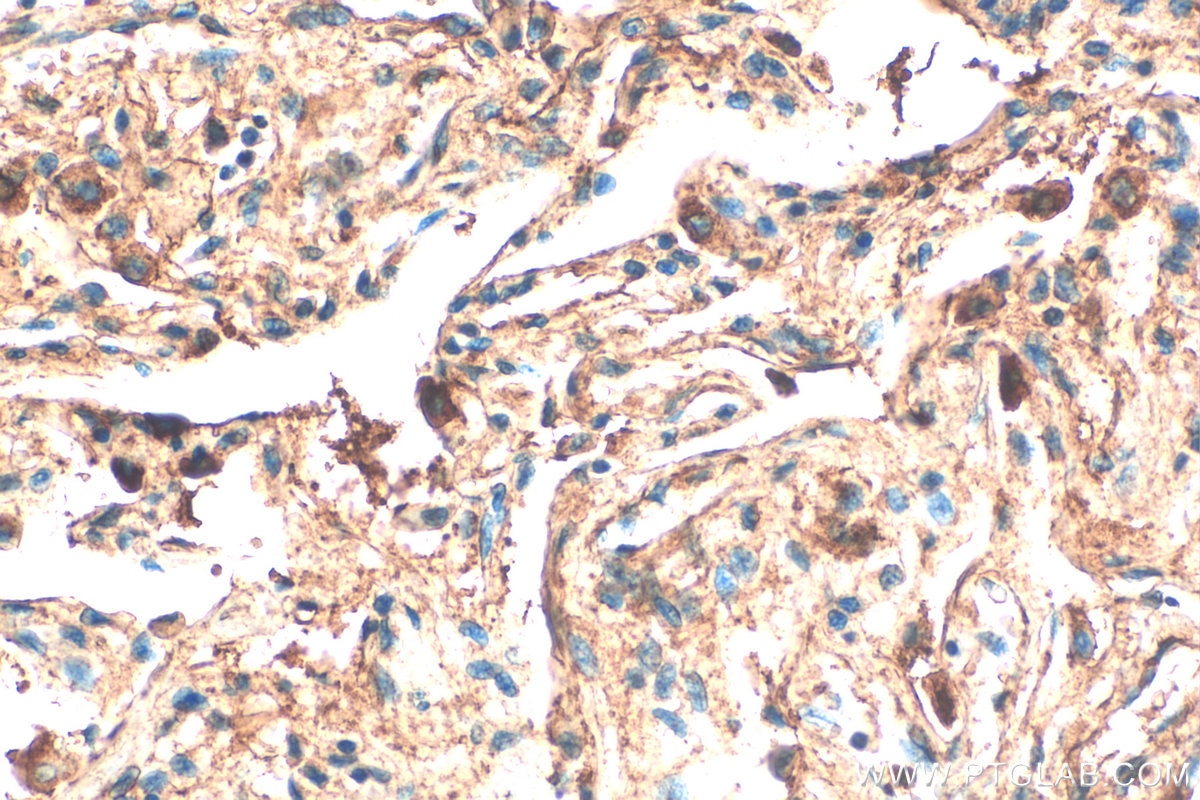
| Positive IHC detected in | human lung tissue Note: suggested antigen retrieval with TE buffer pH 9.0; (*) Alternatively, antigen retrieval may be performed with citrate buffer pH 6.0 |
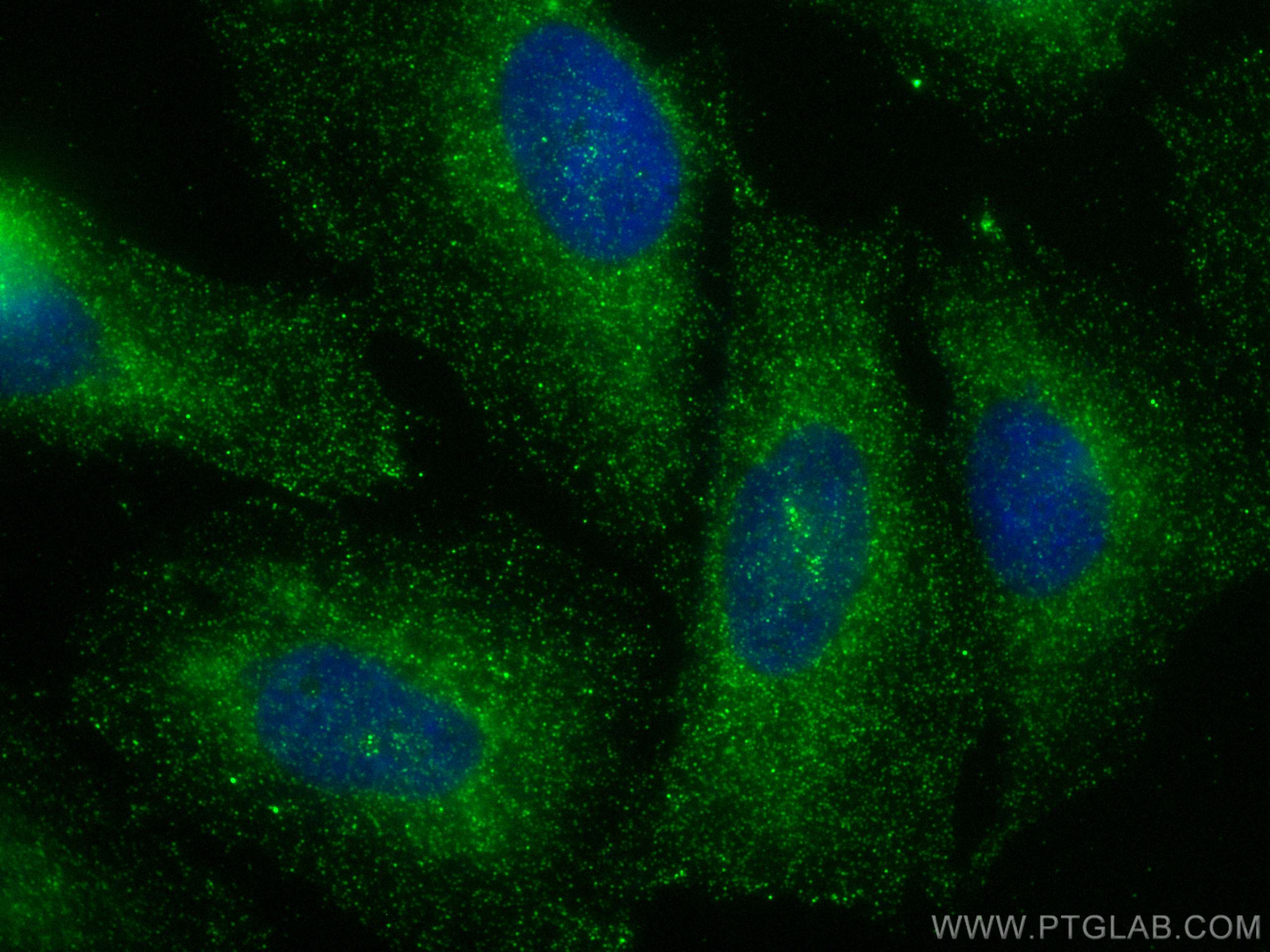
| Positive IF/ICC detected in | Saos-2 cells |
Recommended dilution
| Application | Dilution |
|---|---|
| Western Blot (WB) | WB : 1:500-1:1000 |
| Immunohistochemistry (IHC) | IHC : 1:50-1:500 |
| Immunofluorescence (IF)/ICC | IF/ICC : 1:50-1:500 |
| It is recommended that this reagent should be titrated in each testing system to obtain optimal results. | |
| Sample-dependent, Check data in validation data gallery. | |
Product Information
20692-1-AP targets AGRN in WB, IHC, IF/ICC, ELISA applications and shows reactivity with human samples.
| Tested Reactivity | human |
| Cited Reactivity | human, mouse |
| Host / Isotype | Rabbit / IgG |
| Class | Polyclonal |
| Type | Antibody |
| Immunogen |
Peptide Predict reactive species |
| Full Name | agrin |
| Calculated Molecular Weight | 215 kDa |
| Observed Molecular Weight | 225 kDa, 97 kDa |
| GenBank Accession Number | NM_198576 |
| Gene Symbol | AGRN |
| Gene ID (NCBI) | 375790 |
| RRID | AB_3085612 |
| Conjugate | Unconjugated |
| Form | Liquid |
| Purification Method | Antigen affinity purification |
| UNIPROT ID | O00468 |
| Storage Buffer | PBS with 0.02% sodium azide and 50% glycerol, pH 7.3. |
| Storage Conditions | Store at -20°C. Stable for one year after shipment. Aliquoting is unnecessary for -20oC storage. 20ul sizes contain 0.1% BSA. |
Background Information
Agrin, a large heparan sulfate proteoglycan, is expressed in neuronal, as well as nonneuronal tissues (PMID:12671652). Nerve-derived agrin has been demonstrated to play an essential role in development and maintenance of the neuromuscular junction (PMID:16386415). The agrin gene encodes a protein of more than 2000 amino acids with predicted molecular weight of 225 kDa but can display as 600 kDa protein due to extensive N-terminal glycosylation (PMID:12671652). Neurotrypsin cleaves the proteoglycan agrin at two homologous, highly conserved sites, liberating a middle 90-kDa and a C-terminal 22-kDa fragment from the membrane or ECM-bound N-terminal moiety of agrin (PMID:18230682).
Protocols
| Product Specific Protocols | |
|---|---|
| IF protocol for AGRN antibody 20692-1-AP | Download protocol |
| IHC protocol for AGRN antibody 20692-1-AP | Download protocol |
| WB protocol for AGRN antibody 20692-1-AP | Download protocol |
| Standard Protocols | |
|---|---|
| Click here to view our Standard Protocols |
Publications
What published studies show
The AGRN Polyclonal antibody (Cat# 20692-1-AP) has 2 total citations. They appear in Cancer Research (2026), studying NQO1-driven angiogenesis in esophageal squamous cell carcinoma, and Molecular Neurobiology (2025), investigating omega-3 fatty acids' protective effects on sevoflurane-induced cognitive dysfunction in neonatal mice. The associated research fields are oncology (tumor angiogenesis) and neuroscience (neuroprotection and glymphatic clearance). Both studies used the antibody for Western blot in human and mouse samples, respectively.
| Species | Application | Title |
|---|---|---|
Cancer Res A Noncanonical RNA-Binding Function of NQO1 Drives Angiogenesis in Esophageal Squamous Cell Carcinoma via Extracellular Vesicle-Mediated AGRN Transfer.
| ||
Mol Neurobiol Omega-3 Polyunsaturated Fatty Acids Prevent Sevoflurane-induced Cognitive and Fine Motor Dysfunctions in Neonatal Mice by Enhancing Phosphorylated Tau Glymphatic System Clearance Pathway. |




