



Tested Applications
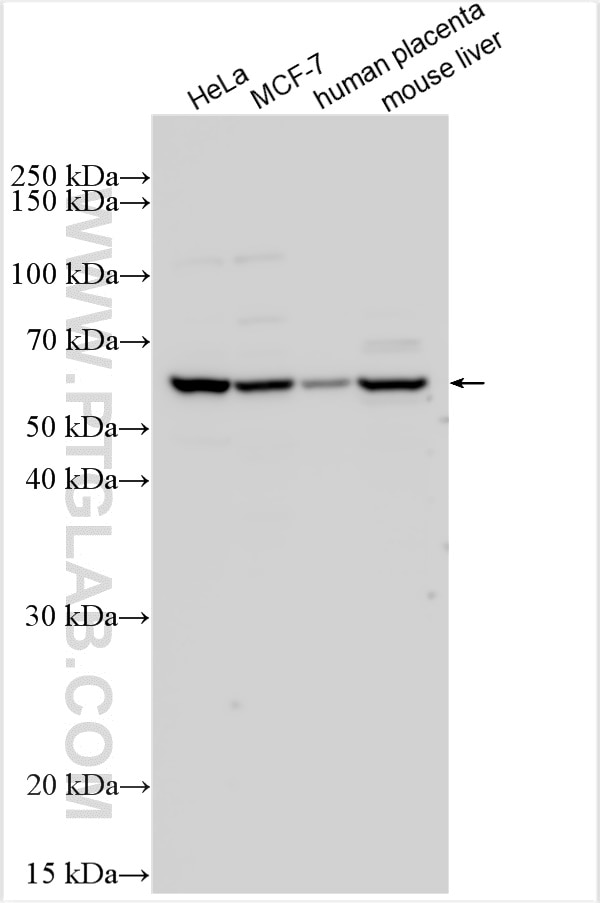
| Positive WB detected in | HeLa cells, MCF-7 cells, human placenta tissue, mouse liver tissue |
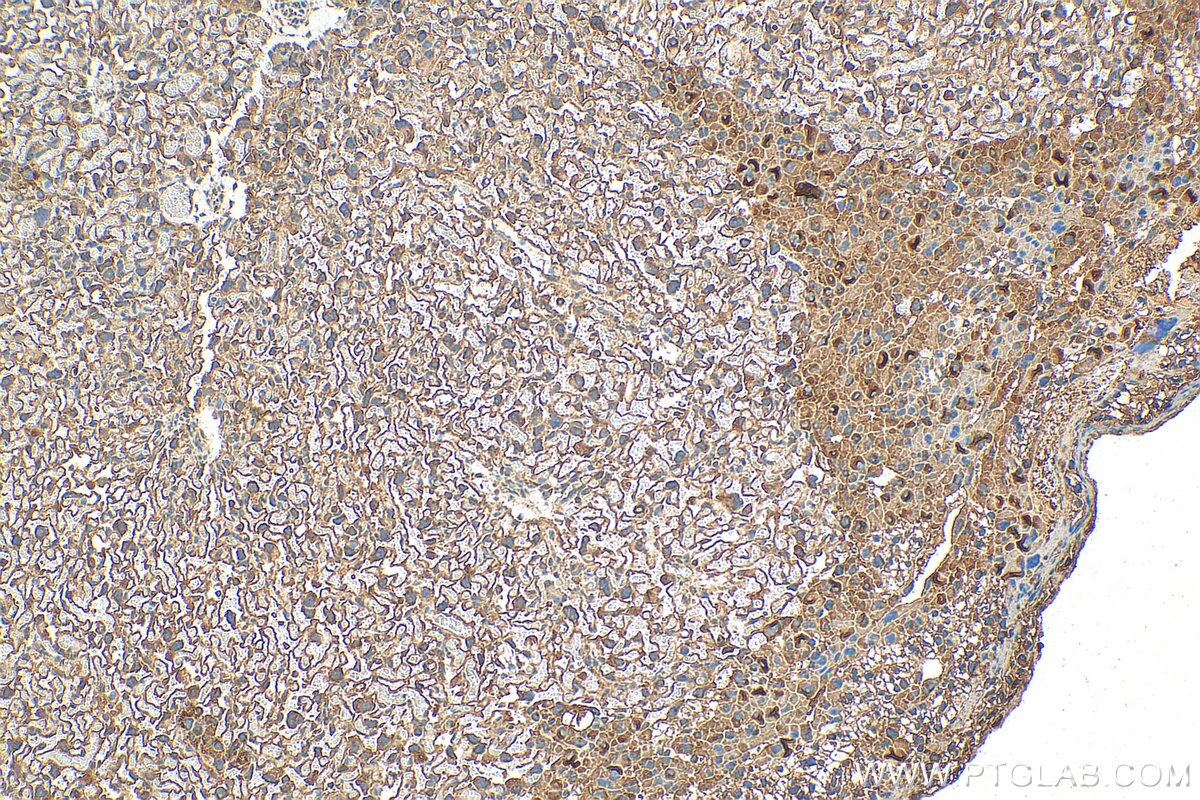
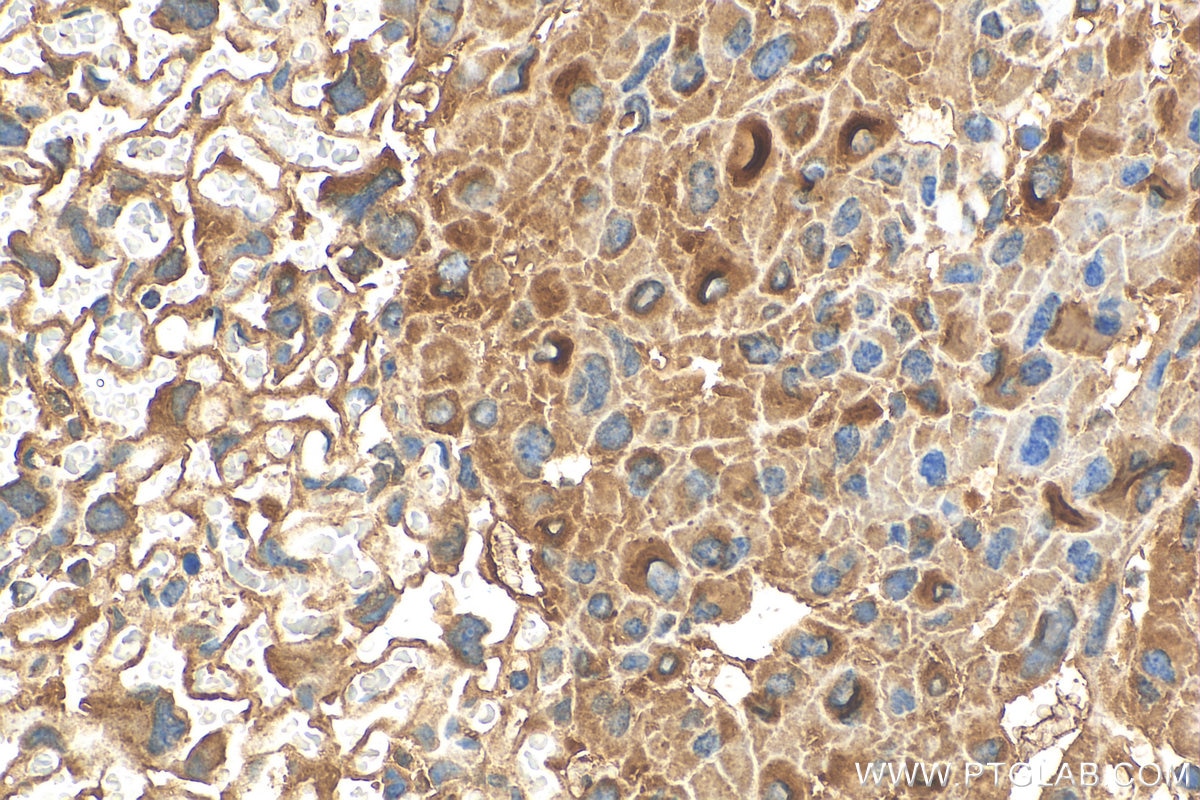
| Positive IHC detected in | mouse placenta tissue, rat small intestine tissue, rat liver tissue, mouse liver tissue, human stomach cancer tissue, mouse small intestine tissue, mouse kidney tissue Note: suggested antigen retrieval with TE buffer pH 9.0; (*) Alternatively, antigen retrieval may be performed with citrate buffer pH 6.0 |
Recommended dilution
| Application | Dilution |
|---|---|
| Western Blot (WB) | WB : 1:500-1:2000 |
| Immunohistochemistry (IHC) | IHC : 1:50-1:500 |
| It is recommended that this reagent should be titrated in each testing system to obtain optimal results. | |
| Sample-dependent, Check data in validation data gallery. | |
Product Information
28084-1-AP targets ALG3 in WB, IHC, IF, ELISA applications and shows reactivity with human, mouse samples.
| Tested Reactivity | human, mouse |
| Cited Reactivity | human |
| Host / Isotype | Rabbit / IgG |
| Class | Polyclonal |
| Type | Antibody |
| Immunogen |
CatNo: Ag26382 Product name: Recombinant human ALG3 protein Source: e coli.-derived, PGEX-4T Tag: GST Domain: 1-199 aa of BC002839 Sequence: MAAGLRKRGRSGSAAQAEGLCKQWLQRAWQERRLLLREPRYTLLVAACLCLAEVGITFWVIHRVAYTEIDWKAYMAEVEGVINGTYDYTQLQGDTGPLVYPAGFVYIFMGLYYATSRGTDIRMAQNIFAVLYLATLLLVFLIYHQTCKVPPFVFFFMCCASYRVHSIFVLRLFNDPVAMVLLFLSINLLLAQRWGWGCC Predict reactive species |
| Full Name | asparagine-linked glycosylation 3, alpha-1,3- mannosyltransferase homolog (S. cerevisiae) |
| Calculated Molecular Weight | 438 aa, 50 kDa |
| Observed Molecular Weight | 50-60 kDa |
| GenBank Accession Number | BC002839 |
| Gene Symbol | ALG3 |
| Gene ID (NCBI) | 10195 |
| RRID | AB_3669644 |
| Conjugate | Unconjugated |
| Form | Liquid |
| Purification Method | Antigen affinity purification |
| UNIPROT ID | Q92685 |
| Storage Buffer | PBS with 0.02% sodium azide and 50% glycerol, pH 7.3. |
| Storage Conditions | Store at -20°C. Stable for one year after shipment. Aliquoting is unnecessary for -20oC storage. 20ul sizes contain 0.1% BSA. |
Background Information
Alpha-1,3-mannosyltransferase (ALG3) encodes an endoplasmic reticulum-localized ALG3 family member that participates in N-glycan synthesis. ALG3 contributes to high mannose-type N-glycans in several cancers, and mannose-type N-glycan upregulation has been shown to be related to cancer progression. ALG3 is overexpressed in oral squamous cell carcinoma(PMID: 33084111), non-small cell lung cancer(PMID: 31899049), and breast cancer(PMID: 33931075) and hepatocellular carcinoma(PMID: 35782861).
Protocols
| Product Specific Protocols | |
|---|---|
| IHC protocol for ALG3 antibody 28084-1-AP | Download protocol |
| WB protocol for ALG3 antibody 28084-1-AP | Download protocol |
| Standard Protocols | |
|---|---|
| Click here to view our Standard Protocols |
Publications
What published studies show
The ALG3 Polyclonal antibody (Cat# 28084-1-AP) has 2 total citations. These appear in Computational Biology and Medicine (IF 7.7) and Cell Stress and Chaperones (IF 4.1). The research fields span pan-cancer multi-omics analysis involving CD8+ T cell infiltration and chemokine-mediated 5-fluorouracil sensitivity, as well as α-1,3-mannosyltransferase inhibition in head and neck squamous cell carcinoma related to cetuximab response and endoplasmic reticulum stress. Cited applications include WB, IF, and IHC in human samples.
| Species | Application | Title |
|---|---|---|
Comput Biol Med Deep pan-cancer analysis and multi-omics evidence reveal that ALG3 inhibits CD8+ T cell infiltration by suppressing chemokine secretion and is associated with 5-fluorouracil sensitivity | ||
Cell Stress Chaperones Inhibition of α-1,3-mannosyltransferase sensitizes head and neck squamous cell carcinomas to cetuximab via endoplasmic reticulum stress. |





